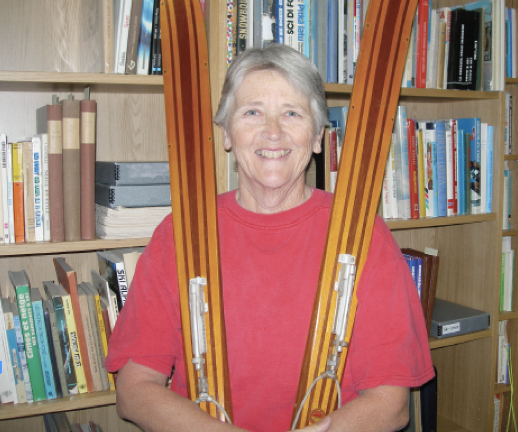
Since 2004, ski historian and ISHA Award winner Ingrid Wicken has housed her California Ski Library in a 960-foot modular building behind her home in Norco, California. The library has grown steadily over the years and is now one of the most extensive collections of ski books, magazines, photographs and paper memorabilia in the United States. The photo archive, for example, includes images of U.S. skiing from the 1930s through the 2000s, covering Sun Valley, Aspen, Squaw Valley, Mammoth Mountain, Yosemite, Mount Hood, American ski jumping, and many California ski areas, large and small. Her book collection numbers 4,500 titles from around the globe. She also has located many rare and hard-to-find brochures, programs, research documents and correspondence from ski racers, writers and resort developers.
Now Ingrid needs our help! Freestyle pioneer Doug Pfeiffer—honored member of both the U.S. and Canadian Ski and Snowboard Halls of Fame—has recently donated 99 boxes of one-of-a-kind ski books and vintage magazines. The building is chock full, and Wicken has launched a Go Fund Me page to add another 480 square feet of display and storage space.
The California Ski Library is a 501(c)(3) nonprofit, so donations are tax-deductible. Chip in to the fundraising campaign online at: https://tinyurl.com/CASkiLibrary. Learn more about Ingrid’s library at skilibrary.com.
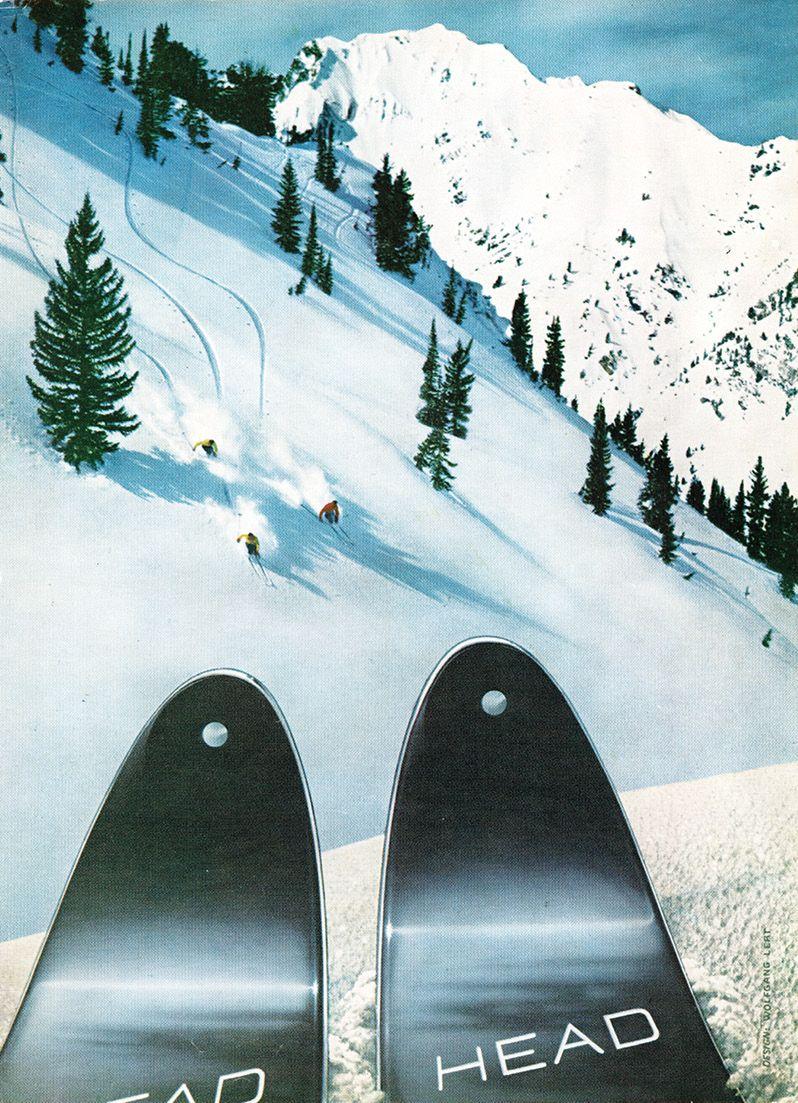
By the early 1960s, Head was the leading ski brand in the United States and the UK. At one point in the decade, an estimated 50 percent of all skis sold in the U.S. were Head skis. A marketplace leader has the luxury of being able to be subtle in its advertising. (Watch an ad for Apple or Google lately?) That was the approach with this illustrated ad for Head skis in the October 1958 issue of SKI. A blue-bird powder day. First tracks with two friends. And just the tips of a pair of Head Standard skis about to drop in. What more is needed? Nothing, really. Message delivered.
Coming Up In Future Issues
X Marks the Spot
A made-for-TV event in 1997 that included shovel racing forever bent the arc of racing and the Winter Olympics. That first Winter X Games is celebrating its 20th year in Aspen in January, virus or not.
Really Earn Your Turns
Don’t let summer stop you. Sand ski at the Great Dunes National Park.
Three Years that Changed Skiing
Driven by dramatic advances in gear, skiing may have been transformed more from 1929-1932 than in any other three-year span in the history of the sport.
We Need More Cowbell!
A brief history of the clanging bells that cheer on alpine racers.
PLUS:
Going Deep: An historic exploration of some of the world’s biggest storm cycles and record snowfalls.
How is it that a young man—raised in the road camps of California’s Central Valley, abandoned at age 15 by his father, deposited with his grandparents in a damp coal-mining town in central Washington by his mother, and thrust into adulthood near the end of the Great Depression—eventually came to build one of the biggest and most successful ski resorts in the country?
Dave McCoy’s work ethic, self-reliance, determination, optimism and ingenuity certainly played roles, but perhaps there was a more determinative influence.
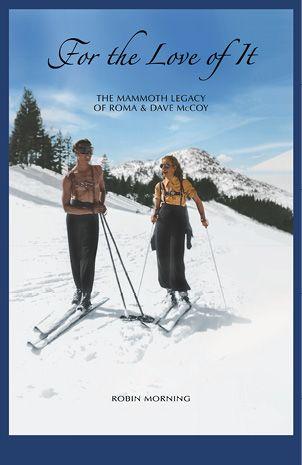
Author Robin Morning returns with her second comprehensive work covering the history of California’s Mammoth Mountain and its protagonists with For the Love of It: The Mammoth Legacy of Roma & Dave McCoy. Note the order of Mammoth’s founders in the title, as Robin (and Dave) both attribute much of his success to his wife of 80 years, local girl Roma Carriere. In the book, Roma’s perspective is intimately shared through first-person chapters alternating with the third-person descriptions that tell Dave’s story.
The book details the lives of Dave and Roma from childhood through the completion of Chair One in 1955, marking the beginning of commercial skiing at Mammoth. While the legends of Dave’s life in the Eastern Sierra are widely known—from aqueduct repair work with the Civilian Conservation Corps, to erecting ski tows throughout the Highway 395 corridor, and his fortuitous hiring as a hydrographer (for his skiing ability)—the familiar stories blossom here in a conversational tone.
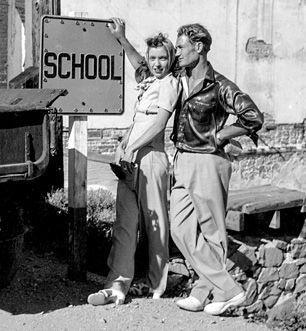
Dave and Roma McCoy in Virginia City, Nevada in 1938.
Dave met Roma in Bishop, a shy local girl who had a passion for dance but was soon converted to the rhythms of skiing. Inspired by a desire to have fun up in snow country and share that fun with others, together they built a legendary junior racing program at Mammoth while raising six racers of their own. Kids from near and far gravitated to Mammoth to enjoy Roma’s home cooking and cozy floor space while under the tutelage of Coach Dave.
Mammoth Mountain was developed not through any vision shared with would-be financiers, but through the McCoys’ remarkable resourcefulness. Dave became something of a Pied Piper on the mountain, with a diverse following of former accountants, engineers, World War II veterans and surfers abandoning their former lives to participate. Roma provided the home base where all were welcomed as family after a day of good clean fun moving tows, fixing weasels, clearing roads and skiing.
Morning grew up in Santa Monica and raced for McCoy at Mammoth, competing for the U.S. Ski Team from 1965 to 1968. The day before the opening ceremonies for the 1968 Winter Olympics at Grenoble, she broke her leg on a downhill training run. After coaching junior and master’s racers in Southern California, Mammoth, and Colorado, she became a schoolteacher and eventually found her way back to Mammoth, where she still lives. She’s the author of the ISHA Award-winning book Tracks of Passion: Eastern Sierra Skiing, Dave McCoy & Mammoth Mountain.
Morning has published her new book, For the Love of It, in part as tribute to her friend McCoy, who died in February 2020 at 104 (see Skiing History, March-April 2020). Available in softcover, 426 pages with numerous photos, signed copies available. Order online at www.blueoxexpress.com.—Chris I. Lizza
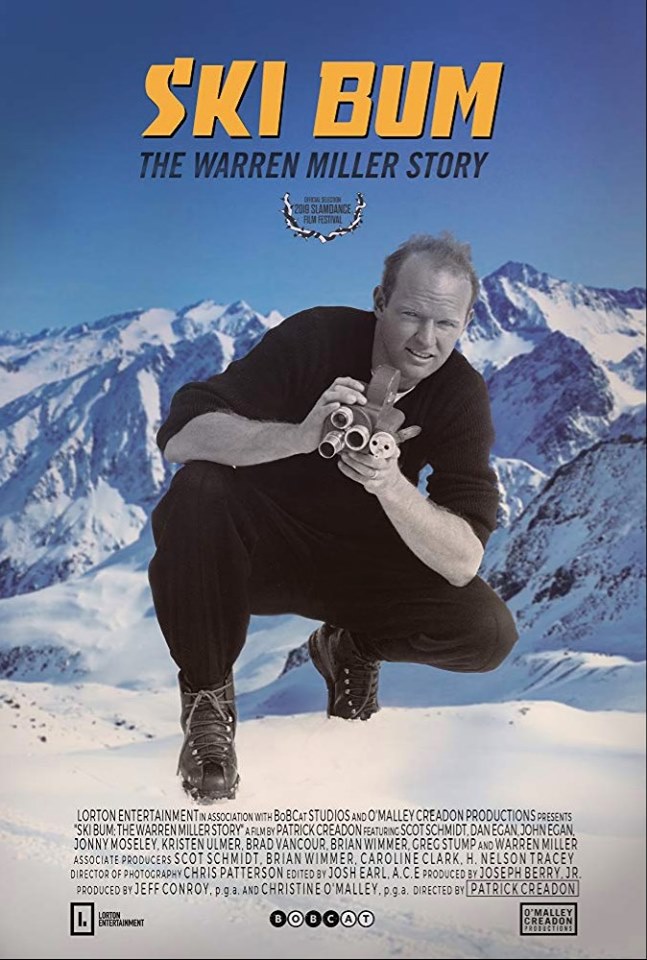
Ski Bum: The Warren Miller Story
Ski Bum is a 90-minute review of the late Warren Miller’s extraordinary career, told through archival footage and one final interview with Warren himself.
For decades, the ski season didn’t really begin until the latest spectacular film was released by Warren Miller Productions, filled with balletic, slow-motion mountain footage of death-defying ski and snowboard stunts. Director Patrick Creadon’s Ski Bum—titled after the moniker the Seattle-area legend often used for himself—celebrates the life and art of one of the most prolific sports-documentary pioneers.
Credited with more than 750 sports films, Miller started as a surfer in his native Hollywood before moving to the Pacific Northwest to practically invent the winter-sports film genre. As Creadon’s homage shows, Miller’s simple 8mm movies from the 1950s snowballed into a 50-year commercial-film career that set the standard for audacious stunts. But success did not come without hardship; Miller used to promote his films on exhausting 100-city road tours, which took a toll on his family life and finances.
Based on a 2018 interview the then-92-year-old Miller gave shortly before his death at his Orcas Island home, Ski Bum explores the techniques used by the veteran filmmaker, who also served as cinematographer, editor, producer—and often live narrator—of his films. Using interviews with daredevil skiers, never-before-seen outtakes, and home movies, Ski Bum is a must-see for any ripper or shredder forever in search of the gnarliest powder.
Creadon is a director and cinematographer born in 1967 in Riverside, Illinois. He graduated from the University of Notre Dame in 1989 with a BA in International Relations. Creadon is married to his collaborator, producer Christine O’Malley. They co-founded their full-scale media production company, O’Malley Creadon Productions, which is based in Los Angeles and focuses on nonfiction storytelling.
The Berkshires of Massachusetts have long been known as a winter sports paradise. Forty-four ski areas popped up across the region from the 1930s to the 1970s. The legendary Thunderbolt Ski Trail put the Berkshires on the map for challenging terrain, while major resorts like Brodie Mountain sparked the popularity of night skiing with lighted trails. All-inclusive areas—like Oak n’ Spruce, Eastover and Jug End—brought thousands of new skiers into the sport between the 1940s and 1970s. Meanwhile, snow trains made it fun and easy for metro-area skiers to plan weekend ski excursions.
But despite the surge of interest in skiing in Berkshire County, the majority of these ski areas would not last. Early areas closed permanently during World War II, followed by lift relocations and the shutdown of the snow trains. In the 1970s and 1980s, the pace of closures increased due to competition from larger areas to the north, gasoline shortages, a dearth of natural snow, and a lack of volunteers at community ski centers. Over the last few decades, these once-storied places faded away and were nearly forgotten. Trails became forests once again, base lodges rotted into the ground, and lifts rusted away.
In Lost Ski Areas of the Berkshires, author Jeremy Davis has brought these lost locales back to life, chronicling their rich histories and contributions to the ski industry.
Each former ski area, no matter how small or brief in operation, is chronicled, along with 75 historical photographs and trail maps, and the stories of those who skied them. For those who wish to explore these areas and see their ruins, a hiking guide is included for publicly accessible locations. The seven still-surviving ski areas have their own chapter.
Jeremy Davis is the founder of the New England and North East Lost Ski Areas Project (www.nelsap.org) and has written five books on lost ski areas. He serves on the Skiing History editorial review board and the board of directors of the New England Ski Museum. He is a senior meteorologist and operations manager at Weather Routing Inc., forecasting for the marine industry.
Lost Ski Areas of the Berkshires by Jeremy Davis. 240 pages. The History Press. $21.99 softcover, Kindle edition available. Winner: 2019 ISHA Skade Award.
DrySlopeNews.com
Patrick Thorne, creator of dryslopenews.com
Artificial slopes, using carpet or matting in place of snow, bring skiing to areas without reliable natural snowfall. Skiers have used them for over a century, but the earliest artificial surfaces manufactured specifically for skiing date from the 1950s. Since then, more than 1,000 have been built in 50-plus countries worldwide. The slopes come in many different shapes and sizes, with several companies involved in their manufacturing over the past 70 years, so no two are ever the same.
Dry ski slopes are essential for teaching millions of people to ski or snowboard. They can take the basic skills acquired on artificial slopes and then ski at conventional resorts around the world. Indeed, claims ski writer Patrick Thorne, dryland slopes have been a major factor in the success of the global ski industry. Many established dry slopes have strong community support, enabling children and people with special needs to learn to ski or board as well as practice regularly. They’ve also bred some of the world’s best skiers and snowboarders who’ve gone on to World Cup and Olympic glory.
The website DrySlopeNews.com includes an extensive directory of existing and former dry slope operations, with a timeline history going back to the Vienna Schneepalast of 1927. The site is the brainchild of Thorne, who learned to ski on a dry slope as a youngster in the late 1970s.
Thorne has covered skiing from his base in the United Kingdom for more than 30 years and has recently joined ISHA as a contributor to Skiing History and skiinghistory.org. He operates the news site InTheSnow.com and a sister site, indoorsnownews.com, covering the snowdome universe. DrySlopeNews.com won a 2019 ISHA Cyber Award. —Seth Masia
North Country
In Littleton, New Hampshire, near Cannon Mountain, Lahout’s Country Clothing and Ski Shop has done business at the same location since 1920. Fourteen-year-old Herbert Lahout emigrated from Syria in 1898, and became a railroad laborer. He married his wife Anne in 1919 and the couple sold groceries from a horse-drawn wagon. The following year they moved the business into Littleton’s Old Grange Hall, and lived upstairs. Herb died in 1934 and, in the depths of the Depression, Anne was left to run the store with her kids Gladys, 14, and Joe, 12.
Joe learned to ski, and the sport became his lifelong passion. After returning from service in the South Pacific during World War II, he added skis to the store’s inventory of hardware, dry goods, beer and groceries. Under the management of Joe’s three sons, and now of his grandson Anthony, Lahout’s developed into a full-service ski and outdoor store, with six locations in Littleton and Lincoln, half an hour south.
Joe died in 2016, on his 94th birthday. The 21-minute film North Country tells the family’s story, with plenty of vintage ski footage from the Franconia Notch region. Lahout’s became integral to the history of skiing in New Hampshire. It’s a story of tough people thriving in a harsh climate—people who ventured out into the wider world but returned to the store to support their parents and grandparents.
Director Nick Martini runs Stept Productions, making commercials for brands like Toyota, Oakley, Columbia, The North Face and Under Armour. He grew up in the Boston area, skiing in New Hampshire. After earning his MBA, executive producer Anthony Lahout worked in finance before taking marketing jobs at Smith Sport Optics and Spyder Skiwear. He returned to Littleton in 2015 to take over the family business. So far, the film has been shown at the Telluride Mountainfilm Festival, Banff Film Festival, and the Kendall Mountain Festival in the United Kingdom. The next step: Finding partners to bring the film to the public. —Seth Masia
North Country, produced by Anthony Lahout, written and
directed by Nick Martini. Winner: 2019 ISHA Film Award. Learn more at steptstudios.com.
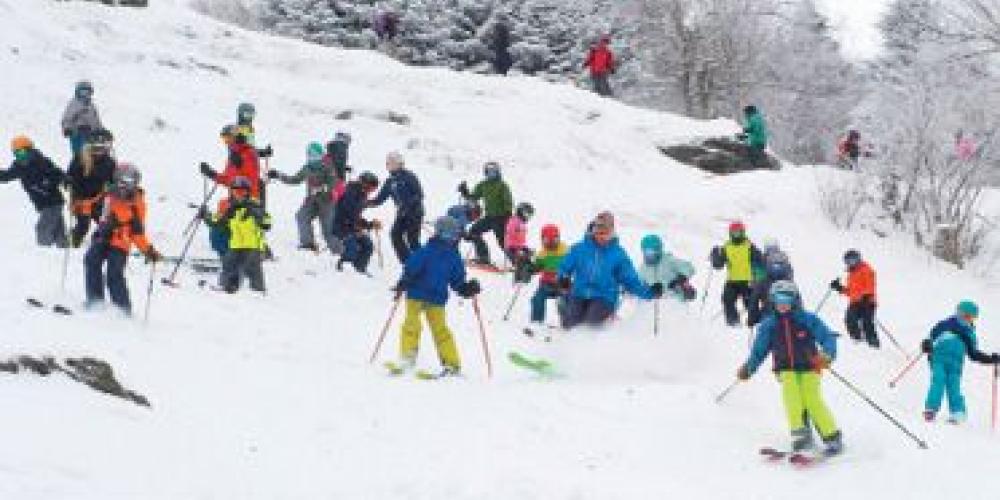
Edie Thys Morgan’s excellent profile of Glen Plake (“Evolution of Rebel,” May-June 2020) perfectly captured the person I call the “World’s Most Recognized Skier.” I’ve always been proud to call Glen and his wife, Kimberly, friends. I admire his enthusiasm for all things ski—especially the roots of freestyle—and the way he connects with all kinds, and all ages, of skiers.
Over the years, Glen has appeared many times at ski shows I’ve produced. He immediately attracts a crowd—just like he does when at the many small ski areas that he and Kimberly visit on their Down Home Ski Tours. He always makes time to talk, to pose for pictures, sign posters and, in general, make everyone feel like the most important person he’s met that day! Glen Plake is the best ambassador our sport has ever had, a true “natural resource” that the World of Snow is lucky to have.
Photo above: Plake (center, blue parka) attracts fans at Mad River Glen in Vermont (above) and Black Mountain in Maine (center, plaid shirt) on his Down Home tours of small U.S. ski areas. Wallace Brodeur photo.
All Downhill For Pat Paré
I wanted to contribute a little more information about my mother, Pat Paré, who raced at the Seigniory Club with the Penguins (“Canada’s Forgotten Ski Center,” Skiing History, September-October 2020). As the story explained, in February 1939, she was 21 years old and known for her nerve. She raced out West, in Canada and the United States, at Mont Tremblant and everywhere else she could. But years later she told us, her six children, that at the time she hadn’t yet learned to ski. She just pointed herself straight down the hills, and either she crashed or got to the bottom first. That year she won the downhill at the Women’s Dominion Ski Championships at the Seigniory. She could not have won the slalom.
My grandfather lamented the cost of her medical bills to Bill Oliver, the head of Noorduyn Aviation, asking for his help because now she wanted to learn to fly. He was sure she was going to kill herself trying. Oliver called one of his pilots into his office, an airplane mechanic from Toronto who’d been flying since he was 14 years old, and told him the daughter of a rich friend was coming in to learn to fly. “Take her up, give her a good scare, and send her home,” he said. Mom never got her license, but she got her pilot, my father.
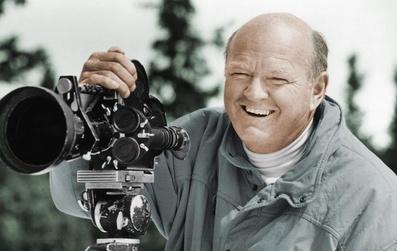
"Ski Bum: The Warren Miller Story," is now showing on Amazon Prime.
The 90-minute film, produced by Patrick Creadon and Christine O'Malley, is based largely on archival footage provided by Warren Miller Entertainment. It follows Miller's dramatic life story from the beginning, starting with a childhood spent escaping from a dysfunctional family by surfing and skiing. The story is told through interviews with Warren himself, shot a year before his death, and interviews with his children and close friends. More interviews and plenty of action footage feature skiers Scot Schmidt, Jonny Moseley, Colby James, the Egan brothers, Kristen Ulmer, Greg Stump and many more.
Amazon Prime members can see the film for free; nonmembers can rent it here.
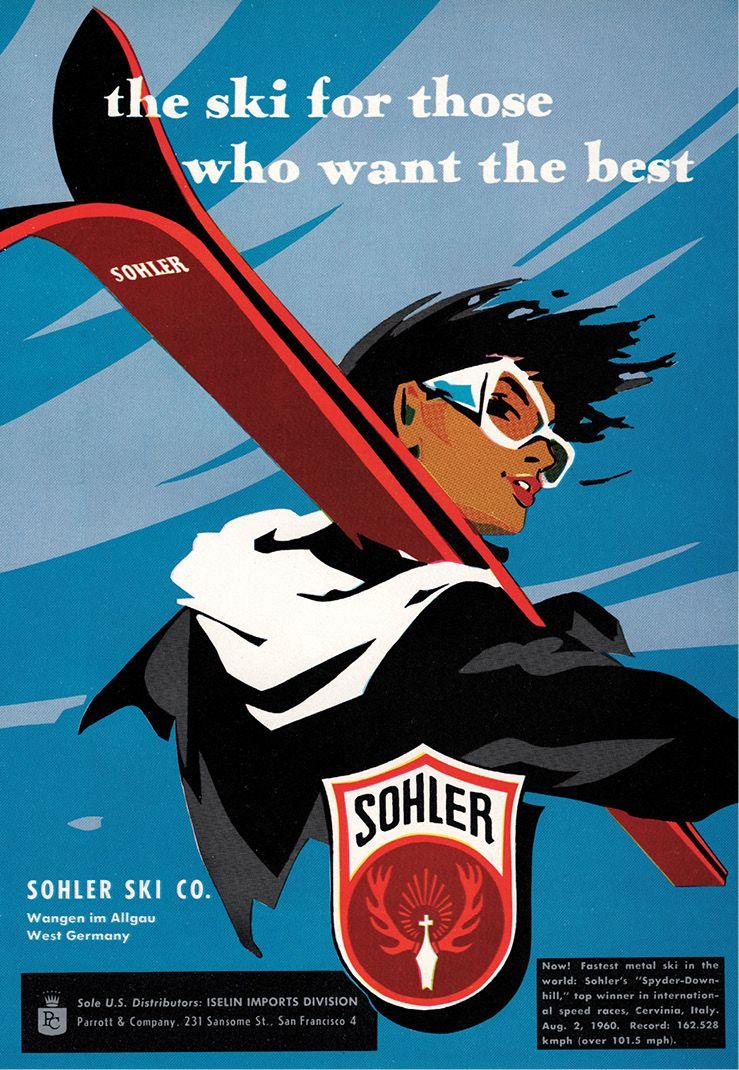
Looking back nearly 60 years, this Sohler Ski ad, featuring thick-rimmed white sunglasses, hoody ski parka and a glamorous wind-blown milieu, could be selling today’s hip outdoor fashion, as well as “the ski for those who want the best.” The ad, from the December 1961 issue of SKI magazine, touts the German ski manufacturer’s “Spyder-Downhill” as the “fastest metal ski in the world.” No exaggeration, there. Sohler was the ski supplier for Luigi DiMarco’s speed-skiing world record set in Cervinia, Italy, in August 1960, at more than 101 mph. With his record run, DiMarco became the first human to officially break 100 mph on skis. (DiMarco was back in 1964 to raise the record to 108 mph.) The current record? In 2016, Italian speed skier Ivan Origone blazed down a course at Vars resort, in the French Alps, at more than 158 mph—in a fashionably bright red speed suit.
COMING UP IN FUTURE ISSUES
Decisive Moments (Part 2)
Paul Ryan searched through his archives to find the most captivating images from his career as a globe-trotting
ski photographer.
We Need More Cowbell!
A brief history of the clanging bells that cheer on alpine racers.
Where Are They Now?
Pernilla Wiberg, Sweden’s all-time record-holding female alpine ski racer, is still giving back to the sport.
Quantum Leap
Alpine skiing took a big step forward between 1930 and 1932 with the introduction of steel edges and locked-down heels, paving the way for its introduction to the 1936 Winter Olympics.
Hall of Famer Sverre Engen influenced many aspects of the sport. Perhaps none as enduring as lightening the load for ski movie production.
By Mike Korologos
A natural promoter, Engen understood the power of marketing to build brand awareness. He barnstormed the country with his brothers to hold ski-jumping events in front of thousands of spectators, and, they hoped, future movie ticket buyers.
In the late 1940s and early 1950s, when ski movie-making was in its infancy, major outdoor filmmakers used “Hollywood methods” of production. Ski-movie shoots were built on the foundation of cumbersome 35-mm cameras affixed atop bulky tripods, with these setups hand-carried from ski lifts to scenic locations by camera crews that did not ski. Often these daylong efforts resulted in 10 to 15 seconds of usable footage.
Pioneering filmmaker Sverre Engen helped turned that laborious process on its head, forever changing how action sports films were made, according to his son, Scott Engen. “Dad may not have been the first to make ski movies, but he sure helped revolutionize the way they were produced,” Scott says.
Sverre honed his film-making skills in the early 1930s and early 1940s while hiking, hunting and working for the Utah Fish and Game Department as he produced and shot informational and educational movies as part of his job.
He also produced, while assigned to the 10th Mountain Division at Camp Hale, Colorado, morale-boosting broadcasts for the Free Norwegian expatriate members in the U.S. and Canada. “In those jobs, Dad came to fully appreciate the virtues of moving fast and traveling light when it came to carrying equipment in the mountains in the winter,” Scott says.
Unlike most ski-movie filmmakers at the time, Sverre was an accomplished skier, which greatly helped him with his movie projects. Traveling light and being nimble with his on-snow production methods provided cost- and time-saving efficiencies, which allowed him to travel into the wilderness to film spectacular scenic footage. Those scenic shots became the signature look of the dozen or so 90-minute ski movies he would later produce.
Born in Norway in 1911, Sverre learned to ski at 2 and moved to the United States at 18, soon settling in Utah. He was among the last of a colorful generation of Norwegian immigrants who were deeply involved in many aspects of the sport. Sverre gained fame as a jumping champion, resort operator, ski instructor, pioneer in the study of avalanche control and maker of ski movies. He served as Alta’s ski school director and as the cofounder and first manager of the new Rustler Lodge at Alta. The U.S. Forest Service named him as Alta’s first snow ranger in 1947 and he coached the University of Utah Ski Team to its first national collegiate championship that same year. He also found time to help build ski jumps at Ecker Hill, Becker Hill and Landes Hill, all in Utah.
Engen was inspired to make his own movies while appearing in several of Fox Movietone’s Ski Aces vignettes. These short films, shown on movie screens across the country as lead-ins to the day’s feature film, starred Sverre and his brothers Alf and Corey skiing down gorgeous powdery mountainsides or in zany ski scenes.
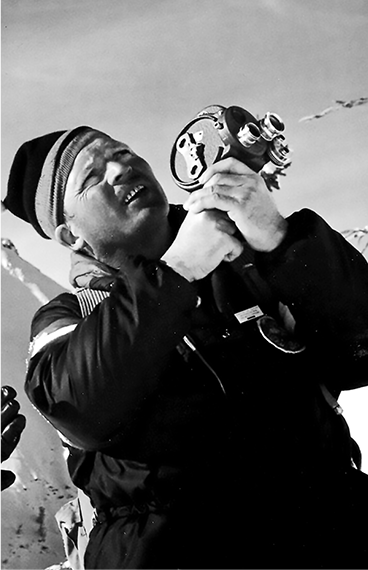
Sverre’s penchant for traveling light found him embracing the latest equipment that came on the civilian market at the end of World War II. This included the classic Bell and Howell 70-D series 16 mm camera. Sverre would have seen this camera used by John Jay when filming for the 10th Mountain Division. Driven by a hand-wound, clockwork spring motor, it didn’t require batteries, which annoyingly would fail in the wet or cold of the mountains or merely peter out during a shoot.
The camera’s downside, explains Scott, was the time and total darkness required to change rolls of film in the mountains. It had to be done only by feel and often by cold and numb fingers. He said his dad stashed a heavy, black canvas lightproof film-changing bag with arm sleeves in his rucksack. In a pinch, he would use his ski parka, folding over the neck and waist hems to improvise a film-changing bag, using the sleeves for access.
“Never wanting to miss a great action scene, Dad sometimes carried three fully loaded D-70 cameras,” Scott said. “Later he used a compact Bell and Howell 16 mm camera that used 50-foot long film magazines that could be instantly installed in the camera. The magazines were about the size of a small paperback book and designed for the gun cameras used in WWII fighter planes.” Sverre now had his “ideal film-making package,” Scott said. “He could ski anywhere with several small, lightweight, spring-driven cameras, each featuring instant magazine loading.”
He also was a natural promoter, helping to build brand awareness decades before that was a concept. The three Engen brothers barnstormed the country in the 1930s and 1940s, staging ski-jumping shows before tens of thousands of spectators. He touted that fame in his promotional posters and media interviews. And Sverre also had an influential friend: Lowell Thomas, the famous radio commentator, who skied with him several times a year at Alta.
In his book, Skiing a Way of Life, Saga of the Engen Brothers, Sverre describes golden advice from Thomas. “He suggested I talk more about the action. He said, ‘you know, Sverre, a good commentary is almost as important as the film itself . . . speak louder so people can hear and understand you.’ I worried about my Norwegian accent, but he assured me that it was okay and might add a little flavor.” Often when Sverre appeared on stage for his screenings, especially in New York or Los Angeles, Thomas either would introduce him personally or via recorded messages.
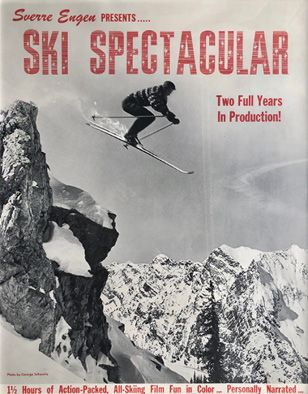
In addition to being a main character in Ski Aces (1944) and Margie of the Wasatch, Sverre’s feature length movies included Champs at Play, Dancing Skis (1956), The Snow Ranger, Skiing, Their Way of Life (1957), Skiing America, Ski Fever (1958), Ski Time USA (1959), Skiing Unlimited and Ski Spectacular (1962). He also produced numerous Fox Movietone episodes and short ski promotional vignettes.
Alta purchased most of Sverre’s original reels in the 1990s, says Alta general manager Michael Maughan. The film rolls have been digitized and stored for posterity.
Mike Korologos’ ski articles have appeared in newspapers and periodicals worldwide for more than 60 years. He was skiing editor for The Salt Lake Tribune for 25 years and a correspondent for SKIING Magazine for 30 years. He served as press chief for the organizing committees for the 2002 Olympic and Paralympic Winter Games in Salt Lake City, his hometown.
photo courtesy Scott Engen
Arnold Lunn and Sandra Heath
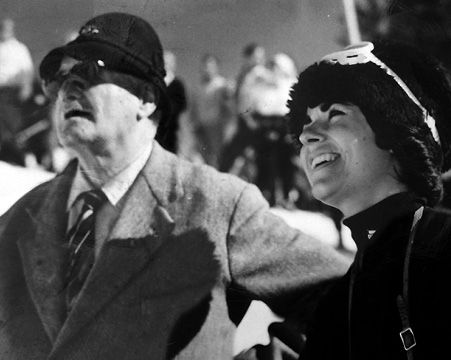
With the passing of John Fry earlier this year, Sandra Heath was motivated to reach out to Skiing History to convey how John always appreciated, and supported, the telling of a good tale. Heath, who modeled for Bogner in the 1950s and 1960s, writes: “John Fry encouraged me to tell this story. In the winter of 1961, when I was being filmed in the Alps, the Fox-Movietone crew and I had the good fortune of visiting the Bellevue Hotel in Mürren, Switzerland. I was introduced to Sir Arnold Lunn, who asked me to join him watching the dangerous climbing activity on the Eiger. He was enchanting: a poet, philosopher and inspirational genius to the ski world. Some 30 years later, in England, I had a drink at the home of Elisabeth Hussey, with her sister Philippa. Elisabeth was Sir Arnold’s secretary and confidante. She sprang from her chair to retrieve something and said ‘This photo is such a mystery. Do you happen to know who this gal is?’ I was flabbergasted—it was me!”
Jeff Blumenfeld, recipient of the 2020 Leif Erikson Exploration History Award, has spent a lifetime covering and supporting the exploits of adventurers worldwide.
ISHA VP Jeff Blumenfeld Wins Prestigious Exploration Award
Jeff Blumenfeld, ISHA vice president and a self-described “groupie for adventures and explorers,” was recently named the winner of the prestigious 2020 international Leif Erikson Exploration History Award.
Blumenfeld, the editor and publisher of the Boulder, Colorado-based Expedition News website, was recognized for his ongoing work to promote and preserve exploration history. Blumenfeld says that “receiving the award and recognition from the exploration community is quite rewarding. I am privileged to tell their stories.” But what keeps him on task is a bigger mission.
“Exploration is critically important,” he says. “It’s through exploration and field research that we’ll answer many of the questions, many of the mysteries of this planet and hopefully make the world a better place for our children.”
In addition to his work on his website, Blumenfeld is active in helping new explorers gain international exposure, peer recognition and, critically, funding for their research and expeditions.
“If I can foster their efforts, I’m totally rewarded by that,” he says.
The Leif Erikson Exploration awards, which include the History Award and the Young Explorer Award, were established by the Exploration Museum in 2015, and are presented for achievements in exploration and for media coverage and documentation of exploration history.
The museum, located in Húsavík, Iceland, 30 miles from the Arctic Circle, is dedicated to the history of human exploration, from early adventurers through space exploration. Blumenfeld received the award in August in a Zoom ceremony, as part of the annual Húsavík Explorers Festival.
Blumenfeld is an active member of the Explorers Club, and is president of the North American Snowsports Journalists Association. He has written several books to promote travel and exploration, including Get Sponsored: A Funding Guide for Explorers, Adventurers and Would-Be World Travelers and Travel With Purpose: A Field Guide to Voluntourism.
SKI ART
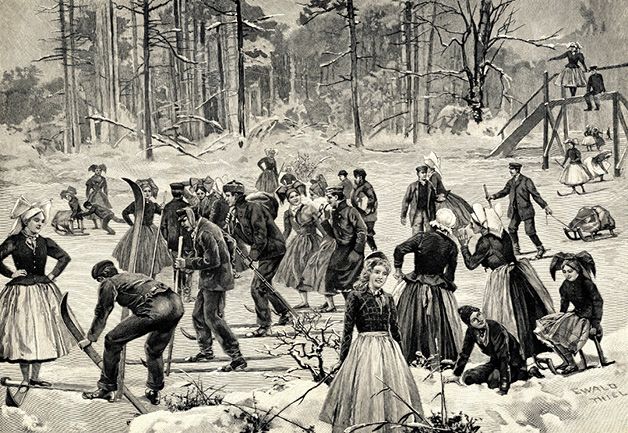
In this illustration, Thiel depicts a crowd of skiers enjoying the Spreewald, a nature preserve near Berlin.
Ewald Thiel (1855-before 1939)
For such a prolific social painter and illustrator, it’s surprising so little is known about German artist Ewald Thiel; we don’t even know when his death occurred. We do know he was born in Kamanten, in East Prussia (now Klimowka in Kaliningrad, Russia) on August 12, 1855. He studied at the Prussian Art Academy in Berlin and in 1878 at the Royal Academy of Art in Munich. He settled in the Halensee region of Berlin.
Thiel became an illustrator of many Berlin scenes, and his work appeared in popular weeklies. He illustrated books and created wood engravings; he drew scenes of lakes and drainage works, the lighting of bridges, exposition openings, and dancers, lawyers, workers, and politicians. Perhaps his most famous sketch (turned into a color portrait) was the drawing of Otto von Bismarck addressing the Reichstag on February 6, 1888 when he proclaimed: “Wir Deutsche fürchten Gott, aber sonst nichts auf der Welt!” (We Germans fear God, but nothing else in the world!).
He drew skiing scenes, too, including a hunter on skis, a skiing postman, and skiers on the Feldberg. He based the scene pictured here on a sketch by Ernst Hosang of the crowd enjoying the Spreewald, Berlin’s nature preserve. In 1866, a railway from the capital reached Lübbenau, a village at the center of the 200-square-mile area of heathland and pine woods crisscrossed by canals.
An enterprising teacher, Paul Fahlisch, had begun promoting tourism here in 1882. The Spreewald soon became the bourgeois’ place to enjoy summer and winter. Many of the skiers in the scene are locals; the women are wearing the traditional headgear of the Sorb community, Slavic immigrants who settled here in the 6th century. Thiel’s careful depiction of the skier with scarf tying down his cap and protecting his ears, one with a pipe, another carrying a sack, and a third putting on a ski, all attest to a well-grounded knowledge of the skiing world of 1899. The picture was published in Das Buch für Alle, a magazine that appealed to the middle class. — E. John B. Allen
Why's it called that?
Sneg, Schnee, Neige: Why do we have different words for snow?
Five or six thousand years ago, near the beginning of the bronze age, a tribe in what is now Ukraine domesticated horses and learned to ride. They quickly spread their culture, and language, in all directions.
No direct record of their language survives, but scholars call it Proto-Indo-European or PIE. By comparing words in Sanskrit, ancient Greek and Latin and modern languages, linguists have come up with a list of about 200 root words from PIE—white was albus, the root of our word Alps.
The PIE word for snow was sneygh. Cultures close to the PIE homeland kept that word: Slavic languages use some variant of sneg, and the tribes north of Central Asia’s Altai mountains, where bronze-age skiing survives to this day, say snig.
In Northern Europe, the word evolved to schnee (German), sneeuw (Dutch), snow (Friesian and English), snø, snö and snjorr (Norwegian, Swedish and Icelandic). In the Mediterranean, proto-Latin (Italic) turned sneygh into snix. Then the s dropped, becoming nix (Classical Latin), neige (French) and nieve or neve (Italian and Spanish). —Seth Masia
SNAPSHOTS IN TIME
1936 RACING ON KENYA’S GLACIERS
British ex-pats held a ski meet on the Lewis glacier on 17,057-foot Mount Kenya, in central Kenya about 90 miles northeast of Nairobi. The sole female contestant—the dashing Nancye Kennaway—won the women’s division and Bill Delap, who started organized skiing on the glacier starting in 1933, won the men’s downhill. The true ski pioneers of the region, however, were German geographer Hans Meyer and Austrian mountaineer Ludwig Purtscheller, who in 1889 became the first people to reach the 16,893-foot summit of Kibo — the highest of Kilimanjaro’s three cones, 200 miles to the south. —E. John B. Allen (Historical Dictionary of Skiing)
1944 CLOSED ON SUNDAYS
For the first several years after its opening in 1944, Timp Haven in Utah’s Provo Canyon was the only ski area in the country that closed on Sundays, due to the religious beliefs of its owner. Paul “Speed” Stewart, a sheep rancher, ran the resort with his brother Ray for more than 20 years. “We just don’t believe in working on Sunday,” Speed’s wife Hilda told the Deseret News in 1965. By that time, his busy resort offered skiing, skating and tubing — but Speed never did learn to ski. “Don’t have the time,” he said. Actor Robert Redford and other investors bought the resort in 1968 and renamed it Sundance. —Mike Korologos
1967 SHOVEL-RIDING GNOMES
While skiing down for our last run, we stopped in the lee of a big cedar tree to look at the view of endless Laurentian hills and frozen lakes stretching out below us. Suddenly, as we all stood there leaning on our ski poles, six little men who looked like tassel-capped gnomes came laughing by us—hell-bent and sliding straight down the mountain—sitting on big, wide snow shovels. Clutching the handle up between their legs, they were having the ride of their lives, speeding with merry abandon over the bumps, down the chutes and through the trees. Their shouts and laughter echoed up the slopes as they went at crazy speeds down the fall line. “Who are those crazy little men?” said Johnny. “Zee trail packers, Monsieur,” said Pierre. We shoved off and chased the “gnomes” to the base of the mountain, swinging through slalom glades, losing them, finding them and laughing all the way. We were in love with the day, the mountain, and the French-Canadian people. —Frankie and Johnny O’Rear,
“Chateau Bon Vivant: The Hilariously True Misadventures of Two Vastly Unequipped Innkeepers Who Run a Ski Lodge in Winter in Old Quebec”
1978 STICK TO THE TRAILS
Don’t go blithely whipping off the trails at Vail, Colorado, this season. Under a new get-tough policy, the U.S. Forest Service is planning to prosecute people who ignore ski-area boundary and trail-closing markers. The penalties: six months in jail and a $500 fine. —SKI (October 1978)
PARKING THE MIND AT KEYSTONE
First the instructor asked us to think of a word that described our skiing. I chose “wobbly.” Mark, a Los Angeles advertising man, chose “strain.” Judy said “tense.” We each acted out our bad quality, exaggerating and clowning. We skied down a gentle intermediate run, clenching our teeth and holding our arms out like scarecrows. “Look at them,” said a voice on a chairlift. “Oh, they’re just doing Inner Skiing,” said its seatmate. —Abby Rand on the Inner Skier Week at Keystone, based on the best-
selling book Inner Skier (SKI, November 1978)
1989 UNITED NATIONS IN THE ALPINE LIFTLINES
Our State Department should analyze national deportment in liftlines across the Alps as an aid to understanding the character of Europeans. The Germans are the most aggressive. The French step all over everyone’s skis. An Englishman slammed into the line and knocked over my daughter. The Swedes make a wedge of six skiers and slowly surge through the line. The polite Japanese make block reservations on the cable cars. As for the Americans, they’re so afraid of making the wrong impression that they get squeezed to the back—the wimps of the European liftlines. —Peter Miller (Snow Country, August 1989)
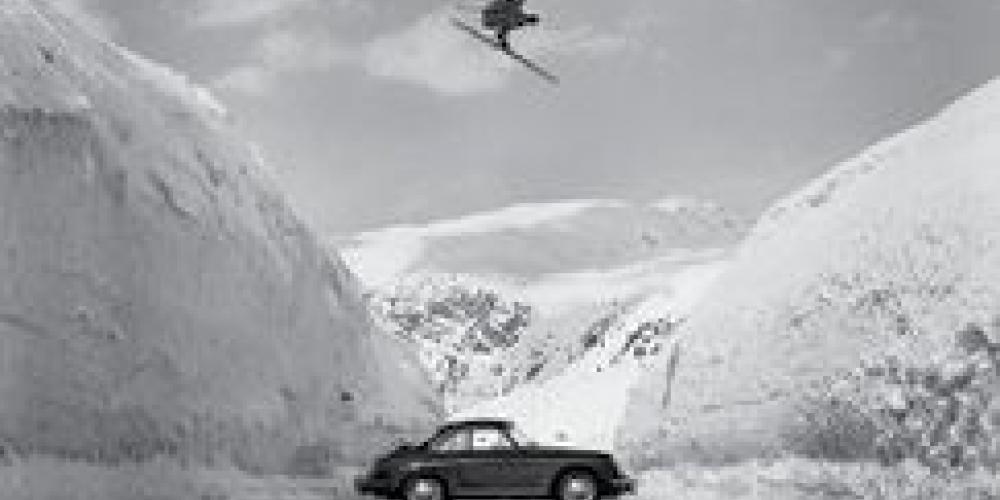
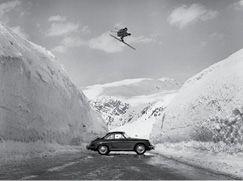
In the Hans Truöl photo shown in the July-August issue (“Big Air”), the caption says it was taken in Lech, Australia. That would be Lech, Austria! The location is actually nearer to Zürs than to Lech.
Truöl took several different photos of a skier jumping over Porsche cars along that section of highway between Zürs and the Flexen Pass. The occasion was the 1956 Porsche Club Winter Ski-Treffen. For many years, starting in the mid-1950s, Porsche Club skiers would gather in Zürs with their cars for this annual event.
I’ve been back to the Arlberg a dozen times and skied the trails on both sides of the road. Never have I seen the snowbanks as high as they were in that photo. Another sign of global warming.
Bill Hayman, PSIA Instructor
Jay Peak, Vermont
The Jet Stix Story
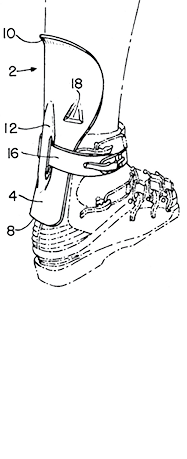
Several years ago, you published an article about ski inventions (“Bygone Gizmos,” September-October 2017). The story mentioned that Jack Nagel, who ran the ski school and shop at Washington’s Crystal Mountain, was the inventor of the Jet Stix. Although Jack was a valued member of the company, his responsibilities were primarily financial.
The Jet Stix story begins at Crystal, where I was a ski patroller and weekend racer. To improve my racing technique, I needed more leverage to recover from the occasional backseat turn. I decided to make some fiberglass extensions to attach to the back of my boot, and I could really feel the difference. After making an additional pair with a strap so anyone could try them, Jack asked if he could take a test run. At the end of the run he said, “Let’s go up to my office. We need to talk.” Bottom line: We changed boot design for the better!
Brent Gray
Elizabeth, Colorado
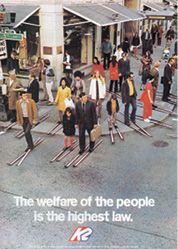
Positive ID: K2 Ad Was Shot in Seattle
In the January-February 2020 issue, the back cover was a reprint of a K2 ad from the 1970s, with a caption asking if readers knew where the photo had been shot. I’m quite sure that’s the White-Henry-Stuart Building at the southeast corner of 5th Avenue and Union Street in downtown Seattle. My office was a few blocks from that corner. At lunch time, I’d often walk past to visit the city’s leading sports store, Eddie Bauer—the only store that carried true seal-skin climbers.
When cartoons take a run at skiing, mayhem ensues.
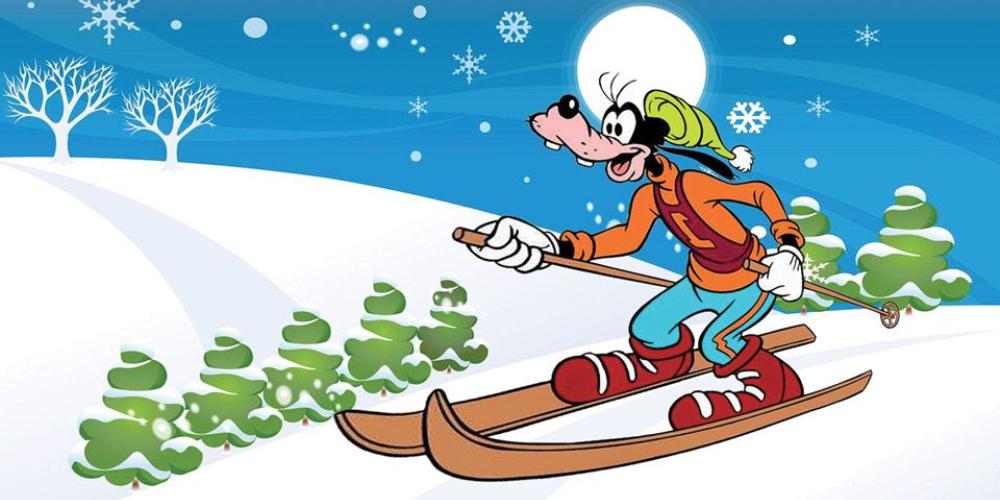
Goofy does not live up to his name in what might be the most realistic instructional cartoon on skiing (above). Part of Goofy’s “How To” oeuvre, The Art of Skiing shows viewers how to dress, load a chairlift and kick-turn, and even features an authentic yodeler on the soundtrack.
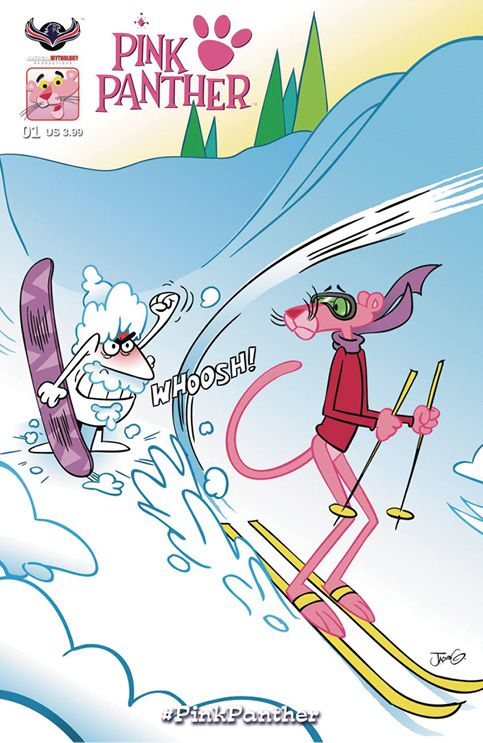
The Pink Panther ends up the victor, of course, when working at a ski resort in Pink Streaker.
What is quickly learned from total immersion into the golden age of animation, roughly the 1930s through the 1970s, is that when Hollywood animators put characters on skis, they suspend the laws of physics. From the earliest cartoon depictions to a recent animated relaunch on HBO, skiing is primed for slapstick humor, visual punchlines and lots and lots of long freefalls.
Popeye crashes off ski jumps. Wile E. Coyote falls off cliffs with an ice machine on his back. The Pink Panther is engulfed in a giant snowball, while Homer Simpson hangs from a chair upside down and is blasted by a frigid fan gun and fiery snowcat exhaust, to name just a few.
Each stunt is more gravity-defying than the next one, often relying on a host of products, usually from the Acme Corporation, makers of sticks of dynamite, intricate booby traps, and anvils and bank safes that inevitably are dropped on unsuspecting heads.
And when viewed through 21st century goggles, some animation was so politically incorrect as to be downright cringeworthy, from Betty Boop resisting an unwanted suitor, to Tom from Tom & Jerry panting over a ski bunny, to poking fun at poor Mr. Magoo for his near-sightedness.
A natural fit for slapstick humor, skiing syncs up perfectly for the misadventures of Wile E. Coyote, perhaps the most hapless victim in animated history.
The sight gags are endless. There are drunken St. Bernards, skiers on the wooden runners of a rocking horse, a dachshund too long for a single pair of skis riding atop two pairs of them, and characters sailing off ski jumps with parachutes.
You’ll often see one of the most popular of all ski sight gags: downhill tracks on both sides of a tree, as if the cartoon character went through unharmed. (A tip of the hat to Charles Addams’ famous 1940 cartoon “The Skier” in the New Yorker that set the gold standard.) But in cartoonland, no one is seriously injured. Like a classic clown bop bag, they bounce back up for even more indignities in the next scene.
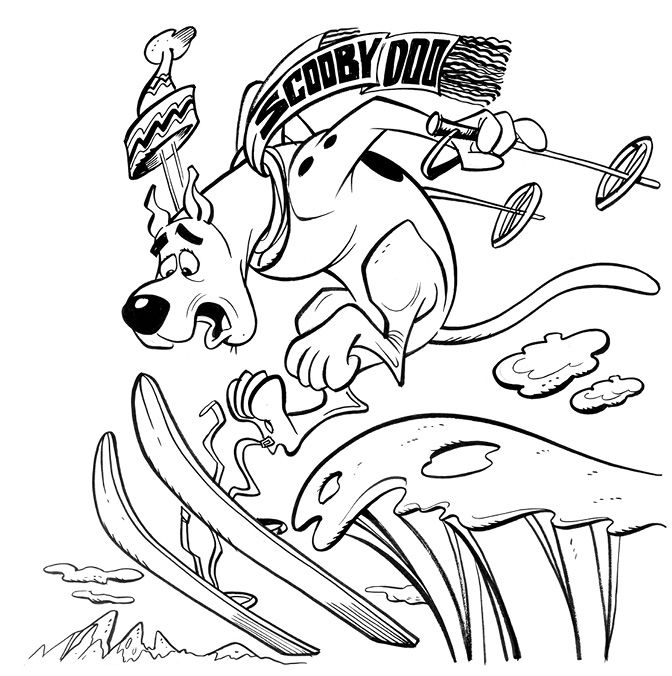
Scooby Doo and the gang travel to a resort in the 2002 episode There’s No Creature Like Snow Creature, which features American Olympic bronze medalist Chris Klug playing himself.
Lucille Ball broke her leg skiing while starring in a TV sitcom, and her real-world accident (and her subsequent leg cast) was famously written into that season. “But in cartoons, characters get hurt, you laugh, and you move on to the next gag,” A.B. Osborne, Professor of Animation at Georgia’s Augusta University, explains.
What is it about skiing that appeals to cartoon animators? “It’s a visual sport and people get it immediately,” Osborn says. “When someone is going down a hill on skis, you don’t have to explain it. I never went skiing in my life, but I know what it is.”
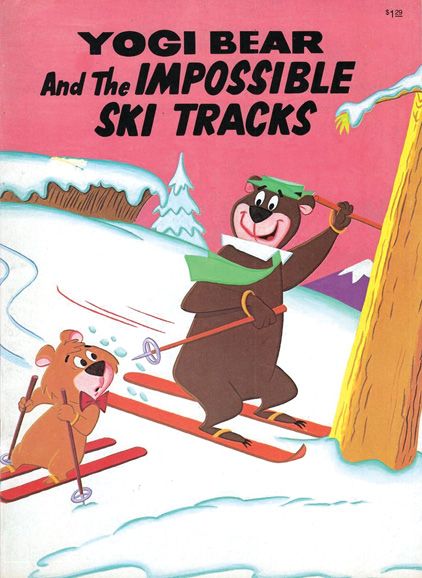
With Yogi Bear and buddy Boo-Boo Bear residents of “Jellystone Park,” having them slap on skis for an episode or two fits in perfectly with their winter wilderness habitat.
Hours viewing vintage cartoons online reveals a world where skiing was considered glamorous and a colorful theme for all manner of cold-weather comedy and conflict. Popularized in 1930 during the start of Hollywood’s golden era of animation, these short-form cartoons ran before main features, then were eventually broadcast on TV. Many were inspired by vaudeville acts such as The Three Stooges and Laurel and Hardy, according to Robert Ito writing in the New York Times (May 29, 2020).
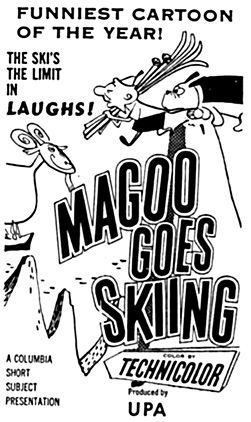
In Magoo Goes Skiing, the character faces many of the typical props in skiing cartoons, including mountain goats, going airborne and a St. Bernard dog coming to the rescue.
Pandemic Antidote
Watching ski cartoons from a couch is the perfect antidote to a cranky Covid-19 lockdown. According to CartoonResearch.com, the earliest references in titles to ski themes are from the Mutt and Jeff shorts. Among the 292 animated cartoons produced from 1916-1926 that depict skiing are On Ice (1918), Mutt and Jeff in Switzerland (1919), The Frozen North (1919), The Far North (1921), and Any Ice Today (1922). American cartoonist Paul Terry’s series of animated short subjects based upon Aesop’s Fables included ski scenes in On the Ice (1924), An Alpine Flapper (1926), and Cracked Ice (1927).
Those shorts are unavailable, so I wasn’t able to confirm their ski content. The earliest cartoon depiction I could confirm is Krazy Kat’s Snow Time (1932). When Krazy tries to jump in his skates over a row of barrels, he misjudges the distance and crashes into the last barrel, breaking it into slats, two of which stick to his feet as skis. He slides uncontrollably down the pond, jumping over small snow mounds. A snowman unzips his “snow” suit, revealing a skeleton inside, and tosses the snow back at Krazy, who grows into a giant snowball.
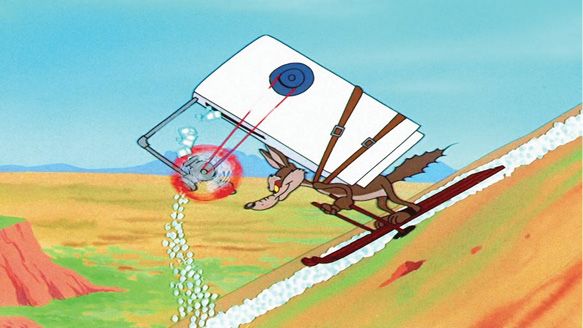
Wile E. Coyote frequently uses the services of The Acme Corporation in Road Runner cartoons, in what inevitably turns into Rube Goldberg-inspired plots.
Betty Boop & Pudgy in Thrills and Chills (1938) is one of the least circulated or known of all the Betty Boop episodes. According to CartoonResearch.com, Betty tries to get on a train to the mountains, but her way is blocked by a freckle-faced male doofus who demands, “Hey pretty girl. Give me a kiss and I’ll let you in.” He then stalks her for more than six minutes. He eventually saves Betty and her dog Pudgy from peril. The dastardly interloper finally gets his kiss—from the dog. Politically correct it’s not.
Goofy’s The Art of Skiing (1941) is one of the most definitive ski cartoons in animation history. This was the first in Goofy’s acclaimed “How To” catalogue of shorts in which the character tackled a recognized sport. Walt Disney Productions animators even retained a professional yodeler to provide an authentic soundtrack.
In the cartoon, Goofy explains how to dress for the day’s activities—including devising his own challenge of putting on trousers when his feet are already in skis. Finally reaching the summit by way of a chair lift, he demonstrates a kick-turn, and how to get up when fallen. He lands backwards and skis in reverse, which, of course, eventually leads to him going off a ski jump—except Goofy forgets to lace his ski boots, which separate his skis from his feet shortly after takeoff. He manages to get hold of both of them, using the skis as glider wings to maneuver between mountain peaks, then finally crash-lands through the window of his own room at the ski lodge. Goofy falls instantly sound asleep, to close out the perfect day on the slopes.
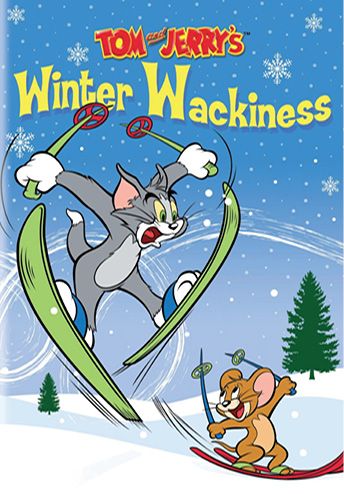
Tom and Jerry take their battles to the slopes for several episodes, including Winter Wackiness and The Ski Bunny, which brings them to the Swiss Alps.
One of the cleverest of all sight gags, which channels Rube Goldberg, appears in Fast and Furry-ous (1949) a Warner Bros. Looney Tunes Road Runner cartoon that shows a resourceful Wile E. Coyote strapping a full-size refrigerator to his back, then feeding ice cubes into a meat grinder to create a strip of skiable crushed ice. It works great—until he skis off a cliff.
Back in the 1950s, any infirmity was seemingly fair game. In Magoo Goes Skiing (1954) the opening sets up a gag to follow, as the severely near-sighted Magoo calls out to a mountain peak with his best attempt at a yodel—but is disappointed to hear no echo. The fact that he’s serenading a picture on the ski lodge wall rather than a real mountain is the explanation. Magoo really intends to go skiing—but of course he picks up a St. Bernard along the way (another ski resort stereotype) whom he thinks is his nephew Waldo.
Skiing, and its alluring enthusiasts, has always offered plenty of opportunities for romantic entanglements. Incongruously, Popeye appears far from the sea in Ski-Jump Chump (1960), jealous that his sweetheart Olive Oyl is falling for Frenchman Gorgeous Pierre, the greatest ski jumper in the world. The sailorman, of course, eventually wins his sweetie back with the help of some spinach-fueled courage.
Meet the Flintstones
Things get sticky for the modern Stone Age family when Fred Flintstone and his pal Barney Rubble appear in The Flintstone’s Here’s Snow in Your Eyes (1962). The first primetime animated show on television was a sly take-off of The Honeymooners.
Fred and Barney are off to Stone Mountain Ski Resort for a Loyal Order of Water Buffalo Lodge convention. Because none of the members’ wives have been invited to go along, Wilma and Betty stoically remain at home—but their stoicism quickly evaporates when they learn that the resort is also the site of the Miss Winter Carnival beauty contest.
More recent favorites include the Pink Panther Pink Streaker (1975) wherein the famed big cat works at a ski area and unintentionally bedevils the Little Man character who is trying to learn to ski from a book appropriately titled, How to Ski. In Tom & Jerry The Ski Bunny (1975), set in the Swiss Alps, Tom competes against his mouse buddy Jerry for the affections of a female kitten dressed as a ski bunny.
No less of a show than The Simpsons, the longest running American sitcom of all time, headed to the mountains. In Little Big Mom (1999) the family visits Mount Embolism, where Homer must decide which double diamond trail to descend. “The Widowmaker? That one is for the ladies,” he says. The Spinebuster trail he calls “boring,” before deciding to take the Colostomizer run. The hapless character soon cries, “Oh my legs, this is the worst pain ever.”
Cartoons on the Rebound
Cartoons are coming back. One reason is Covid-19, which translates to a nationwide captive audience of homebound kids, along with adults who are primed for some feel-good nostalgic screen time. In fact, Looney Tunes Cartoons, a revamp of the classic Warner Bros. series that had its glory years in the 1940s and 1950s, premiered on HBO Max in May 2020.
Darryn King, in the May 17, 2020 Wall Street Journal, wrote “Animation has seen a 22 percent surge in viewership during lockdown, more than any other category, according to Reelgood, a website that analyzes streaming viewer behavior patterns. This is likely because of the huge demand for content for children stuck at home, but it is also possible that the art form, liberated from real-world constraints, is suitably escapist entertainment right now.”
These catastrophic cartoons convey just what skiing has been trying to overcome for decades, to be known as a relatively safe, healthy, family endeavor rather than as risky business. But where is the entertainment in that?
Then again, as ski resorts develop their Covid-era protocols for next season and require advance reservations, among other restrictions, if you find yourself skiing less, maybe what you need are more ski cartoons in your life.
ISHA vice president Jeff Blumenfeld, a resident of Boulder, Colorado, is the president of the North American Snowsports Journalists Association (NASJA.org). He is author of Travel With Purpose: A Field Guide to Voluntourism (Rowman & Littlefield, 2019). Learn more at travelwithpurposebook.com.
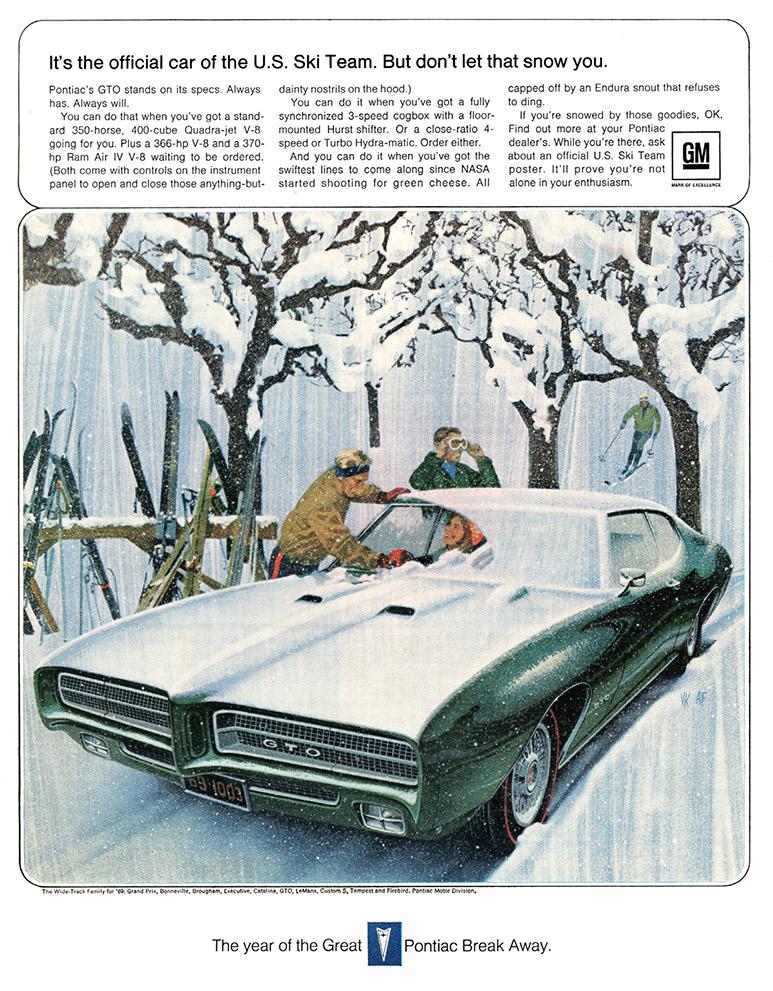
This ad for the Pontiac GTO was published in the January 31, 1969 issue of LIFE magazine. It was the official car of the U.S. Ski Team, which had been formally organized just a few years earlier, in 1965. The same month this ad ran, the footage for the iconic ski movie Downhill Racer was shot. Karl Schranz and Gertrude Gabl won the overall 1968–1969 World Cup titles, and American racer Marilyn Cochran won the women’s GS globe.
Coming up in future issues
CARTOON CLASSICS
From the Road Runner and Bugs Bunny to Wile E. Coyote, skiing was often used as a prop for mayhem in TV’s classic animated cartoon series of the 1960s and 1970s.
CROSS-COUNTRY CALDWELLS
Over 70 years, America’s first family of nordic skiers have formed an inseparable bond with the sport
WE NEED MORE COWBELL!
A short history of the clanging bells that cheer on alpine racers
NEVER-SEEN SKI SCENES
Ski photographer and cinematographer Paul Ryan searched through his archives for surprising, captivating images of Olympic stars and celebrities from the 1960s
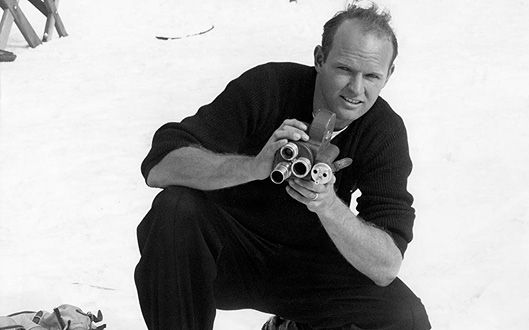 Ski Bum is a 90-minute review of the late Warren Miller’s extraordinary career, told through archival footage and one final interview with Warren himself.
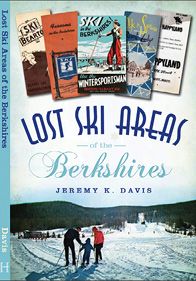 The Berkshires of Massachusetts have long been known as a winter sports paradise. Forty-four ski areas popped up across the region from the 1930s to the 1970s. The legendary Thunderbolt Ski Trail put the Berkshires on the map for challenging terrain, while major resorts like Brodie Mountain sparked the popularity of night skiing with lighted trails. All-inclusive areas—like Oak n’ Spruce, Eastover and Jug End—brought thousands of new skiers into the sport between the 1940s and 1970s. Meanwhile, snow trains made it fun and easy for metro-area skiers to plan weekend ski excursions.
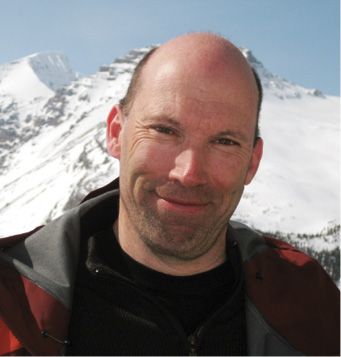
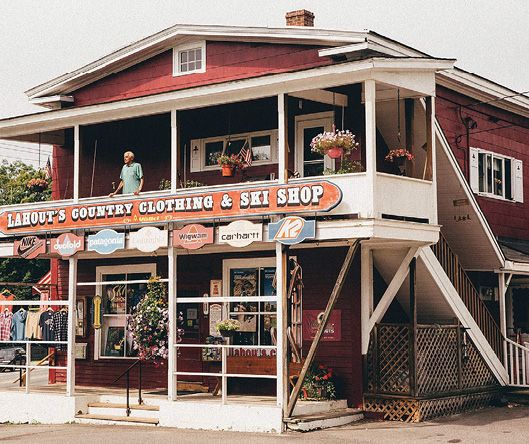 In Littleton, New Hampshire, near Cannon Mountain, Lahout’s Country Clothing and Ski Shop has done business at the same location since 1920. Fourteen-year-old Herbert Lahout emigrated from Syria in 1898, and became a railroad laborer. He married his wife Anne in 1919 and the couple sold groceries from a horse-drawn wagon. The following year they moved the business into Littleton’s Old Grange Hall, and lived upstairs. Herb died in 1934 and, in the depths of the Depression, Anne was left to run the store with her kids Gladys, 14, and Joe, 12.

 "Ski Bum: The Warren Miller Story," is now showing on Amazon Prime.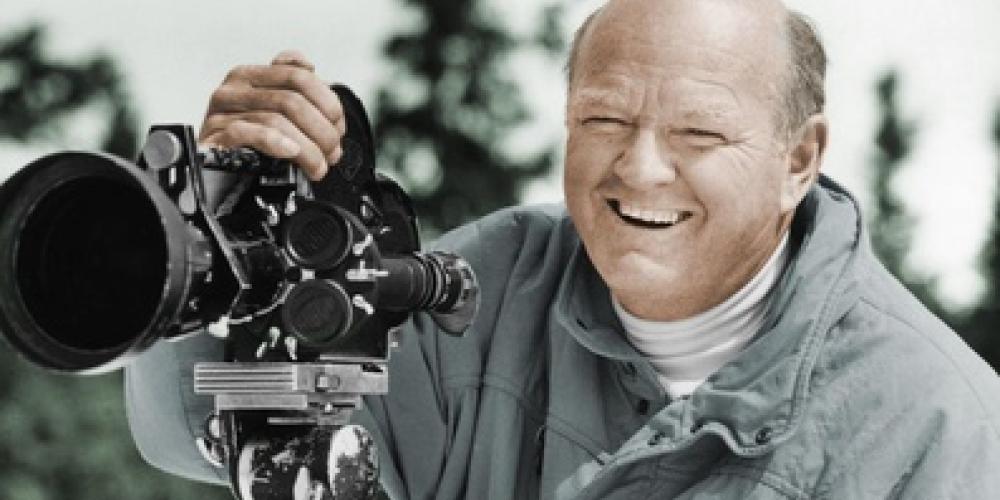
 Arnold Lunn and Sandra Heath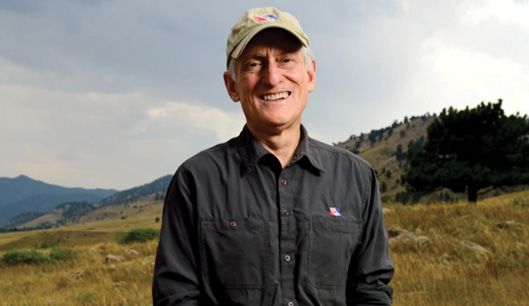



 The Jet Stix Story
 Positive ID: K2 Ad Was Shot in Seattle