Culture

Open to Public?
Off
Timestamp

This Glossary of Historical Ski Terms is from the book "Story of Modern Skiing," by John Fry, published in 2006 by University Press of New England, 380 pages, 90 illustrations, $24.95."

The author is indebted to Seth Masia, to Doug Pfeiffer, and to the editors of the Professional Ski Instructors of America Alpine Technical Manual for their help in assembling this Glossary.  

Acclimatize, Acclimate. Adapt to a change in altitude, ideally done in stages to reduce physiological stress.

Alpine. When the A is capitalized, the word Alpine relates to the Alps. In lower case, alpine may refer to anything mountainous like the Alps, and specifically applies to downhill skiing, as contrasted with nordic (cross-country and jumping). Downhill, slalom, giant slalom and Super G are alpine competitions.

Alpine Combined. A downhill and a slalom race either held intentionally as a combined event, or the linking of two races on the calendar to produce a combined result. Result of a combined competition was once derived from mathematically computing FIS points. Today it is done by adding up the times.

Angulation. Any movement or positioning of the leg or body to roll the ski onto a higher edge angle relative to the snow. Before the introduction of higher plastic boots, ski instructors assumed that this could best be achieved by angling the torso down the hill (or toward the outside of the turn) , at the same time as the hip and knees were angled into the mountain. This was known as the comma position. The improved control provided by modern boots has rendered the comma position obsolete. Angulation can now be achieved with the lower leg and emphasized with the hip, independent of upper body position.

Anterior cruciate ligament (ACL). The knee ligament that connects the femur (thigh bone) with the tibia (shin bone) and prevents the forward movement of the tibia on the femur. The posterior cruciate ligament prevents backward movement of the tibia on the femur. ACL tears became a common ski injury after 1980, as a result of changed boot design, ski shape and binding height combined with the skier’s feet-apart stance.

Anticipation. The skier’s upper body anticipated the direction of the coming turn, acting as an anchor for the lower body to turn against. As the tension was  released (muscles relax) and the skier “let go” of the old turn, the legs realigned with the upper body and started the turn.

Arlberg. A mountainous region of western Austria encompassing the classic ski resorts of St. Anton, St. Christof, Lech, Zurs. Home of famed ski teacher Hannes Schneider, who formulated the Arlberg technique, and of Stefan Kruckenhauser, who popularized wedeln. 

Arlberg Strap. A leather strap that was wrapped around the boot and attached to the ski to prevent it from running away when the binding released.

Arlberg Technique. A series of movements taught in progression, starting with the snowplow and progressing to turns made with the skis parallel, developed by Hannes Schneider. (See Arlberg, above.)

Arete (French). Sharp mountain ridge with steep sides.

Backscratcher. While airborne, the skier’s knees are bent so as to force the ski tips to drop sharply downward. The tails of the skis may even scratch one’s back. Also called a Tip Drop.

Backside. The backside of the snowboard is the side where the rider’s heels sit. The backside of a snowboarder is the side where the rider’s back faces.

Bathtub. See Sitzmark.

Bear trap. A binding that did not allow release. It had fixed toe irons, and the heel was often lashed to the skis with a leather strap, long thong or laniere.

Bevel. Modifying the edge of a ski so that it forms something other than a perfect 90-degree angle.  The ski edge has two surfaces: the base edge contiguous to the ski's sole, and the side edge meeting the ski's sidewall. A beveled base edge is "softened" by about one degree -- in effect it's recessed relative
to the sole surface -- so the ski rolls more smoothly on and off the edge. A bevelled side edge -- sharpened to 1, 2 or 3 degrees of acute angle -- can
help a racer to hold a more aggressive line on ice.

Biathlon. A competition among rifle-bearing skiers originating in the 18th Century, which rewards skill in skiing cross-country and marksmanship. Results are computed in time. Minutes are subtracted for errant shots. Biathlon has a separate sports governing body recognized by the International Olympic Committee.

Binding platform. In the days of carved "ridgetop" skis of hickory and ash, it was common to provide a flat, and usually slightly raised, platform at the ski's center for mounting the binding and boot. Beginning with international standards for bindings (see DIN), the binding mounting zone on the ski was defined as flat platform or plate designed to anchor the binding screws. In 1989, World Cup champion Marc Girardelli began using the Derbyflex plate, a solid aluminum plate glued to a thick sheet of neoprene rubber, inserted between the ski and the binding. The platform provided an additional inch of leverage relative to the ski's edge for more edging power, and additional boot clearance so that the ski can be pitched onto a higher edge angle.  The leveraging power from the elevated platform also leverages the power of forces coming back into the knee from the snow. To reduce knee injuries among racers, the FIS limited the total "stack height" -- the distance between the snow and the sole of the boot -- to a maximum of 55mm. A typical high-performance recreational binding today has a stack height of 45mm; the ski itself may be about 15mm thick.

Blindside. In snowboarding, when the rider approaches or lands “blind” to the direction of travel.

Boarder Cross. Snowboarders race through turns and obstacles and jumps in heats of 4-6 riders, starting simultaneously.  The term derives from a similar format used in motorcycling – motocross.

Bonk. In snowboarding, to hit a non-snow object hard.  

Boilerplate. A glazed covering of solid ice on a trail, usually produced after rain or after wet snow freezes.

Boogying. To ski the bumps all out -- a 1970s hot dog skiing term.

Canting.  The process of making adjustments – primarily to bindings and boots – in order to improve the alignments of feet, knees, hips and upper body. The alignment is typically done mechanically by a footbed in the boot, and/or by adjusting the boot’s cuff.

Carving. Turning the skis by causing them to travel on edge with minimal lateral slipping or skidding. The tail of the ski is on a forward moving path that follows the tip of the ski. A pure carved turn, whether on skis or on a snowboard, is defined by its leaving a clean, elliptical track on the snow.

Camber. The arch built into a ski from tip to tail. Camber was created to generate even pressure on the snow along the length of the ski. A “stiff” ski resists being de-cambered or pressed flat.

Catwalk. Narrow road often built to enable wheeled machines to ascend the mountain in summer and snowcats in winter. Catwalks double as ski trails in winter, characterized by long traverses that link to another trail, a lift or to another section of the resort.

Center Line. A conceptual model created by the Professional Ski Instructors of America “for selecting appropriate movement patterns under a variety of circumstances.”

Chattering. The ski’s edges grip on ice but rebound, vibrating and chattering -- as opposed to carving or skidding smoothly.

Christie. A contraction of the word Christiania, describing a turn made with the skis parallel (a parallel christie), as distinct from a turn made with the skis partially in a stem or vee configuration (known as a stem Christie), or a turn made wholly with the skis stemmed (known as a stem turn, snowplow or wedge turn). In post-20th Century ski schools, the term christie may denote a skidded parallell turn, as opposed to a carved turn. 

Cirque. A bowl-like shape, typically at the head of a valley, created by a former glacier.

Concave Running Surface. A frequent defect for many years in the manufacture and curing of fiberglass and plastic skis produced in molds. The concave ski’s bottom resists turning. The defect is corrected by flat-filing or machine-grinding the skis to bring the edges down to the level of the running surface.

Convex. The opposite condition of concave. A convex base feels unstable to the skier, doesn’t track accurately, and sideslips on ice. In the factory, when a new ski receives its final grind before the resin is fully cured, it can be delivered to a ski shop concave in the shovel and tail, and convex in the middle.

Corn snow. Pellet-sized particles formed from repetitive thawing, refreezing, and recrystallizing of the snow. Corn snow has a texture that facilitates turning and causes skiers to feel as if they’re skiing on ball bearings.

Cornice. Overhang of snow and ice typically found on a high ridge. Dangerous  skiing to the skier who stands for long on one, and extreme skiing to those who jump off one.

Counter rotation. Simultaneously twisting the upper body in one direction (usually opposite to the direction of travel), and the lower body in another direction.

Cross-Country Relay. See Team Event.

Crossover. Swinging one ski around the other so that the feet point in opposite directions, then extricating the standing ski to re-align itself to the other.

Crud, Breakable Crust. A condition in which the snow surface has frozen into hard crust over soft snow underneath. Crud often refers to settling snow that has been cut up by skiers. When the skier’s weight is sufficient to break through the crust, but unpredictably, the resulting condition is difficult to ski.

Daffy. An early freestyle stunt, the daffy was a mid-air split – the skier extended one leg forward, the other rearward. If airborne long enough, the skier could sky-walk – that is switch legs fore and aft two or three times. The term daffy, according to freestyle pioneer Doug Pfeiffer, originated in the idea of the stunt  being daft, or slightly crazy.

Damping. Quality in a ski which prevents it from vibrating excessively, a problem with early metal skis. Skis insufficiently damped are unstable, and may chatter on ice. An over-damp ski, on the other hand, feels heavy and sluggish, doesn’t glide easily on wet snow especially, and tends not to rise to the surface in heavy powder. 

Deep-crouch Christie. While traversing at a comfortable speed the skier suddenly assumes a low crouch position. Taking advantage of this unweighting movement, he turns the skis toward the fall line while keeping the weight on the inside-of-the-turn ski and letting the outside one drift off as if about to do a gymnast’s split. Once the desired new direction is obtained, a normal skiing posture is resumed. Obsolete.

DIN Setting. Every binding has an adjustable release setting which determines the torque required to release the skier in a fall. Beginning in 1979, bindings used a standard scale to measure release values. The standard, DIN, stands for Deutsche Industrie Normen -- German Industrial Standards. The number,  usually visible in a tiny panel on the toepiece, theoretically represents the torque in decanewtons per degree to release the binding toe. The higher the number, the greater the force required to release. An expert recreational skier might set his binding at 8; a beginner, depending on weight and strength, much lower, say 3. The setting of the binding’s heel piece is proportional to the toe setting at a ratio determined by the manufacturer.

Down-unweighting. A lightening of the pressure of the skis on the snow made by a sudden dropping of the skier’s body. (See up-unweighting.)

Fakie. In snowboarding, to ride backwards without facing the direction of travel; also Switch.

Fall Line. Line down the hill that gravity would direct a rolling or falling object. The steepest or shortest line. A sequence of ski turns is typically made by a skier crossing back and forth across the fall line.  

FIS. Federation Internationale de Ski, the International Ski Federation, made up of almost a hundred national ski federations around the world, headquartered at Oberhofen/Thunersee, Switzerland.

Flying Sitzmark. In deep snow, with a modicum of speed, the skier launched  airborne from between both poles, kicked the skis forward and vertical, typically  in an X-configuration, and landed with his rear end first in the deep stuff, leaving a giant sitzmark in the snow.

Four-way Skier. One who competed in downhill, slalom, cross-country and jumping. The four-way champion was often called Skimeister. (See Skimeister.)

Frontside. The frontside of the snowboard is the side where the rider’s toes sit.

Grab. To hold the edge of the snowboard with one or both hands while airborne.

Halfpipe. A vertical U-shaped structure sculpted from snow. Snowboarders and skiers use the opposing walls of the halfpipe to get air and perform tricks as they travel downhill. At ski areas, specially designed grooming machines are used to make halfpipes.

Jib. In snowboarding, to ride on something other than snow --- e.g. rails, trees, garbage cans, logs.

Garland. A teaching exercise used to develop skill in unweighting and edging the skis. The skis are alternately slipped downhill and traversed, without the skier making a turn.

Gate event. Refers to a slalom or giant slalom race. A gate or technical skier specializes in slalom and giant slalom, in contrast to the speed competitions of downhill and Super G.

Gelandesprung. A powerful jump off a bump or a built-up jump, executed by the skier using both poles and often spreading his legs in mid-air.

Geschmozell, Geschmozzle. A downhill competition, in which all the racers started at the same time. The practice was abandoned for most of the 20th Century, but was revived with the popularity early in the 21st Century of skier-cross and boarder-cross races.

Goofy, Goofy-Footed. In snowboarding, riding with the right foot in front instead of the left foot, which is the normal stance

Graduated Length Method (GLM). A system of teaching in which the pupil progressed from shorter to longer skis.

Hairpin. In slalom, two gates set vertically down the hill and close together.

Heel side. The edge of the snowboard under the rider’s heels.

Herringbone. A technique for climbing the hill by putting the skis on edge in a vee-configuration, with the tips fanned outward. The skier walks up the hill on alternating feet while edging to avoid slipping backwards. The pattern left in the snow resembles the skeleton of a fish.

High Back Boot. See Jet Sticks.

Huck. In snowboarding, freeskiing and a variety of other sports, to fling the body into the air -- that is, to launch a jump. A huckfest is a big-air contest, formal or informal. 

Inside ski. In a turn, the skis describe an arc or partial circumference of a circle. The inside ski is the one closer to the circle’s center. At the start of the turn it is the downhill ski; at the weight transfer it becomes the unweighted ski, and at the turn’s conclusion, it has become the uphill ski.

IOC. International Olympic Committee is headquartered in Lausanne, Switzerland. The IOC recognizes the FIS as the official governing body for the sports of skiing and snowboarding.

ISHA. International Skiing History Association publishes a bimonthly journal, Skiing History (formerly Skiing Heritage), and operates the most extensive website about the sport’s history. Office and subscription services at the U.S. National Ski and Snowboard Hall of Fame in Ishpeming, Mich.

Jet Sticks, Jet Stix. Beginning around 1966, the French introduced an aggressive style of slalom skiing called avalement, which depended in part on storing energy in the stiff tail of the ski, then releasing it for acceleration. To aid in loading the tail, racers began experimenting with ways to build up the back
of their leather and plastic boots, using tongue depressors, aluminum plate, fiberglass, duct tape -- anything that fell to hand.  By 1969, most boot manufacturers responded by offering plastic "spoilers" to build up the back of the boot.  An aftermarket option was Jet Stix, a set of spoilers with a buckle strap which could be attached to any pair of classic ankle-height boots.

Kicker, Kicker Jump. Steeply built jump designed to hurtle the freestyle aerialist vertically into the air, making possible flips and various inverted aerial stunts. By contrast, the lip of a classic nordic jump is designed to maximize the jumper’s horizontal distance.

Klister. An extremely sticky or tacky wax enabling cross country skis to grip and glide on warm, wet or frozen granular spring snow. 

Kofix. One of the early brand names for a polyethylene laminate bonded on to the ski’s base to form its running surface.

Langlauf. German word for cross-country skiing.

Laniere. Shorter version of the long thong (see below).

Long Thong. A leather strap used by racers and good skiers until the 1960s to hold the foot securely on the ski and to strengthen the leather boot’s lateral support of the ankle. As long as six feet and wrapped around the boot, the long thong attached to steel rings on the sides of the ski, or it was threaded through a mortise drilled through the wooden ski under the foot.

Lift Line. A line of skiers waiting to get on a lift. Long lift lines are synonymous with waiting a long time in the lift line. The term lift line also refers to the cut through the trees where the lift ascends the mountain.

Massif. A mass or group of summits.

Mid-entry Boot. A design usually incorporating an overlap lower shell to provide accurate shell fit, and a hinged upper cuff that opens wide for easy entry and exit. Mid-entry boots were aimed at intermediate skiers who wanted a more precise fit than was available with rear-entry boots, but who didn't want to wrestle with the stiff flaps of an overlap racing boot. (See also overlap boot, and rear-entry boot.)

Mogul. A bump formed as a result of skiers repeatedly turning in the same place.

Moraine. A ridge formed of boulders, rocks and gravel pushed downhill or aside by a glacier and left behind after the glacier's retreat. A terminal moraine appears at the end of the glacier; lateral moraines at its sides.

NSAA, National Ski Areas Association. A trade association of more than 400 mostly U.S. ski areas, headquartered in Lakewood, Colorado.

NSPS, National Ski Patrol System. Association of ski patrolmen and women, headquartered in Lakewood, Colorado.

Nordic Combined. The result of competitors racing cross-country and jumping. Distance and style in the jumping event and times in the cross-country event, were converted into points. Beginning in 1968 in Norwegian meets, and then in the mid 1980s in international meets, the finish order in the jumping event established the starting order in the cross-country race. The first man crossing the finish line in the cross-country race wins the Combined.

Off-piste. Terrain that is not on a prepared slope. See piste.

Outside ski. (See inside ski.)

Overlap boot.  A plastic boot into which the foot is inserted as it would be into a conventional work boot or old-fashioned leather ski boot -- that is, through the top of the cuff.  Overlap boots typically consist of a lower shell with overlapping flaps over the instep, which are closed tightly around the foot with over-center buckles. A hinged upper cuff with overlapping flaps in front of the lower shin closes tightly around the ankle and lower leg with over-center buckles and velcro straps for maximum control of a high-performance ski. The stiff plastic flaps can be difficult to flex for entry and exit.

Piste. French word for trail or track or groomed slope.

Platterpull, Poma lift. A stick with a round, flat disk is attached at its other end to a moving steel cable. To ride uphill, the skier inserts the stick between his or her legs, with the flat disk placed behind his or her derriere. The other end of the stick mechanically grabs the moving cable and the rider is pulled along the snow uphill. The platterpull is often called a Poma lift, after the name of its inventor Pomagalski.

Polish Donut. In freestyle, a variant of the Worm Turn. Skier, usually while traversing, suddenly sat down to the side of the skis, raised them sufficiently to clear the snow, and spun around in a full circle before continuing.

Pre-jump. A technique for reducing the tendency to become airborne when confronting a bump or terrain irregularity. The skier jumps before reaching the bump or drop-off, skims over its top and lands on the downhill side.

PSIA, Professional Ski Instructors of America. National association of certified ski instructors, headquartered in Lakewood, Colo.

Rappel. Descending a mountain on a rope using braking devices. In English, it translates as "to slow" or "brake." German: abseil. Frequently misspelled as "repel."

Rear-entry boot. A plastic boot into which the foot was inserted through a "door" or flap at the back. The main shell was seamless, and the rear flap was  secured with over-center buckles or ratcheting straps. The advantage of the rear-entry boot was that it was easy and quick to get in and out of. The disadvantage was that the shell didn't close accurately around the foot. Aggressive skiers and magazine testers found the rear-entry boot inadequate for performance skiing, and it went from the most widely sold boot in the 1980s to one that is almost unavailable in shops.

Reuel (Royal) or Flying Christie. Moving in a traverse, the skier picks up the lower ski and angles it downhill toward the fall line. The turn is done with the weight entirely on the inside or uphill ski, the opposite of what is considered “normal” skiing. For greater spectator effect, the last ski to leave the snow is raised into various positions such as a T-position or back-scratcher. Named for the freestyle pioneer Fritz Reuel (pron. royal).
 

Schuss, Schussing. To ski without making turns or checking speed. From the German word meaning gun shot, rush, rapid movement.

SIA. SnowSports Industries America, formerly Ski Industries America, a trade association of equipment and clothing manufacturers and distributors, headquartered in McLean, Virginia, near Washington, D.C.

Shaped Skis. Skis with an emphatic or exaggerated sidecut. Over a period of several years since the 1990s, “shaped” skis have come to be the norm and represent the bulk of current ski sales. Future technological advances could change this in unforeseeable ways.

Sidecut. The linear curved side shape of a ski that facilitates its turning when the ski is on edge. Sidecut, or side camber, causes a ski, viewed from the top or bottom, to resemble a wasp shape. It is wider toward the tip or shovel of the ski, narrow at the waist, and flares again at the tail.

Short Swing. A series of short, tight turns executed down the fall line. Called wedeln in German and godille in French.

Shred. In snowboarding, to tear up the terrain.

Sitzmark. A term used to describe the depression in the snow left by a fallen skier. 

Skier Cross. A giant slalom type sprint with bumps and mounded curves, in which a half-dozen competitors start simultaneously (see Geschmozzel), and the winner crosses the finish line first. Top finishers from each heat move on to the next round.  The event is patterned after motocross racing.

Skier-day, Skier-visit. One skier or snowboarder participating one day at a ski area. The skier-day is the most common measure used by ski areas to measure the volume of their business.

Skijoring. A skier holding a rope is pulled along the snow by a horse, snowmobile or four-wheel vehicle. Popular activity in the 1930s.

Ski Flying. Ski jumping on a jumping hill rated greater than 120 meters. On March 20, 2005, Finnish ski flyer Matti Hautamaki jumped 235.5 meters, a distance of 772.7 feet.

Skimeister. German word meaning an all-round proficient skier in both alpine and nordic. A skimeister was the winner of a four-way competition involving slalom, downhill, cross country and jumping. (See Four-way). The term Snowmeister was used in 1995 to describe the winner of a competition involving skiing and snowboarding.

Serac. A tower of ice, found among glaciers, and often spectacular in appearance.

Scree. Rocky debris on mountainsides.

Sick. Expression for something radically good.

Slab. Layer of compacted or frozen snow that creates the potential snow lying on top of it to avalanche.

Slow Dog Noodle. Skier rode up a steep side of a mogul to dissipate speed while assuming an exaggerated sitting back position. At the crest of the mogul and while still crouching, with skis now balanced directly on the crest, the skier swiveled the skis. The slower the motion, the more perfect the execution.
Snowplow, Wedge. Going straight down the hill or making slow turns with the skis in a vee configuration -- tips pointed in, tails fanned out.

Steepness, Pitch. The gradient of a slope’s steepness can be determined by two measures – degrees or percent. Percentage – the figure commonly used by ski areas -- is determined by dividing the vertical height of the slope by its horizontal distance. For a hill that drops 20 vertical feet and projects out by 100 feet, the division yields .20 and the hill is said to have a 20% gradient, equal to a steepness of 11 degrees. A hill with a 60-foot drop and projecting out 100 feet has a 60% grade and a 31-degree steepness. A 100% slope is 45 degrees steep, dropping one foot for every horizontal foot. Beyond that steepness, snow has difficulty holding and only the most extreme skiing is performed. About 70 percent of the terrain at ski areas falls between 15% and 40% of grade, according to the ski area design consultant, the late Jim Branch.

Stem, Stemming. Technique for slowing speed. (See snowplow, Christie.)

Super-Diagonal. A 1940s rubber strap that attached to hooks on the ski’s sidewall and that stretched around the ankle to hold the boot heel firmly in place.

Switch. In snowboarding, to ride with the tail of the board in front.

Team event. The oldest team event in skiing is the cross country relay race involving four competitors, with men racing a 10-kilometer leg and women 5 kilometers. In the Olympics and FIS World Championships, all members of the first, second and third-place relay teams win medals. Beginning in 1982, team competitions were introduced in jumping and Nordic Combined.

Technical racer. See Gate event.

Telepherique. French word for an aerial tramway and cable car. Most telepheriques are jigbacks, in which two large cabins are suspended from cables; as one goes up, the other comes down. 

Telemark turn. The outside ski of the turn is advanced forward and is stemmed, with the knee bent, causing the skis to change direction. Requires use of bindings that allow the skier’s heel to be raised. 

Three Sixty. An airborne skier doing a complete 360-degree rotation.

Tip Drop. See Backscratcher.  

Tip Roll. The skier traversed the slope, and with both poles held close together he suddenly jabbed them into the snow on the uphill side of the ski tips. Skier then vaulted with stiff arms, pivoting on the ski tips, and swung the skis in a 180-degree arc so they landed pointing in a direction opposite to the original direction of travel. In a 360-degree Tip Roll, the skis were whirled around in the air so as to land in the original direction of travel.

Top-entry boot. See overlap boot.

Torsion. The resistance of a ski to being twisted along its length. Skis with high torsional resistance (or torsional stiffness) set an edge into the snow more quickly, especially at the tip and tail. Skis with softer torsion set an edge into the snow less emphatically, and can feel more forgiving. 

Track!  A verbal shout or warning by a descending skier to a person below. “Track left” indicates that the overcoming skier intends to pass the person on his or her left; “Track Right,” on the right. The skier above is responsible for avoiding the skier below.

Tracking. Ability of a ski to hold a line in straight running.

Transition. A change in ski terrain, as in going from a flat area to a steep pitch, or going from steep to flat.

Turntable. A binding heelpiece which holds down the heel while allowing the boot to swivel when the toepiece rotates.

Twin tip. Skis turned up at both ends. A snowboard’s nose and tail are shaped identically, so the board rides equally well in both directions.

Unweighting. Taking varying amounts of weight off of the skis to manipulate and control pressure. There are four types of ‘unweighting’: (1) Up-unweighting, produced at the end of the turn with a rapid upward extension of the body. (2) Down-unweighting, produced by a rapid downward flexion of the body. (3) Terrain-unweighting, produced by using the terrain to help unweight the skis. (4) Rebound-unweighting, produced by the energetic force of the skis ‘decambering’ at the end of a turn. Up-unweighting was the classic technique employed for years to get weight off the skis so that they could be twisted or pivoted in the direction of the turn. It allows a flattened ski to be steered more readily.  

Uphill ski. (See inside ski.)

Vertical drop. The difference in elevation between the top of ski run and the bottom; the difference in elevation between the summit of a ski resort and its base; or between the top of a specific lift and its base. A resort typically advertises its vertical as the elevation change from the top of its highest lift to the base of its lowest.

Wedge turn. (See Snowplow, Christie).

Windmilling. Flailing-about of a ski after the binding releases. At one time, skiers wore “safety straps” so that when a ski released it wouldn’t take off downhill at high speed and become a potential source of injury to other skiers. The trouble was that the windmilling ski attached by the safety strap could seriously injure and cut the falling skier. With the invention of the safety brake  -- a double prong that snaps downward and prevents the released ski from sliding – the safety strap was no longer needed and the danger of windmilling was eliminated.

Worm Turn. At a slow moderate speed, skier headed straight down the fall line, lay back on the skis, rolled over like a log, then stood up to continue downhill.


(c)2006 John Fry, all rights reserved, not for reproduction.
 

Category
Open to Public?
Off
Feature Image Media
Image
Timestamp

How concern for the national health and military preparedness led France to build the infrastructure for Chamonix, 1924.

By E. John B. Allen


The generation of men and women who took to recreational skiing on the Continent prior to the World War I looked to Scandinavia as the fount of all things skiing, northern countries with a five-thousand-year head start in utilitarian and sporting activities. The Continent’s military noted the effectiveness of Norwegian ski troops and eventually emulated the notion, Russian, German, Austrian, Swiss and Italian regiments were experimenting with ski troops in the 1890s. The English were contemplating training ski soldiers to guard India’s Himalayan frontier.

The French soon followed. Toward the close of the 1800s, Italian-French border relations had taken on a wary unease. The Revue Alpine of 1901 noted that France and Italy had designated frontier zones in which civilians were not allowed. It was natural then that French military officers stationed in the alpine forts had begun by 1891 to consider using ski troops to patrol the alpine border.

Four French officers made attempts to introduce skis to the military: Lieutenants Widmann, Monnier and Thouverez, and Captain Francois Clerc. Widmann was Swedish, Monnier had skied in Norway, Thouverez was with France’s 93rd Mountain Artillery, and Clerc commanded a company in the 159th Infantry Regiment. These four wrote to the French Ministry of War, prodding them toward establishing ski troop detachments.

The major obstacle to the idea was the general ill health of the French mountain people—the population habituated to the altitude and climate from which the crucial recruits must necessarily be drawn. French villagers of the time survived in primitive and unsanitary conditions that were especially deleterious in winter. Tuberculosis and influenza were rampant, along with the afflictions of goiter and rickets. The romantic patina often applied by writers of village life in the Alps before the intrusion of tourism and urbanization ignored the struggle for survival against disease, malnourishment and unsanitary conditions that were endemic a century ago.

The health problems were acute enough that governmental efforts to improve them took on a note of urgency. In 1902 the French Assembly passed a public health law. How it was carried out depended on the efficiency of each region’s Hygiene Council. In Grenoble, for example, the Isère council took up anti-tuberculosis measures right away according to the 1902 archives of the Grenoble Counseil d’Hygène. Problems with drinking water and sewage disposal continued, however, until addressed in 1908.

A French law of April 15, 1910 gave to the high altitude, climatic stations the right to charge vacationers a residence tax under the condition that certain hygienic conditions be guaranteed, a closed sewer system, etc. These rules were modified and finally set down by France’s Academy of Physicians in May 1913.

Both French national and regional governments were also deeply desirous of supporting and maintaining the growth of mountain tourism. Government health initiatives were driven increasingly by economic as well as military and public health considerations. The steep growth of winter sports devotees early in the 1900s occasioned sharp scrutiny during the winter months by local health commissioners. A not inconsiderable amount of money was at stake. The fortress town of Briançon, for example, hosted 50,000 visitors in 1909, a figure that rose to 65,000 by 1911, according to La Montagne, the publication of the Club Alpin Francais (French Alpine Club, or CAF). Mountain tourism was growing to the extent that huts owned by the French Alpine Club were being replaced here and there by small hotels catering to sportsmen.

There was also a second growing stream of city people who came for “the cure,” a better chance to recover from tuberculosis or influenza. Allotte de Fuye, an early alpinist-skier, wrote in 1891, “Doctors will very quickly understand…that influenza cases…should be sent fleeing from the pestilential centers to breathe the revivifying air…with no trace of microbes.”

There were no flu vaccinations in that day. In the next quarter century, the flu mercilessly wiped out a hundred million people around the world  in recurrent epidemics.  In the West, more individuals died as a result of the 1918 flu epidemic than were killed in World War I to that point. People paid great attention to scientific studies promising a healthier environment at higher altitudes. A report in the 1884 Annuaire de l’Oservatoire showed that a cubic decimeter of air could have a widely-varying bacteria count: 55,000 in the Rue de Rivoli, Paris; 600 in a Paris hotel room; 25 at 560 meters altitude in the French Alps and 0 at 2,000 to 4,000 meters. Clearly, such studies supported the belief in the healing and hygienic advantages of health-cum-sporting stations.

The health problems of the mountain population had to be dealt with, first and foremost. Along with disease, alcoholism was frequently given as a reason for their ill health.  But alcoholism was probably not a problem on a level with that of winter living conditions. Maintaining sufficient warmth to sleep comfortably, in the context of sparsely available firewood forced the villagers to use body warmth of their domestic animals. Mountain farmers simply moved above their stables from December to April. The degeneration of the mountain population, Clerc wrote, “is not due to alcoholism…but to the fashion of living in winter.” The captain had recruited in these villages, had gone into “these dens [where] one cannot breathe after a few minutes.”

“Five months stable living,” commented another observer of winter conditions in the French alpine villages. Val d’Isère was Val Misère: “snow, always snow, then snow again and after three days no hope; the beasts are shut up for six months. For a month now the snow has kept us in our houses and all work stops. We await March and April,” was the summation appearing in the 1903-04 Revue Alpine.

Malnourishment was also severe. In 1905, Captain Clerc noted that “in certain high villages…one is unhappily impressed by the rickets of the race. In five male births, one has trouble in a few cantons to find a [20-year-old] fit for service.” A survey by the military showed that a great number of  conscripts from mountain villages had failed to grow to a mature height of more than five feet. Another result of poor diet was that four per cent of the population of mountainous Savoy, long known as “the fortress of goiterism,” suffered from the affliction. Recruits at the Briançon garrison were taken to see the unfortunates, “emblems of beauty,” as one wrote on a postcard home.

The immediate military threat from Germany became stronger toward the close of the 1800s. With the defeat of 1870-71 always in mind, the national need for a pool of youth strong enough to withstand warfare both in summer and in winter spurred the French to found a number of sporting associations to promote healthy, athletic pursuits for youngsters. The Ferry laws of 1881 made military exercises compulsory in schools and may have given the impetus to the burgeoning number of sports clubs engaged in shooting, gymnastics, running and swimming. Although a report from the Jura noted that, while there were 105 shooting clubs in the region compared to eight ski clubs, skiing nevertheless became part of this movement to combine sport, morality, health and patriotism. 

The Cercle de gymnase de Serres was founded in 1876 for “honest recreation and to encourage sentiments of virtue, fraternity and patriotism.” In Gap, Les Etoiles des Alpes was founded in 1884 “to give youth a civic education as preparation for military service.” One sports organization published a statement in 1911 stressing development of the “physical and moral forces of the young, [to] prepare in the countryside robust men and valiant soldiers and create among them friendship and solidarity.”

This is exactly what the French Alpine Club implied in its motto Pour la Patrie par la Montagne. Its leadership sought to persuade mountain villagers that skiing was not just some wealthy acrobatic sideshow. The French Alpine Club’s Winter Sports Commission, created in 1906, was given official charge of French skiing a year later on the condition that the commission recognize the importance of “skiing’s patriotic and military importance and, its moralizing force as a sport.”

The sentiment was based on the belief that, at the turn of the 20th century, the Norwegians had taken to skiing “as part of their regeneration” during their bloodless but acrimonious and bitter struggle for independence from Sweden. Thanks to a general belief that physical exertion could halt the degeneration of the French mountain people, skiing was transformed from a pastime of the adventurous and wealthy into a means to ensure “strong men and strong soldiers.” Herein lay the true purpose of what was billed as CAF’s first Winter Sports Week, yet the diplomas were for a Concours International de Ski. It was held at Mont Genèvre, near Briançon on February 9-13, 1907. Designed as propaganda for military preparedness, it also had the effect of bringing skiing to civilian notice. The French Alpine Club and the French military both pushed skiing as a means to “better the nation’s defense at the same time as bettering the alpine population.” Both Clerc and subsequent commanders at Brançon, Captains Rivas and Bernard, encouraged soldiers who had received ski training during their periods of military service to return to their villages and teach children to ski. This would drag the villagers out of their winter hibernation and ensure a supply of able ski troop recruits. Rivas, for example wrote in 1906 that he was delighted that 15 out of 18 demobilized servicemen were making skis in their own villages that year.

The French Alpine Club made skiing as a patriotic fitness crusade. “The amelioration of the race haunted us,” wrote Henry Cuënot, the leading CAF spokesman as president of its Winter Sports Commission, looking back at the club’s early efforts to promote the sport. “One knew that Norwegians took to skiing as part of their regeneration, one understood its patriotic and military reach. One wanted to make strong men and strong soldiers.”

The French Alpine Club undertook to organize annual international ski meets, beginning with the one in 1907 at Mont Genèvre near Briançon. From the first, these ski meets ranked as major national sporting events covered by a large number of French papers. There were reporters from L’Illustration, L’Auto, Armée et Marine, Le Petit Parisien, Les Alpes Pittoresques—to name five of twelve newspapers represented at Mont Genèvre. Visiting foreigners brought the excitement of international competition with the Italian Alpini providing a special dash. At Genèvre there was an ice Arc de Triomphe. On one side was CAF’s motto, Pour la Patrie par la Montagne (For the Fatherland by way of the Mountains), on the other was L’Amour de la Montagne abaisse les Frontières (Love of Mountains does away with Frontiers).  Patently, skiing was part of the Franco-Italian détente. CAF held its second meet in 1908 at Chamonix. The third in 1909 was at Morez in the Jura. CAF’s letter soliciting prizes for the Morez meet was clear in its meaning: “Our context is the most powerful means of spreading in our country, a sport which regenerated the Norwegian race.” And Norwegians were always present, adding their supreme authority to the competitions.

The theme of regeneration runs through club discussions and reports. Henry Cuënot, the spokesman for regeneration, wrote many of CAF’s notices. The military fully supported the annual meets by providing a band, teams of soldiers, and the patronage of any number of high-ranking officers. These patrons, if they did not attend themselves, sent deputies to speak the right words at the award banquets. At the 1908 meet, General Soyer, filling in for General Gallieni (who had been at the meet the previous year), affirmed that “all mountain sports are incomparable in making men valiant and vigorous.” 

The fourth CAF meet was held in 1910 at Eaux Bonnes and Cauterets and the fifth, the following year, at Lloran. It was CAF’s policy to hold the meets all over snow-covered France. By the time the seventh annual meet rolled around, correspondents from 17 papers covered the event held in the Vosges  at Gérardmer in 1914, and was the occasion of the awarding of the first military Brévet for skiers. Successful candidates won the right to choose which ski regiment they would join when called to the colors, which happened all too soon; August 1914 the tocsin sounded for World War I.

But Chamonix was coming into its own during those years. It was not the mountains that had first attracted men to the Chamonix valley, but its glaciers. In the enlightened 18th century had come the Englishmen Windham and Pocock, the first of a long line of gentlemanly amateurs. Mt. Blanc was climbed in 1786. In the Romantic age, the high lakes were the attraction, and only from about the mid-19th century did alpinism take hold. There was much foreign business prior to skiing in the valley. In 1860 Chamonix welcomed 9,020 visitors, in 1865 the number was up to 11,789, with the English supplying about one third. Chamonix became “a little London of the High Alps” in the summer season. In 1860 there were 7 hotels, 10 in 1865 including the 300-bed Grand Imperial. An English church was built in 1860, the telegraph arrived two years later, the first of the mountain huts, the Cabane des Grands-Mulets was ready in 1864, and Whymper climbed the first ‘needle’ in June 1865. Skiing came in 1898. Arnold Lunn remembered the guide “who regarded his skis with obvious distaste and terror. He slid down a gentle slope leaning on his stick, and breathing heavily, while we gasped our admiration for his courage.” Chamonix skiing prospered thanks to the local GP, Dr. Payot, who took to visiting his patients on skis. By the beginning of the 1907-08 season there were about 500 pairs of skis in town. CAF was mightily pleased with its propaganda, for skiing was “social and patriotic at the same time.” Chamonix was CAF’s choice for its Second International Week in January 1908. Two hotels had remained open for the winter of 1902, four in 1906, and the number tripled by 1908. The hoteliers had been skeptical at first of CAF’s enthusiasm, but had joined in as the day grew closer. They ended up “surprised by the affluence of their visitors” whose choice was for hotels with central heat. Heating was a major concern for villages and towns as they started to attract winter visitors.

The meet was a resounding success. The reception for the alpine troops, the gentry in their sledge carriages made a fine show, baby carriages on runners provided a charm and calm to the physical presence of all the skiers, the lugers, and bobsled teams. The sober colors of the skiers’ clothes mingled with the elegant costumes of the ladies. Officers from Norway, troops from Switzerland and of course, France’s own Chasseurs Alpins were the cynosure of all. The throng included amateurs from home and abroad, and guides and porters busied themselves throughout the town: all under a radiantly blue sky with the Mt. Blanc chain creating a magnificent backdrop, “a picture rarely seen and suggestive to a high degree.” Chamonix had become Chamonix-Mt. Blanc, a “new winter station…equal to the big Swiss centers,” enthused one commentator in the Revue Alpine.

A new winter station? Maybe. Certainly one not to equal those in Switzerland, nor, indeed, could it compare with its status as a summer destination. In the summer of 1907, Chamonix welcomed approximately 2,000 visitors a day, for a total of c. 170,000. A little more than 2,000 had been in town for its winter week. It was a start to Chamonix’ becoming France’s premier ski and winter sports station, even if it could not compete with St. Moritz and Davos.

Although the numbers of visitors did not greatly increase during the winter seasons—11,725 in 1911-12 to l2,975 in 1912-13—Chamonix’ standing as premier in the places to ski was enhanced by CAF’s sixth international competition in 1912. Of course there was commentary in the French papers, but it also received notice in Oslo’s Aftenposten  and in the Italian paper, Lettura Sportiva. Excelsior, a French paper, put it exactly right, just what CAF wanted to hear: “Chamonix shows, this year, as in others, that it knows how to organize sporting events.”

Chamonix capitalized on its renown and started major advertising abroad. “Sunshine is Life” read an advertisement cued to the fogged in English in 1913. Cheap 15-day excursion return tickets from London cost just £4.0.3 in 1913.The following year the town’s tourism committee decided to spend some of its advertising budget on Algerian and Tunisian newspapers. As the war loomed, Chamonix was thinking internationally.

During this pre-war period, skiing also spread throughout the local community. Much of the early enthusiasm was generated by Dr. Payot. He made the Col de Balme on February 12, 1912 and followed it by crossing the Col du Géant to Courmeyeur in 14 hours two weeks later. The following season he did the traverse Chamonix to Zermatt. He not only was an ardent apostle for skiing, but also for its physical benefits. Skiing was seen as liberating Chamonix folk from the servitude of the snow, bringing health and renewal. As Payot wrote in 1907 in La Montagne, Chamonix residents of all ages were taking to the sport enthusiastically. It was life in the open air. It was impossible, wrote Payot, “when one has got the blood going and the lungs full of pure air to endure the nauseous atmosphere of double-windowed houses.”  It was the end of anemia by confinement. Living was being aerated and sun-drenched, and this, better than thirty ministerial changes in the government, would bring both moral and physical benefits.

It was to youngsters, though, that the French government leadership looked, “impetuous and fecund youth which is little by little declining; they all come to ask of the sun and the pure air power for the days to come or the courage to replace what the days past have extinguished.” There was a strain of romantic desperation sounded as the ominous possibilities of armed conflict between France and Germany turned to probabilities on the eve of World War I. Pour la Patrie per la Montagne took on new significance in the years leading up to the declaration of war in 1914. The French Alpine Club organized L’Oeuvre de la Planche de Salut to provide free skis for mountain children. Few would miss the double meaning of Planche de Salut—these skis were not merely healthy boards but they were also boards of last resort, as one might throw out to a drowning swimmer.  In a few years the children “will make a marvelous army of skiers perfectly trained and ready to defend the soil of the fatherland if needed.”

 “Today,” wrote one of the very few critics of the idea of mingling the ideals of sport and war, “it is not only correct but elegant to be patriotic. The wealthy…add snobbism to their personal pleasure in the aid of national defense, even of the regeneration of the race.”

But a patriotic attitude rather than irony held sway generally. The enthusiasm for fitness manifest in the French Alps, was echoed equally in the Jura, where the earliest sports organization was the “Vélo-Club,” founded in 1892, followed by the “Union Athlétique Morézienne” whose manifesto referred to skiing as “an excellent means of social hygiene.” The sick and the tourists came to the little towns of the Jura “to find repose and health in the mountains and the forests of fir.”

As proclaimed in Savoy, the French needed regenerating because of the squalid conditions of the cities. “Alcoholism, venereal disease and tuberculosis continue death’s work,” was one Savoy doctor’s summation in 1906.

The “air cure,” especially for weak children, was promoted in Chamonix. There puny mites were being turned into robust little fellows by sport and sun well prior to the onset of the Great War. Chamonix’ Dr. Servettaz claimed he required only two months to make children “stronger, with larger chests and lungs, muscles more solid and dense, blood more rich.” Chamonix’s high altitude was widely credited with increasing appetite as well as being good for sleeping.

A Mirroir article in 1914 carried a photo of tracks leading straight to a snowy peak with the skier victorious on top. The caption praised the true alpinist who forgoes the easy pleasures of luge and skeleton and who “with will power, courage, endurance, a strong heart, and fighting white vertigo, specializes in great ascents.” These physical and mental attributes, it was widely believed, would carry Frenchmen to victory in the oncoming battles of World War I. In the midst of the war, the French Alpine Club publicly speculated that one possible positive aspect of the war was that it would exercise a happy influence on general health. Whether it did is immeasurable.

Still, the Ministry of War in 1920, two years after the Armistice had been signed, recognized the French Alpine Club as the organization promoting “physical instruction and preparation for military service” by giving CAF a ten-thousand franc subsidy. Tourism and national health, however, had  by then become of more immediate concern than military preparedness. France was urged “to win the peace.” The National Tourist Office, the Ministry of War, the French railroad companies, and syndicats d’initiative all involved themselves deeply in the “future of tourism in France and the development of the race by the cult of sport.”

After the war as well, France’s mountain communities turned the number one national health problem to advantage. In the generation before the advent of antibiotics, tuberculosis killed off French citizens by the tens of thousands. In 1926, it was responsible for some 20% of all French deaths—almost 150,000. Since the only known effective cure was to dwell for considerable length of time in cold, clear mountain air, mountain villages began to bloom with “cure hotels” for tuberculosis patients. The extensive services required by the sanitariums busied villagers profitably in supplying the services required.

The tuberculosis bonanza, paradoxically, could have driven off healthy tourists. The French government, to meet this threat, distributed subsidies to the mountain villages agreeing to stringent conditions for hoteliers in order to separate patients and tourists. In Mégève, for example, all visitors in 1932 had to present a doctor’s certificate, attesting that they were free of the contagion.

The village of Passy went at the problem by dividing itself into two zones: between 1,000 and 1,400 meters, “cure hotels” and pensions catering to the tubercular received guests under medical supervision. The sick were barred from the second zone, within the village itself. As a result of the quarantine approach,  tourists continued to come. In the twenty-five years between 1914 and 1939, Mégève grew from a village with three hotels to a town with 66 hotels—from 140 beds to 2,400.

 Enter the Olympic presence: Winter Olympics had been contemplated since 1899 but had always run up against Sweden’s Colonel Balck, the promoter of the Nordiska Spelen.  His friend, Pierre de Coubertin, founder of the modern Olympic Games and president of the International Olympic Committee, was not especially noted for his keen interest in skiing. He had been impressed with Balck’s Games (particularly the military skijoring races) run every four years, and did not give much thought to trying to incorporate skiing into the Olympic program, in spite of what he said at Chamonix in 1924. He believed, in 1908, that skiing had a “hygienic value of the highest order” and called it “the best medicine for tuberculosis and neurasthenia.”  However, he was often invited to join the Honorary Committee of CAF’s meets.


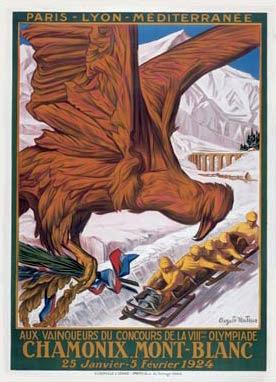
After the war, Chamonix was also growing apace in the twin categories of health center and ski station, particularly the latter. It developed the best lifts and the most expert terrain and was, in that sense, the country’s most prestigious ski village. Chamonix in particular and the French in general had acquired an infrastructure and the experience needed to host ever larger winter competitions—both accumulated beginning in the prewar governmental programs concerned with health, war and tourism. The climax of all this effort came in 1924 when Chamonix was chosen as the site of what became in retrospect authorized as the First Winter Olympic Games. It had not been easy. The Scandinavians had opposed joining the Olympics for years. Coubertin was never an advocate and in 1920 believed that “les sports d’hiver sont douteux,” (winter sports are doubtful) as he penciled in on one protocol. The IOC felt increasing pressure to award the 1924 Games to France, “victor and martyr” of World War I. CAF threw its weighty support behind the proposals for winter games. Meanwhile the Scandinavians sent a warning to the IOC that if skiing were included, they would not attend. At its meeting in Lausanne in 1922, the IOC decided that there would be Games under its patronage but they were not to be thought of as “Olympic” and “champions had no right to medals.” The Games, then, were to be considered as merely an extension of CAF’s International Sporting Weeks that had begun at Mont Genèvre in 1907. The Scandinavians did not approve of this but went along with the contract signed with Chamonix (Gérardmer and Superbagnières were mildly considered) on February 20, 1923 since they were assured that they would not be Olympic Games. “It is absolutely essential,” wrote Siegfrid Edström, the Swedish President of the IOC to the French representative Baron W. de Clary, “that the Winter Games do not take on the character of the Olympic Games,” but to characterize them as “international” would ensure Norwegian, Swedish and Finnish participation.” All parties involved kept this international, as opposed to Olympic, front while the Games were in preparation. The Winter Sports Week was “not an integral part of the Olympic Games,” confirmed Fratz-Reichel, the Secretary of the Committee overseeing the plans and installations at Chamonix. As the opening of the Games drew closer, the difference between an international sports week and a Winter Olympic Games became increasingly blurred, even in the Executive Committee of the IOC. In effect, France’s immense turn-of-the-20th century concern with the deteriorating health of its mountain villagers, its efforts to create a healthy population for military preparedness in the first instance, and a desire for profitable mountain tourism as a second priority led to a much grander concept. The mounting of ever more grand ski tournaments readied France in general and Chamonix in particular to produce what amounted to the First Winter Olympics, retrospectively granted that status by the IOC in 1925.

The uneasy beginnings of Winter Olympics at Chamonix continued to plague the Games in 1928. The Norwegian Ski Association voted 29 for participation, 27 against—hardly a vote of confidence for the Winter Olympics. Not one European had faith that the United States could pull off a successful ski meeting at Lake Placid in 1932. At the end of those ill-attended games, the Technical Committee of the FIS sent a stinging rebuke to Godfrey Dewey. In many ways it was remarkable—considering the politics of the 1930s—that the Winter Games survived the Nazi extravaganza at Garmisch-Partenkirchen in 1936. And then the Second World War put Olympic competition on hold for the duration.

Following the war, the Winter Games increasingly took on a powerful life of its own, particularly after it became fueled by television funding. It is now that huge international undertaking quadrennially riveting the attention of the world’s sports-minded.

The focus has changed drastically. Modern Winter Olympic commentators never hazard the thought that the Winter Olympics are put as a marvelous engine for producing a healthier world population or that these Games constitute fine physical conditioning for potential infantrymen. The theme of the Winter Games (and of the Summer Games as well) has become something altogether different, standing in as a benign substitute for war between nations, a sublimation of future Hiroshimas one hopes will never happen.

Today’s Winter Olympics is an exponentially-growing entity producing ever-larger spectacles for the world’s entertainment, achieving ever-greater complexity within its competitions and attracting ever-larger portions of the world’s attention during those weeks every four years when it is being held on the television screens of the world. In retrospect, it exhibits a wondrously paradoxical contrast to that long-ago series of modest French Alpine Club ski competitions from which those first Winter Games were born three generations ago.

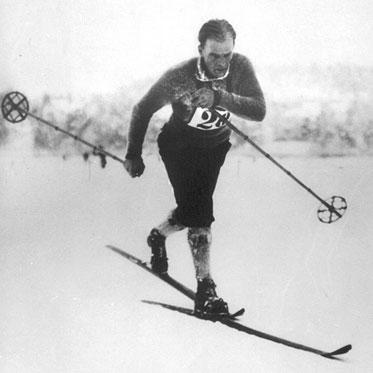
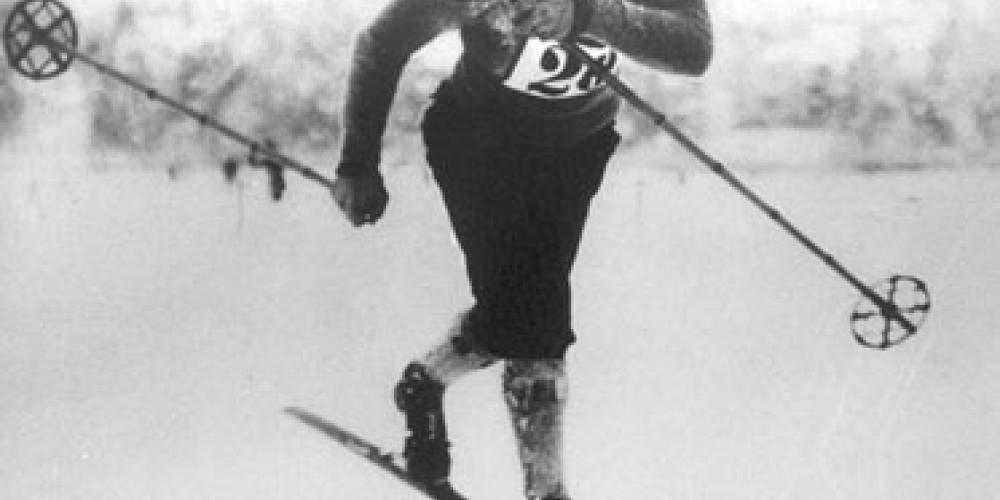
Thorleif Haug, Chamonix 1924
Category
Open to Public?
Off
Timestamp
  • Raclette: Slices of Raclette cheese are melted in small pans, then eaten with boiled potatoes, pickles and dried meats. 
  • Fondue Bourguignon, meat dipped in boiling butter and oil fat to cook, then in a Bearnaise sauce.
  • Tartiflette (aka Reblochonnade). Thinly sliced potatoes sautéed with bacon and onions, moistened with cream, laid over Reblochon cheese, then baked in oven.
  • Kasnoken (spaetzle with melted cheese.)
  • Farcement, a Savoyard dish. Potato cake with bacon, raisins, prunes.
  • Diots a la Braise. Sausage made up of pork and vegetables and cooked in embers of a wood fire. Served with fried polenta.
  • Civet de Chamois des Alpes. Marinated chunks of mountain goat meat, melted lard, carrots, onions, crème fraiche. Fried and then cooked in oven at low temperature.
  • Classic Apfel Strudel.
Category
Open to Public?
Off
Feature Image Media
Image
Timestamp

We, here at the national headquarters of the United States Ski Association and Hall of Fame officials, have long felt the need for a book which would contain an early history of our organization along with a record of the achievements of the people who have shaped our growth.

With the encouragement and help of the late Burton Boyum, past curator of the National Ski Hall of Fame; the late Harold Grinden, Chairman of the Hall of Fame; I have tried to fulfill this need.  Here you will find histories of the various divisions of the USSA, listings of past officers and directors, list of awards, honors and records, and sources of ski information.  It is our intention to issue a supplement each year to keep this material up to date.

We know that this book will help us tremendously in our day to day work here in the office.  Each day brings inquiries by phone and mail for some of the information you will find here.

We feel that the many hours spent compiling and editing this information will be worthwhile if it will also help ou and give you a better understanding of the persons and events that have shaped the history of skiing in the United States.

Attached is the full document in PDF form.  -- Gloria Chadwick, 1970. 

Feature Image
Category
Open to Public?
Off
Timestamp

Article by John Fry

The Beekley International Collection of Skiing Art & Literature,  contains 200 exquisite paintings and sculptures of skiers; 600 posters, some of which now auction for as much as $10,000; magazine covers dating back to the 19th century; unique etchings and lithographs; 2,400 ski pins and stamps; and one of the world’s largest libraries of ski books.

This colorful, impressive collection was long held privately in New Hartford, Connecticut by the late Mason Beekley, a wealthy entrepreneur and founder of the International Skiing History Association. Beekley, who died in 2001 at the age of 74, painstakingly and lovingly assembled ski books and graphics over a half-century of collecting.

Beekley, who first skied when he was a youngster at boarding school in his native Connecticut, began collecting when he was a student at Princeton. He started with a book, Skiing, which he bought for 25 cents at Smith College’s book store. After graduating from Princeton in 1949, he taught and coached skiing at an Eastern prep school, then joined his inventor-father’s hospital-services business. The pay wasn’t much. But even with little money, he was able to amass a voluminous library of ski books. He found them in used book stores and by scouring auctions. “I spent an average of less than $5 a book on my first thousand books,” he said in a magazine interview.

Beekley was a gregarious and convivial man. . .  and wildly optimistic. He habitually began each day by loudly and joyously singing Rogers and Hammerstein’s Oh What a Beautiful Morning, Oh What a Beautiful Day! He also happened to possess a bulldog persistence and a curious mind. When his family’s business turned flat in the late 1970s, Beekley looked to new ventures. He came to realize that doctors and radiologists needed a more reliable way to interpret x-rays, so he began to market tiny lead-containing patches that would stick on the patient’s skin. The markers would be visible after the x-ray pictures were developed, like locators on a map. They brought an immediate improvement in mammography. Today, a couple of million “Beekley Spots” are used monthly in x-ray rooms across North America.

With the business flourishing, Beekley now had serious money to fuel his collecting passion. He turned to oil paintings, early lithographs and prints. “I have only two criteria in buying,” he once confessed. “There must be a skier in the illustration, and I must like it.”

Cartons of books and magazines arrived at The Parsonage, his rambling 150-year-old, 12-room New England home on a hill above New Hartford, Conn. So great was the influx that his wife feared the second floor of the house would collapse under the weight, so in 1993 he built a 2,200-square-foot museum next door, naming it Ski Aerie.

With a museum to fill, his collecting took on an obsessive pace. Beekley began to show up at Christie’s and Swann Galleries poster auctions in London and New York. “On nearly every lot he wanted, Beekley’s paddle remained raised, driving out the competition,” reported an antiques journal of a 1999 poster auction.

If Beekley was not going to be there in person, he placed early bids that other buyers would be unlikely to top. In scarcely a half dozen years from 1993 through 1999, he acquired more than 600 posters from 17 countries—the earliest one dating back to 1890. “Mason Beekley virtually created the market in posters,” says Nicholas Lowry, president of New York’s Swann Galleries.

Two works purchased by Beekley dramatically portray skiing’s change over a hundred years —from utilitarian winter transport to entertaining wintertime diversion. In one of the earliest known American paintings of a skier—an 1873 oil by an artist known only as JHA—a weary farmer heads homeward on skis across his snow-covered pastures. What a contrast it presents to Hot Dog!—a wild portrayal of a 1977 freestyle skier made of glass and aluminum and painted with oils, acrylics and colored pencil by Ricky Bernstein, a Massachusetts artist known for his ironic, caustic commentaries on present-day lifestyles.

Beekley turned to oil paintings, early lithographs and prints. “I have only two criteria in buying,” he once confessed. “There must be a skier in the illustration, and I must like it.” He bought works by Churchill Ettinger, Paul Sample, Sheldon Pennoyer and by the prolific sports artist Leroy Nieman. He loved the big mountain canvases of Eric Sloane, with their formidable cloud formations. A favorite Sloane subject was Tuckerman Ravine at Mt. Washington during its heyday as the Northeast’s spring skiing mecca.

Pop art was a favorite of the Connecticut collector. He acquired the original art of scantily clad pinup girls wearing ski hats or holding a pair of ski poles. A painting done for a popular science magazine depicts a skiing soldier of the future propelled across snow by a giant motorized fan attached to his back. There are ads that used skiing to sell Camel cigarettes and Edsel cars. Beekley purchased a pen-and-ink color calendar illustration by Laurent de Brunhoff of Babar, one of the most famous figures in children’s literature. The little elephant is performing a jump on skis for Queen Celeste.

Beekley began acquiring ski prints 50 years ago, and they span every variety of the printer’s art, from silk-screens to linocuts. Some 400 images by photographers include the work of Ansel Adams, Leni Riefenstahl, Ray Atkeson, Toni Frissel and Winston Pote. During a 1990 Aspen ski vacation, he met American skiing icon Dick Durrance. Both Durrance and his wife Miggs were outstanding photographers, and Beekley added their work to his collection. 

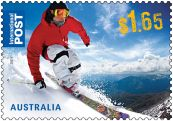
While many skiers collect pins, Beekley’s collection is staggering in size. An array of 2,400 ski pins from 52 countries are displayed in frame-mounted wall hangings, acquired from the Toronto collector Bruce Carnall. He collected ski postage stamps. He bought the collection of former SKI Magazine editor John Henry Auran, giving him 585 postage stamps from 53 countries bearing images of skiers and skiing. “To tell you the truth,” he confessed to Auran, “I’m more interested in the art on stamps than the philately.”

The Beekley library contains 2,110 books and as many booklets and periodicals, from 25 countries. There are English and Danish editions of Fridtjof Nansen’s account of his 1888 crossing of Greenland on skis, the book that first made the world aware of what had been a little known Scandinavian sport. There is a copy of Austrian Matthias Zdarsky’s 1896 Lilienfelder Skilauf-Teknik, the earliest influential book of downhill ski technique. Another, by Vivien Caulfeild – How to Ski, and How Not to, published in 1911-- is one of the first ski instruction books written in the English language. There are books by virtually all of the sport’s creators -- Arnold Lunn, Hannes Schneider, Emile Allais, Otto Lang and the legendary Otto Schniebs, author of the famous quip, “Skiing is not a sport, it is a lifestyle.”

Beekley became concerned about finding a permanent home for his collection in 1998, when he was diagnosed with cancer. He initially focused on Aspen, but the community there was not prepared to commit to the expense of creating a building to house the works, and of a curator and security needed to permit public viewing. Other resorts knew of the collection’s potential homelessness, but none was willing to make the necessary investment. Meanwhile, Beekley’s health worsened. He saw chaos lying ahead -- the dissolution of his beloved collection of art and books. In 2001, when filmmaker Warren Miller became aware of Beekley’s difficulties, he contacted Mammoth Mountain President Rusty Gregory who, with the support of the resort’s founder, Dave McCoy, acted swiftly and decisively to create a museum.

The doors to the Collection at Mammoth Lakes unfortunately closed in 2011. Presently warehoused in Denver, the Collection is seeking a new home. 

See sample images at the Beekley Collection website.


Category
Open to Public?
Off
Feature Image Media
Image
Timestamp

Wherever there’s a sports hall of fame, controversy inevitably arises about who is elected and how. The U.S. Ski and Snowboard Hall ofFame (USSHoF) is no exception. The first criticism of the nomination and election process appeared in SKI Magazine only a dozen years after the Ski Hall of Fame was created in 1956. The Hall came under fire again in the 1990s for honoring developers rather than U.S. Ski Team athletes.

Its latest critic is John Stifter, the editor of Powder Magazine, who believes the opposite: that the highly organized, well-funded U.S. Ski Team dominates selection.  Stifter posted on his magazine’s Website a critique of the USSHoF after he attended its annual induction event in Seattle in April 2012. In his commentary, he noted the high number of deceased skiers on the Honor Roll, challenged its location in Ishpeming, Michigan, and questioned, from his research, the apparent priority of former U.S. Ski Team members over thehigh-profile skiers who are the heroes for today’s skiers and snowboarders. He noted the existence of a proposed new ActionSports Hall of Fame, encouraging it to honor skiers and snowboarders whom he believes are ignored or neglected by USSHoF.

Here’s a digest of what Stifter wrote:

While in Seattle in April 2012 to honor K2 Skis’ 50th anniversary and the induction of new honored members into the U.S. Ski and Snowboard Hall of Fame, I was, ironically, embarrassed by the sport of skiing. Blue hairs—-some humble and insightful, most not so much—-glad-handed one another as if they were at a political party fundraiser.

I sat in the cold, dark parking garage that was supposed to serve asa banquet hall for the 2012 induction ceremony, musing to myself what a joke it all was. It seemed as if inductees were either a former U.S. Ski Teamer or someone too old toeven accept their induction. What sport were we supposedly honoring? Because it sure as hell didn’t reflect the one I revere.

Aside from reading about Glen Plake’s induction in 2010, I had hardly heard of the U.S. Ski and Snowboard Hall of Fame, save for a failed attempt to visit the Hall in Ishpeming, Michigan. Yes, rather than Little Cottonwood Canyon or Jackson Hole or even Colorado’s Summit County, the U.S. Ski and Snowboard Hall of Fame exists on the skiing hotbed of the Upper Peninsula (eh!). Fuming that this hall of fame “represents” our sport, I did some research and discovered these sad facts. Of the 385 members, seven out of ten are deceased. Shane Mc-Conkey and Glen Plake are the only non-U.S. Ski Team members inducted for their ski accomplishments from the last 25 years. Sorry, Daron Rahlves, you don’t count in this case. Non-U.S. Ski Teamers like Monty Atwater, Stein Eriksen, Dick Barrymore, and Warren Miller are members, but not Wayne Wong, Schmidt, Stump, Hattrup, Fisher, Morrison, Kreitler or Pollard. Excluded is a majority of the most nfluential skiers to ever buckle their boots and, arguably, kept the sport relevant and cool.

Despite it being the Ski and Snowboard Hall of Fame, only two snowboarders—Jake and Donna Burton Carpenter—have been elected. A U.S. Ski and Snowboard Hall of Fame official told me that Craig Kelly is being considered. [Editor’s note: In early November 2012, the USSHoF announced its Class of 2012, which includes Wayne Wong and Craig Kelly; see page 11 of the Nov-Dec issue of Skiing Heritage. The selection process was well underway when Stifter contacted the Hall last summer, and was not influenced by his commentary.]

Fortunately, a more contemporary hall of fame is about to launch. The Action Sports Hall of Fame opened online on May 1, 2012. At Xhall.org you can view, nominate, and vote for surfers, skaters, snowboarders, moto and bike riders, and, of course, skiers. Its emphasis is on what’s happened the last 25 years. Action Sports Hall of Fame has the public nominate and then vote for athletes. On the first few pages alone, skiers can vote for Andrew McLean, Anselme Baud, Arne Backstrom, Bill Briggs, Bode Miller, Brad Holmes, and Candide Thovex—quite the age, ski discipline, and nationality range.

If the new Hall continues on its path toward legitimacy, it will require a physical space. Its founder Matt Savage has been in talks with San Diego’s Hall of Champions located in the storied Balboa Park. Plans call for interactive exhibits, like a device that would allow skiers to feel the thrill of tossing a cork 720. —John Stifter (Editor, Powder Magazine)

Heroes of all stripes

A response from the U.S. Ski and Snowboard Hall Of Fame

Contrary to Mr. Stifter’s comments, the U.S. Ski and Snowboard Hall of Fame (USSHoF) does recognize a broad spectrum of ski sports, including snowboarding. Hisvstatement that USSHoF has elected only two non-U.S. Ski Team members in the past 25 years is false. All kinds of inventors, resort pioneers, ski mountaineers and others have been elected who were never members of the Ski Team.

The USSHoF is located in Ishpeming, Michigan, the center of skiing in the late 19th century when ski jumping was king. It was here that the National Ski Association of America was founded in 1905. It is organized skiing’s birthplace, a fact noted in the print program he received at the induction in Seattle. Analogically, you might want to ask yourself why football’s hall of fame is in Canton, Ohio, and baseball’s hall is in the upstate New York backwater of Cooperstown. The reasons are historical, as they are with skiing.

Regarding Stifter’s criticism of the high percentage of deceased individuals on the Honor Roll, the Ski Hall of Fame was established in 1956 and has been nationally recognizing the sport’s heroes for more than 50 years. It should hardly be surprising that many honorees have passed on. The same could be said for anysports hall of fame that has operated for such a length of time. And like most sports halls of fame, USSHoF typically waits until a skier or snowboarder has completed most of his or her career before being honored.

One of those deceased skiers is one we mutually admire, the late Shane McConkey. Glen Plake was concerned when he learned of his election to the Ski Hall of Fame, initially believing that we thought his career was over. He changed his mind after being told that the rock band Metallica had recentlybeen elected to the Rock and Roll Hall of Fame. Plake is one of the most enthusiastic inductees of the Class of 2010.

Regarding the Action Sports Hall of Fame, do you honestly think our top athletes will get more and better recognition in a museum that celebrates high-profile athletes, like the stars of NASCAR? In doing his research, Stifter should have taken the time to examine the rules for nominating and selecting people to the Hall of Fame, posted at our Website, www.skihall.com. There he would see that the door is wide open for the skiers whom he reveres. USSHoF has recognized extreme skiers Bill Briggs and Doug Coombs. Dahren Rahlves is in the Hall of Fame, contrary to what Stifter writes. The nomination process is open to anyone, and I would encourage Stifter and his readers to take the time to participate, instead of sitting back and complaining about who hnot been recognized. —Tom West (President, U.S. Ski and Snowboard Hall of Fame)

The National Hall of Fame is not tied to a building

BY JOHN FRY

Mr. Stifter is either conflating or confusing two matters: a hall of fame and the qualities defined for admission to it; and the operation of a museum with challenges of building cost, physical location and attracting visitors. In this conflation or confusion, Stifter is not alone. Many people see the Hall of Fame as inseparable from the building in Ishpeming on Michigan’s northern peninsula, where the pictures and biographies of 382 Hall of Famers are displayed. Their choice and election, however, is separable.

The main process of choosing and electing new Hall of Famers happens independently. The process would exist even if there were no national ski museum. Each year, new honored members are on display at a fundraising dinner attended by more than 400 people—next year at Vail, this year in Seattle, the previous year at Sun Valley.

Meanwhile, I do not know Stifter, but he seems, by his own description, a shy sort—the kind of guy who prefers to stay in a dark corner at a boisterous cocktail party. Too bad for him. In Seattle he could have talked with Olympic gold medalist Phil Mahre; or met one of America’s greatest jumpers, Gus Raaum; or questioned freestyle pioneers Doug Pfeiffer and John Clendenin, making him a better-informed editor of his magazine.

There’s still a lot that could improve the U.S. Ski and Snowboard Hall of Fame. When I was inducted in 1995, I annoyed the ski establishment by speaking and writing about history-makers who’d been ignored in the Ski Hall’s selection process. I cited, for example, plastic boot inventor Bob Lange and adventure skier Ned Gillette, neither of whom had yet been honored. But as an editor I wasn’t on the same track as Stifter, who seems to want a hall of fame of instant celebrity, primarily honoring people who recently jumped off cliffs and performed stunning feats while riding avalanches in the backcountry. Stifter is correct in noting that USSHoF has done little to honorsnowboarders. The sport was barely 25 years old at the time, and personally, I didn’t favor in 2007 the Ski Hall’s change of name to include snowboarding. The sport famously has its own culture, starting with its original, vehement opposition to coming under the governance of the International Ski Federation (FIS). That the Burton Carpenters, husband and wife, were the sport’s first inductees suggested to me an idea originating with and imposed by the honorees, not one inspired by the Ski Hall.

In Stifter’s hall of fame, 70 percent of its members—like Andrea Mead Lawrence and Howard Head—would be de-listed because they’re

dead. As for selection, by his process, if Stifter were running the Baseball Hall of Fame, active stars like Alex Rodriguez or Justin Verlander would already be in it. So would Barry Bonds, and so would Pete Rose, now barred from baseball, who would have been elected when he was an active player, and the disgrace of his wagering had not yet unfolded. Not for nothing, do I continually press for the Ski Hall of Fame, like football, basketball and hockey, not to elect people whose active careers are still in process.

As for physical ski halls of fame and museums, they are starved for money and attendance. The Canadian Ski Museum is shut down. The Beekley International Collection of Art and Literature is currently warehoused. When Powder Magazine founding editor Jake Moe recently visited the Norwegian Ski Museum at Morgedal, he was one of only 12 visitors in a week. Stifter’s putative hall-of-famers would  be celebrated in a part of southern California where snow doesn’t exist. —John Fry 

 
Category
Open to Public?
Off
Feature Image Media
Image
Timestamp

in 2011 the Australian post office issued three skiing and snowboarding stamps honoring the 150th anniversary of skiing in the Snowy Mountains.

The 1859 Australian gold rush drew thousands of miners and would-be miners to New South Wales. They came from all over the world, including a number of Norwegians, some fresh from the goldfields ofCalifornia, where they had some experience with early longboard racing. It’s estimated that from April to September of 1860, some 3,000 people wintered atAustralia’s Kiandra mining camp.

They didn’t hunker down in their canvas tents . They made skis. Newspaper reports published during the winter of 1861 describe young folks climbing the local hill and descending at the speed of railroad trains. By 1896 there was documentary evidence of a Kiandra Snow Shoe Club having been in existence since at least the early 1880s, and photos show single-stick downhillers blasting into town.

Kiandra is now a ghost town, but the club, now named the Kiandra Pioneer Ski Club, is still active in Perisher Valley. Local lore says it was organized in mid-1861 (during the southern-hemisphere winter, of course). While no one can prove that, the post office has accepted the year as the founding date for Australian skiing. It’s a legitimate historical question, because 1861 would predate the races organized by a club in Trysil, Norway, in January 1862. The first ski clubs for which we have newspaper accounts, in Onion Valley and LaPorte, Calif., were reported in January, 1861.

The Skiing Australia stamps, including a first day cover, were designed by John White, of the Australia Post Design Studio. They are available online at www.auspost.com.au/stamps while stocks last. —Seth Masia

Category