WOMEN SKI JUMPERS FIGHT FOR GENDER EQUALITY
Early women ski jumpers
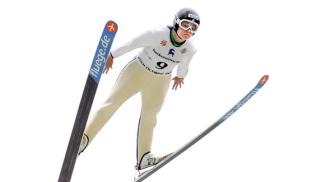
License to Jump! A Story of Women’s Ski Jumping, Editors Marit Stub Nybelius & Annetter R. Hofmann (2015), and Time Magazine, in an 2009 article “Why Can’t Women Ski Jump,” and other sources, describe the long fight to get women’s ski jumping accepted as an Olympic sport. Salt Lake City’s Lindsey Van (photo above, courtesy US Ski Team) was one of the athletes who led the effort.
Ladies ski jumping began when they went skiing for the first time in Norway. In 1862, Ingrid Vestby made the first woman’s recorded jump. 10-year-old Ragna Pettersen jumped 12 meters in 1897. In the late1800s, Asker became famous for ladies competitions. Hilda Stang set three women’s distance records in the early1900s (14.5, 21& 22 meters). In 1914, at Trondheim, 28 women participated in a jumping competition. However, Norwegian girls faced discrimination and had to resort to trickery - dressing as boys.
Other countries had pioneer women jumpers. In 1911, Lady Hocking jumped 7 meters at the British championships in Switzerland. Kitzbühel’s Countess Paula vonLamberg jumped 22 meters After WWI, women’s ski jumping expanded. Mademoiselle Engelbrecht from Munich became famous. In 1926, Norway’s Olga Balstad-Eggen set a women’s distance record (26 meters). Canada’s Isabelle Coursier excelled in the 1920s, setting a distance record in 1928 (32 meters).
In the Northwest, “girl ski jumpers” were important participants in early tournaments.
Norwegian immigrants brought ski jumping to this country, many settling in the Northwest. According to Harold Anson, in Jumping Through Time,
Norwegians brought to their new country a passion for skiing. They organized ski competitions to strengthen their ethnic ties...It has been said that wherever two or three Norwegians gathered together, they constructed a jump and held competitions. This was never so true than in the Pacific Northwest...
In February 1916, after Seattle received a record 38-inches of snow, its Norwegian “expert ski men” held a ski jumping exhibition to demonstrate “the popular Scandinavian sport.” Queen Anne Hill’s steepest street became a ski jump - a four-block slide with a 45 degree incline and a take-off at the bottom, where jumpers hurled “themselves in the air landing many feet beyond...” The event included ten “crack jumpers” and a “ladies skiing event.” Reidar Gjolme (1902 Holmenkollen winner) had the longest jump. Seattle Times, February 6, 1916.
Based on this success, in February 1917, the Norwegian community held a ski jumping tournament at Scenic Hot Springs, west of the railroad tunnel through Stevens Pass. Twenty men entered, “many with championship records,” and a “[k]een rivalry between the fair sex...is anticipated.” Reider Gjolme won the tournament, but its surprise sensation was Olga Bolstad, a 20-year-old recently arrived from Norway. She borrowed skis and won the women’s event, just missing “taking first honors” in the men’s event, where she received honorable mention. “Although an unknown when she arrived, she speedily became the most talked-of person in the tourney, owing to her sensational jumping.” Seattle Times, February 4, 1917; Tacoma News Tribune, July 22, 1917.
Between 1917 and 1923, the Norwegian community held “an event unprecedented in America... a midsummer ski tournament” at Paradise Valley on Mount Rainier, which at 5,400 feet, “often held snow into July....” The tournaments grew in popularity every year, attracted the region’s best jumpers, and women played an important role.
The first tournament held on July 29, 1917, attracted 50 spectators and was won by Olga Bolstad, “the most sensational lady ski-jumper in the Northwest.” Olga received “first prize over a field of men contestants.” Called “champion of the Pacific coast on skis...[h]er lightness and grace made her a favorite with all, and she seemed to skim through the air like a bird...” Tacoma News Tribune, July 29, 1917.
The 1918 tournament attracted 17 jumpers and 350 spectators. Olga, the crowd favorite, was “one of the cleverest skiers in this country, and has performed feats in Norway that rank her high among Scandinavian manipulators of the ski.” However, three men outmatched Olga with “their greater strength for length of jump.” Tacoma’s Sigurd Johnson won. Olga finished fourth, but impressed the crowd.
H. Nelson and Miss Bolstad won the plaudits of the gallery, both making beautiful runs
of exceptional length and with perfect poise. Miss Bolstad was easily a favorite with the spectators, but she is a young woman of slight build and was therefore considerable handicapped against a field of skilled men jumpers. For nerve and grace and general expertness, however, no other contestant...deserved greater laurels than she.
Seattle Times, June 27 & July 8, 1918.
The 1919 tournament was “similar in every detail to that practiced in Norway,” where summer tournaments are held at Finse, a stop on the Bergen to Oslo railroad line. “Mount Rainier is the only place in the United States where a ski contest can be held during the summer.” The tournament attracted 500 spectators and “the best ski-running talent,” many “capable of returning to Norway... and putting up the stiffest fight for the honors.” Olga Bolstad “stands high among the ski runners of the Northwest.” Sigurd Johnson won the tournament with a 100-foot jump. Olga won a special cup for “a perfect jump, with perfect landing, at a distance of 64 feet.” Seattle Times, June 30, 1919.
Tragically, Olga Bolstad Eggen (who recently married) died in childbirth in August 1919. To add to the historic confusion, Norway’s Olga Balsted Eggen was well-known in the 1920s, setting a women’s distance record in 1926.
The 1922 tournament offered two days of exhibition jumping and an international ski jumping contest on the third. Canada’s Revelstoke Ski Club sent five of its best competitors, including Nels Nelsen (Canadian National Champion) and his brother 17-year old Ivind Nilson (1922 Boy's World Champion). National Champion Lars Haugen, from Steamboat Springs, also entered. There was a gliding contest with 25 Norwegian women and girls, and a five-mile cross-country race. Ivind Nilson won with a leap of 86 feet. The cross-country race was won by 51-year old Chris Bakken (former champion of Norway). Seattle’s Aulaug Friele won first prize in the women’s gliding contest. Seattle Times, July 1 & 4, 1922; Seattle P.I., July 5, 1922.
The 1923 tournament drew 1,500 spectators and 20 ski stars (“the most daring ski jumpers of the United States and Canada”), including Nels Nelson who set a world distance record in February 1923 (234 feet), and Canadian star Isabelle Coursier.
Isabel Coursier (known as Revelstoke’s “glider girl”) started skiing at eight, and at 15 went off Revelstoke’s “Suicide Hill.” In 1922, at age 16, Isabel jumped 84 feet, setting a women’s world distance record. Until then, women jumped holding the hand of a man. Isabel was the first to jump without the support of a male escort.
The 1923 tournament featured females who were “rapidly coming to the front as daring jumpers:” Isabelle Coursier (“a pretty 16-year old French-Canadian society girl who was feminine champion of the world”); Seattle’s Harriet Hanson (who “made many thrilling winter jumps near Scenic Hot Springs”); and Seattle’s Alma Graff. TNT, July 2, 1923.
17-year-old Ivind Nilson won with a record jump of 124 feet. Isabel Coursier “won the first place in the girls’classic on a jump of seventy-eight feet,” receiving “a great ovation and a special trophy.” Chris Bakken won his second cross-country race. “The women’s showing was considered exceptional.” Harriett Hanson won the annual ski race for girls, making the course in 27 minutes 16 seconds,” and Elsa Graff finished eighth. Seattle P.I., June 10, July 4 & 5, 1923.
No more mid-summer tournaments were held on Mt. Rainier, but they began Washington’s role as a national center of ski jumping that lasted until 1978.
Female jumpers could compete in other Washington tournaments. Leavenworth’s 1931 tournament had five jumping classes for men and one for women. An event picture says, “Female Competitors in the third annual ski tournament, Leavenworth, Washington.”
Seattle Ski Club women competed in club tournaments. The Seattle Times of February 19, 1931 showed three women holding jumping skis, “casting a critical eye at the Snoqualmie Pass ski trajectory... and finding it excellent.” The headline said, “Brushing Up Their Technique, They’ll Take the Big Jump Soon.”
Norwegian Johanna Kolstad, known as “Queen of Skis,” toured the U.S. between 1933 and 1938, after setting women’s world distance records in Norway in 1931 (40 meters) and 1932 (62 meters).
In 1932, two 19-year-old “Norway ski girls,” Johanna Kolstad and Hilda Baskerud, competed in a jumping tournament in Olso, where they performed brilliantly and “placed in the final standings...But the shock to Ski Officialdom was too much. They were barred from later competition with their masculine rivals....” In October 1932, they were invited to perform in the US by Chicago’s Norge Ski Club. At the Norge tournament, Johanna made exhibition jumps of 125, 136 and 128 feet. The Pacific Northwestern Ski Association invited Kolstad and Baskerud to appear at its 1933 Pacific Northwest Championships. “Girl ski jumpers, even in Norway, are very rare. It’s particularly a male sport, and a dangerous one.” Seattle Times, January 1 &15, 1933.
Kolstad performed an exhibition jump on Salt Lake’s Ecker Hill with the famous ski jumper Alf Engen, and was the headliner at the 1933 Northwest Championship tournament that included “girl’s and women’s gliding...Male skiers step aside for the fairer sex.” Seattle’s Ole Tverdal won the tournament, but Kolstad, the “Norwegian girl skier, made trim jumps of 118 feet in an exhibition event.” Seattle Times, March 7 & 13, 1933.
At the Cascade Ski Club’s tournament on Oregon’s Mt. Hood, Johanna performed exhibition jumps of 131 and 130 feet. In April, she entered the tournament at Dunsmuir, California on Mt. Shasta, leaped 152 feet, and tied Willie Straughour for first place.
Between 1933 and 1938, Johanna toured North America, jumping in many tournaments. In 1938, she leaped 72 meters at Berlin, N.H, setting a women’s distance record. In 1940, Kolstad won her last competition at a Ladies Cup at Midtstubakken in Oslo with a jump of 70 meters, but never got to perform on Oslo’s Holmenkollen jumping hill.
In the late 1920s and early 1930s, women were allowed to jump at Winter Carnivals at Genesee, Colorado, although on smaller hills than men. “Girl-jumpers” performed jumps at indoor-ski shows in the late 1930s in New York, Boston and Seattle. In spite of the success of these athletes, women were not allowed to jump in the Olympics because it was thought their bodies could not handle the sport.
WOMEN SKI JUMPERS’ FIGHT TO COMPETE AT THE OLYMPICS
In spite of the success of women ski jumpers in the early days, their attempts to participate in formal ski jumping events stagnated until 1972, when Trondheim’s Anita Wold jumped 80 meters in Meldal, Norway, and 97.5 meters in Sapporo, Japan in 1976. In 1981, Finland’s Tiina Lehtola become the first woman to jump over 100 meters. In the early 1990s, Austrian Eva Ganster demonstrated women’s ability to jump at a high level.
In 1991, the International Olympics Committee (IOC) said all Olympic sports must be open to both genders. However, the rule did not apply to sports that already existed, including ski jumping, since it had been an Olympic event since the 1924 Winter Games. Starting with the 1998 Nagano Games, women jumpers petitioned to compete at Winter Olympics, but were denied by the IOC.
Utah Winter Sports Park outside Salt Lake City had been training young girls and boys to ski jump for years. On September 30, 1996, the famous Alf Engen (multiple winner of National Jumping and 4-Way Championships) visited the Park and met 10–year-old Lindsey Van. Alf told her “I feel you have the potential to one day become a great woman ski jumper.” Their meeting is memorialized in a picture -the old champion meets the future champion.
In 1997, women were first allowed to compete in the U.S. National Ski Jumping Championships. U.S.’s Karla Keck became the first women’s champion. In 1998, Lindsey Van won her first of 13 U.S. National Women’s Ski Jumping Championships, and competed in her first FIS event in 2002.
In 2003, Women's Ski Jumping USA was formed to provide funding and support for the U.S. Women's ski jumping team to prepare top women for national and international competition.
In 2004-2005, women jumpers began competing in the Continental Cup, organized by the International Ski Federation (FIS), the second level of international competition but women’s top international event at the time. Lindsey Van won eight Continental Cups.
In 2005, IOC President Gian Franco Kasper said women should not ski jump because it "seems not to be appropriate for ladies from a medical point of view." In 2006, the IOC refused to admit women jumpers into the 2010 Vancouver Olympics, and the U.S. Ski and Snowboard Association dropped support for the U.S. women's team, saying it could not afford to fund a non-Olympic event.
In 2009, women’s ski jumping began at the FIS Nordic World Championships in the Czech Republic. At least 30 women jumpers from 11 nations participated. Lindsey Van won, becoming the first women’s world champion.
In April 2009, Van and nine other female jumpers filed a lawsuit against the Vancouver Organizing Committee, asking British Columbia’s Supreme Court to find that excluding women’s ski jumping from the Olympics violated Canada’s ban on gender discrimination in its Charter of Rights and Freedoms. The Court held the IOC's decision was gender discrimination, but as an international organization, it was not required to obey Canada's laws.
In 2012, women competed for the first time in the World Cup on the normal-hill in Lillehammer, Norway. The first winner was U.S.’s Sarah Hendrickson. Sarah won the 2013 women’s Ski Jumping World Championship and dominated the World Cup, winning nine times.
On April 6, 2011, the IOC announced that women's ski jumping would be included in the 2014 Sochi Olympic Games. Women competed in the normal-hill event, although men competed in three events, including the large-hill and Nordic Combined. The normal-hill features a 90-meter jump, which was standard until 1964, when large-hill competition on a 120-meter jump was introduced at the Innsbruck Games. Germany’s Carina Vogt become the first women's Olympic ski jumping champion.
Lindsey Van led the 15 year quest for gender equality in ski jumping. When she retired, she had won the first women’s ski jumping World Championship in 2009, had 60 FIS podium finishes, and 16 national titles. She summarized competitor’s feeling for the sport - “You are up in the air and for a minute it’s as if you can fly. It’s a feeling like nothing else I’ve ever felt, and as soon as I land, I just want to go back to the top and do it again.”
It took years of lobbying and a lawsuit before the international ski fraternity allowed women to compete in ski jumping, traditionally a male dominated sport. Women’s normal-hill jumping has been a part of the Winter Olympic Games since 2014. Women first competed on the large-hill in the 2026 Cortina Games. Olga Bolstad, Isabelle Coursier and Johanna Kolstad and other women jumping pioneers would be proud.
Their next fight is to compete in the Nordic Combined (where an athlete ski jumps and races cross-country) at the 2030 Games, led byNordic Combined USA.
FIGHT FOR WOMEN TO COMPETE IN NORDIC COMBINED
Women are now fighting another battle - to compete in the Nordic Combined at the 2030 Winter Olympics, where an athlete ski jumps and races cross-country.
Men have competed in Nordic Combined since the 1924 Games. In 2022, the IOC refused to add women’s Nordic Combined to the 2026 Games, citing concerns about the sport’s readiness. Nordic Combined faces an existential threat. Rather than adding a women’s event, the IOC is considering removing the sport from the 2030 Winter Games. The IOC will conduct an evaluation of the sport, citing what is says is limited global participation and viewership, before making a decision, likely in June 2026.
On January 29, 2026, Nordic Combined USA and Nordic Combined News launched a campaign to urge the IOC to include women's Nordic Combined in the 2030 Games, and preserve the men's event, based on proven participation.
Since 2022, World Cup Nordic Combined events have nearly doubled, expanding to 17; viewership increased 25% last year; 12 nations competed at the 2025 World Championships, where the top four places were won by athletes from Japan, Austria, Norway and the US; and three US women finished in the top 10 at the January 2026 World Cup. More than 40 women compete in Nordic Combined at the World Cup level, with over 200 registered internationally.
Supporters are encouraged to sign this petition, https://c.org/Xn5njYN2hh,
and post their thoughts on social media and tag @nordiccombinedusa, using the hashtag #NOCO2030.
[1] John W. Lundin is a lawyer, historian and author. He is the author four award winning books, many magazine articles, and regular contributor to Skiing History. Ski Jumping in Washington State: a Nordic Tradition (2021) was the companion to two ski jumping exhibits John helped organize: “Sublime Sights: Ski Jumping in Nordic America,”at Seattle’s National Nordic Museum in 2021; and “Skiers in Flight: Sun Valley’s Ski Jumping Roots,” at the Regional History Museum in Ketchum, Idaho, in 2022. He won the 2023 Western Heritage Ski Prize from the Far West Ski Association for his multi-year “Work to Preserve Ski Jumping History, Expressing Norwegian Identity, and its Role in the Development of Skiing in America.”