Biathlon
By William D. Frank
The winter sport of biathlon combines rifle sharpshooting and cross-country skiing. The name itself is a neologism derived from the pentathlon of the ancient Greek Olympics. Although many well-meaning biathlon promoters in the decades following World War II tried to make the sport more palatable by suggesting prehistoric antecedents in hunting or this link to ancient Greece, such impressions are a red herring: throughout the twentieth century and into the twenty-first, the conflation of sport with warfare, especially at the Olympics, has informed the very concept of biathlon and its prior iteration, Military Patrol.
Since 1993, the International Biathlon Union (IBU) has administered biathlon competition worldwide in association with sixty-one national federations. Today, biathletes compete in eleven separate events, each with its own rules and regulations: the Individual; the Short Individual; the Sprint: the Super Sprint; the Pursuit; the Mass Start 30; the Mass Start 60; the women's 4 x 6km Relay; the men's 4 x 7.5 km Relay; the Mixed Relay; and the Single Mixed Relay. These intriguing competitions—devised for compelling television coverage—have attracted ever-increasing viewership, elevating biathlon into the ranks of the most popular winter spectator sports.
From its tenuous introduction to the Olympics in 1960 through its current status as one of the world’s premier winter events, the nations of Scandinavia and central Europe have monopolized biathlon, most significantly Norway, Sweden, France, Germany, Finland, and Russia. Why these nations in particular have dominated the sport for over half a century stems from the significance of nationalism, militarism, and winter warfare across the northern reaches of the Eurasian landmass during the late-nineteenth through twentieth centuries. During the Cold War, state-sponsored athletes of the Soviet Union, East Germany, and the eastern-bloc countries used biathlon as an international stage upon which to promote a purported communist superiority to the west. In the twenty-first century, this militarized notion of east-west confrontation still holds sway at biathlon venues: as a result of Russia’s rampant violation of IBUregulations through a decades-long, state-sponsored drug enhancement program and its invasion of Ukraine in 2022, athletes of the Russian Federation and Belarus have been banned from all IBU-sanctioned competitions, including the Olympics.
Early History
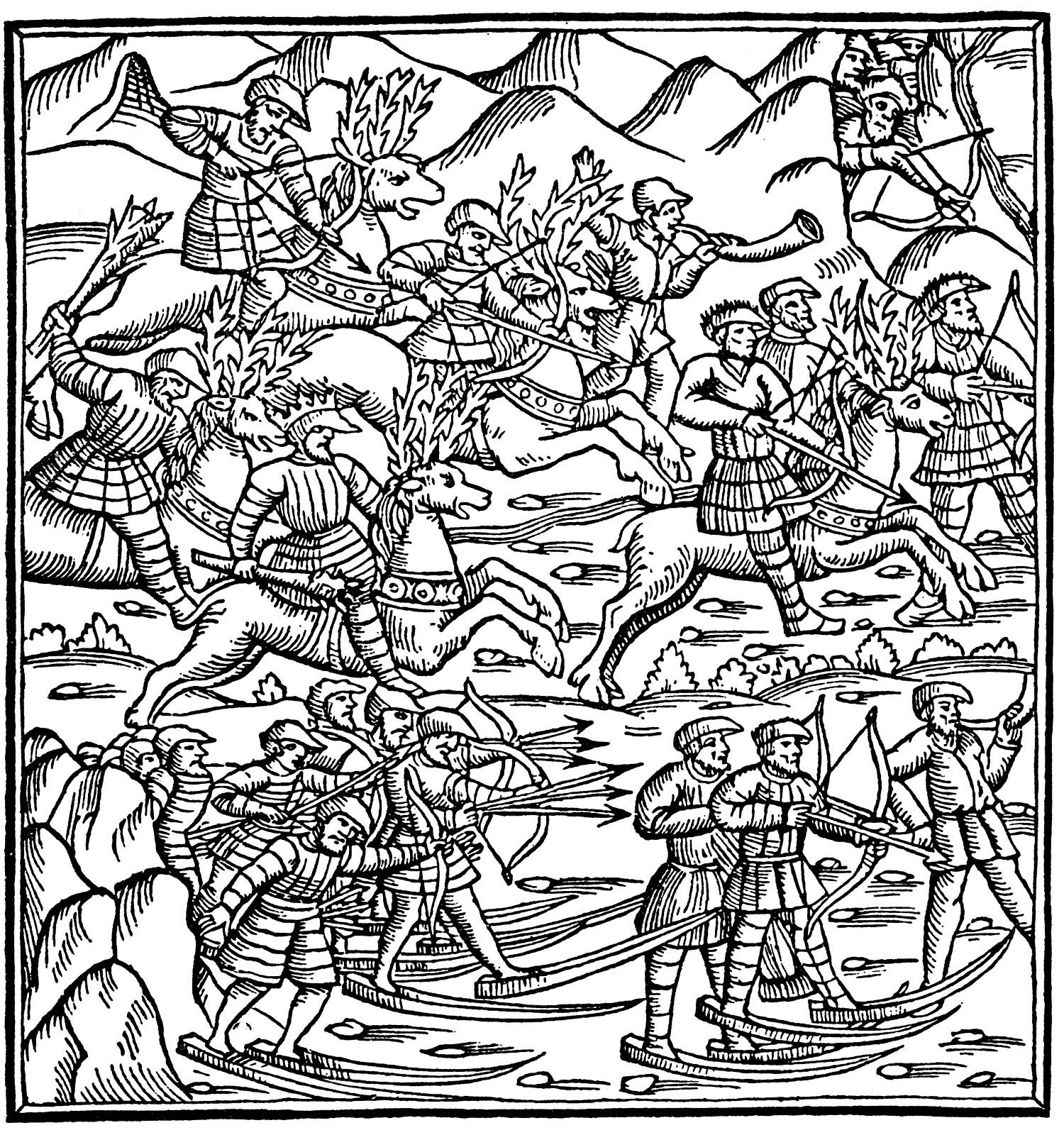 An illustration from Olaus Magnus’s 1555 edition of History of the Northern Peoples depicting Saxo Grammaticus’s twelfth-century story about Finns on skis and riding reindeer who attacked forces allied with Denmark in the ninth century. The Italian artist commissioned for this volume, published in Rome, obviously had never seen skis. These fanciful renditions of the ski (resembling a wooden clog with an enormously elongated toe) are visual interpretations of the term “snowshoe” (Schneeschuh in German, or soulier à neige in French), a common descriptor used throughout Europe until the early twentieth century. Source: https://commons.wikimedia.org/wiki/File:Olaus_Magnus_-_Tengild_and_his_men.jpg
Millennia-old rock carvings of skiers and wooden remnants of skis themselves substantiate prehistoric use of skis along the northern tier of the Eurasian landmass. The indigenous peoples required skis for the basics of life, travel, work, and hunting, because of the region’s harsh winter conditions. As territorial defense grew in importance on either side of the Arctic circle, nations whose climate produced snow during the winter months developed the use of skis for military purposes (Allen, 2007; Frank, 2013; Frank and Allen, 2019).

The first written reference to combat carried out on skis dates from the twelfth century. In his Gesta Danorum, Saxo Grammaticus documents how Finns "gliding on slick logs" attacked Ragnar Lodbrok and the Danes in a region Grammaticus knew as Bjarmia during the ninth century (Figure 1). By the middle of the sixteenth century, the militarization of skiing increased dramatically, due especially to the efforts of Sweden’s King Gustav Vasa. Vasa formed Scandinavia’s first mobile ski units in 1555, boasting in a letter that his troops could travel 185 kilometers in a single day. That year, during the Russo-Swedish War, five hundred Swedish and Finnish ski troops routed a far superior Russian army of five thousand in Finland at Joutselkä. A decade later, combined Swedish and Finnish skiers invaded the province of Ingria, at the time ruled by the Tsardom of Russia; as the Russians swept back in 1590, six hundred Finnish farmers on skis thwarted a potential invasion in Karelia. By the end of the decade, during Russia’s struggle over dynastic succession from 1598-1613 (the Time of Troubles), Mikhail Skopkin-Shuiskii led five divisions of skiers to Moscow against the cavalry of the Polish-Lithuanian Commonwealth at the siege of Troitse-Sergieva Lavra, one of the watershed events of the Polish-Muscovite War (Frank, 2013).

During the modern period (circa 1500), rapid improvement of firearms influenced changes in military strategy, which in turn led to incorporating skis for rapid troop movements during winter campaigns among nations occupying the Scandinavian Peninsula and northwestern Russia. By mid-eighteenth century, the Norwegian army had established regular ski detachments: as part of their training, troops began to engage in military ski competitions formulated by Schach Karl Rantzau in 1767 (Holm, 1965). In Russia, Catherine the Great’s commanders deployed ski troops near the Ural mountains during Pugachev's Rebellion. Throughout the Napoleonic Wars, these Russian ski troops served both in Aleksandr Suvarov’s campaign in the Alps and against Sweden’s own ski detachments during the Finnish War at the battles of Puhäjoki, Revolax, and Pulkkila (Frank, 2013; Frank and Allen, 2019). Russia’s annexation of the Grand Duchy of Finland during this period had significant impact on the Russian Civil War and the Winter War in the twentieth century.

The 1815 Treaty of Paris ended twelve years of European-wide warfare and, as a result, skiing gradually fell by the wayside in the military. By 1826, ski troops were no longer part of the army in either Sweden and Norway, now conjoined in an uneasy union. Nonetheless, patriotic Norwegians banded together in 1831 to revitalize skiing as a means of national self-defense; in 1861, the foundation of the Trysil Rifle and Ski Club further bolstered the military aspects of the sport by combining it with sharpshooting. (Frank, 2013; Stegan, 2019). These developments led to a revitalization of ski exercises in the Norwegian army, resulting in Oscar Wergeland’s publication of an up-to-date ski drill manual in 1863 and a history of military skiing in 1865; nonetheless, skis were only in common use among Norway’s general public in thinly-populated interior and northern regions outside of major towns. During the period between 1880 and Norwegian independence from Sweden in 1905, skiing revived all across Norway and provided the basis for a national sports identity known as idræt: “striving to perfect the individual soul as well as the body” and “develop the physical and moral strength of nations” (Allen, 1993; Allen, 2007).
This concept of idræt defined an amalgamation of sport, militarism, and nationalism already on the rise all across the globe by mid-nineteenth century. Most significantly, idræt informed the polar exploration of Fridtjof Nansen: his successful crossing of Greenland on skis in 1888-1889 and attempt to reach the North Pole from 1893 to 1896, propelled skiing into the consciousness of people all around the world. (Allen, 1993; Goksøyr, 2002; Allen, 2007; Frank, 2013).
Cavalry
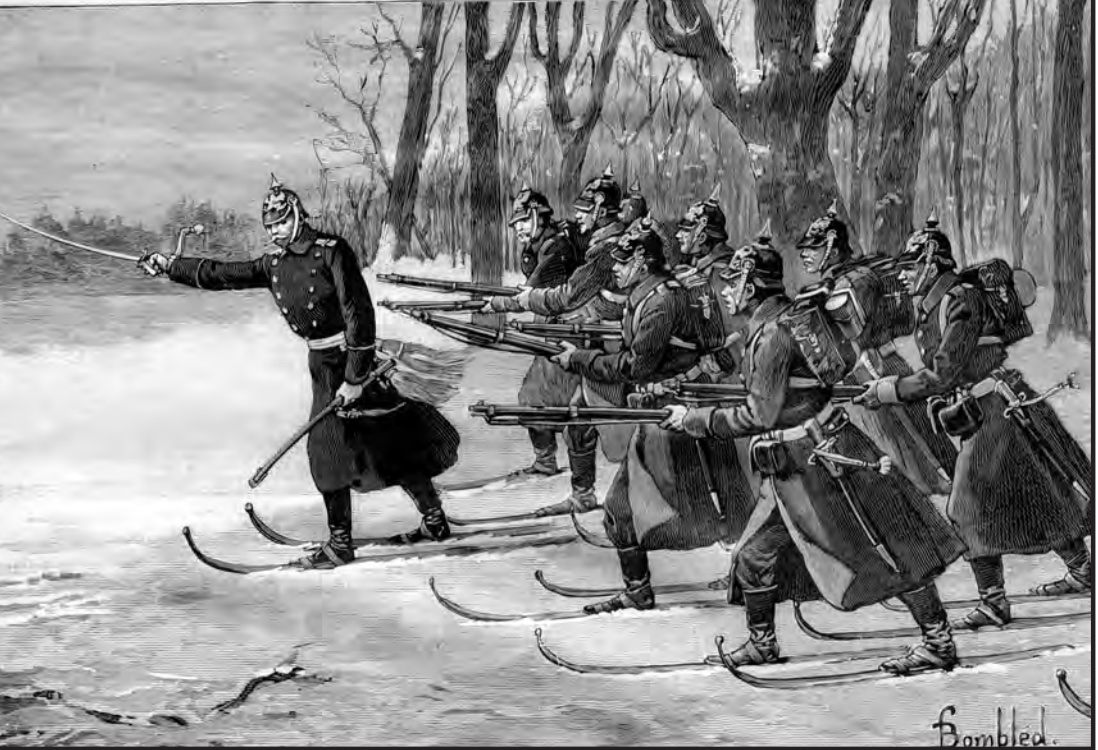 “Exercises du patin dans l’armée Allemande. Manœuvres d’un peloton du 82e hessois, aux environs de Goslar, dans le Hanovre [Ski exercises in the German army. Platoon maneuvers among the 82nd Hessians in the Goslar region of Hannover].” An imaginative 1892 rendering of German soldiers drilling in ski formations by Louis Bombled for the French magazine L’Illustration. At the time, the Norwegian term “ski” did not exist in French: patin [ice skate] or patin à neige [snow-skate] often served as a descriptor. This image captures the late-nineteenth century notion of a cavalry-style winter attack carried out on skis. Source: E. John B. Allen Collection. L’Illustration No. 2599 (17 Décembre 1892), 509.
Modifications in the tactical use of cavalry during the nineteenth century played a crucial role in the militarization of skiing in the twentieth. With antecedents stretching back to ancient warfare, European armies emphasized the frontal cavalry charge to “shock” and soften enemy positions for a follow-up by infantry. During the American Civil War, the wide-open countryside traversed by both Union and Confederate armies encouraged some cavalry units to morph into mounted infantry with the ability to undertake long-range raids behind enemy lines, reconnaissance, and screening. These lessons were not lost on European military theoreticians in the latter half of the century when the armed forces of most nations transformed cavalry regiments into mobile and stealthy field units. By the time of the Second Boer War, both the Boers and forces of the British Empire used horse-mounted riflemen rather than traditional saber-brandishing cavalry. Still, the romanticized notion of the cavalry charge lingered well into the twentieth century. (Hamilton, 1908; Stuart, 1971; Frank, 2011).
However, military maneuvers conducted on either side of the equator differed significantly from those carried out at higher latitudes. The disastrous invasion of Russia by Napoleon in 1812 and experiences nearly six decades later during the Franco-Prussian War indicated that in winter, mounted troops and horse-drawn vehicles faced limitations from heavy snowfall and icy roads. Recalling that French dragoons had been unable to pursue ski troops of Prussia’s Swedish ally during the Pomeranian War earlier in the century, some in the European press suggested that the Prussians would have had more success in winter combat against the irregular troops of the French army had they been equipped with skis in northern France. (Frank and Allen, 2019) (Figure 2). By the end of the century, Alpine nations were incorporating skiing and mountaineering into the military (Figure 3).
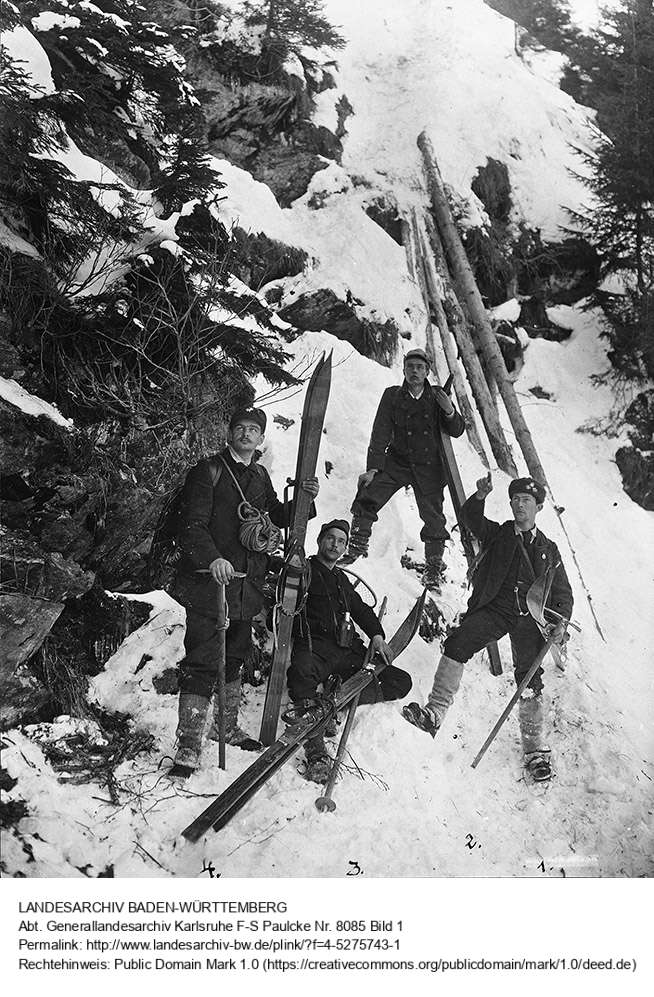
The first ski ascent of a 3,000-meter peak, 5 January 1896: (left to right) Victor de Beauclair, Peter Steinweg, Erwin Bauer, and Wilhelm Paulcke on the Oberalpstock. The following year, de Beauclair and Paulcke with three other companions completed the first ski traverse of the Bernese Oberland, generally acknowledged as the birth of ski mountaineering. A life-long ski enthusiast, Paulcke had an inadvertent yet profound impact on Military Patrol, biathlon, and competitive ski mountaineering, an optional sport at the 2026 Winter Olympics. Paulcke integrated the German Turnen concept of physical fitness as military preparation and team building into the organization of Germany’s first ski unit attached to the Eighth Jäger Battalion in 1898. During World War I, he served with German mountain troops in the Vosges and on the Italian Front as well as teaching skiing to the Ottoman army. During the inter-war years, he helped establish the German, Austrian, and Central European ski clubs while promoting the military value of skiing and mountaineering. Source: Landesarchiv Baden-Württenberg, Generallandesarchiv Karlsruhe, F-S Paulcke Nr. 8085
Russo-Japanese War
Concurrent with the Boer War in southern Africa, the Boxer Rebellion in northern China—a reaction to European meddling at the height of the age of imperialism—involved multi-national military intervention. Russia’s refusal to remove troops from Manchuria after the rebellion clashed with Japan’s own imperial ambitions in the region. Emboldened by a military alliance with Britain signed in 1902, the Japanese navy attacked and sank Russian battleships at Port Arthur in February 1904. The ensuing Russo-Japanese War proved to be an unmitigated disaster for the Russian Empire (Allen and Frank, 2020) and a game-changing success for Japan (Koda, 2005). Contemporary advancements employed during this war, such as large-caliber artillery, rapid-fire machine guns, railroad transportation, and communication via telephone and telegraph, altered warfare’s organization and tactics, foreshadowing the world-wide hostilities that followed one after another as the century progressed (Salik, 2020). In addition, the Russo-Japanese War was the first intercontinental confrontation to witness combat at high latitudes in the middle of winter which sparked further interest in Military Patrol and biathlon in the twentieth century.
This early twentieth-century clash of empires attracted world-wide attention. Some on-the-ground military observers considered Pavel Mishchenko’s raid behind Japanese lines at Yinkou from January 9-16, 1905 the most significant cavalry operation in the history of modern warfare in Europe, comparable to those undertaken during the American Civil War (German General Staff, 1910). Equally important were the severe winter conditions endured by both sides during the battle of Sandepu (or Heikoutai), January 25-29, 1905. Temperatures during the day peaked at -12 °C and at night dropped to -28 °C. Although there was only a thin layer of snow at the beginning of the battle, a blizzard on January 26-27 impeded a 25-kilometer night-march of the Japanese Fifth Division. Similar conditions hampered the winter-hardy Third Siberia Corps prior to the battle of Mukden at the end of February. All of these details were duly noted by international observers (Vaissiere, 1910; Gripenberg, 1910; von Tettau, 1911a; von Tettau, 1911b; German General Staff, 1913; Committee of Imperial Defense, 1920). Contemporary publications and photographic evidence from Russia indicate that okhotniki had skis on the ground there (Figure 4). Medics of the imperial army employed skis to transport the wounded across the snow and ice, a popular subject for illustrations in the European press during the war (Komets, 1904; Meshetich, 1906). On the other hand, these same Russian skiers became the object of ridicule for artists in Japan (Allen and Frank, 2020).
Conclusions drawn by the Russian General Staff in the war’s aftermath changed the imperial army’s perception of military tactics prior to World War I and led to major reform. Turn-of-the-century advances in the technology of ammunition and firearms made frontal attacks more lethal. This put a premium on an aggressive offense: seizing the initiative while both sides were still maneuvering into battle positions while engaging in flanking operations, rear attacks, and envelopment to displace the enemy from potential defensive deployments. In addition, carrying out a war far from major supply centers and in the harsh climate of the Russian Far East meant that geography, weather, and lines of communication would all factor into a successful campaign; and that training for combat in winter conditions would be an essential component of military preparation (Martynov, 1906; Menning, 1992; Frank and Allen, 2019). Although these notions played only a minor role in World War I they were crucial in the Russian Civil War, the Winter War, and the Soviet Union’s counteroffensive to Germany’s Operation Barbarossa during World War II (Frank, 2013).
Okhotniki
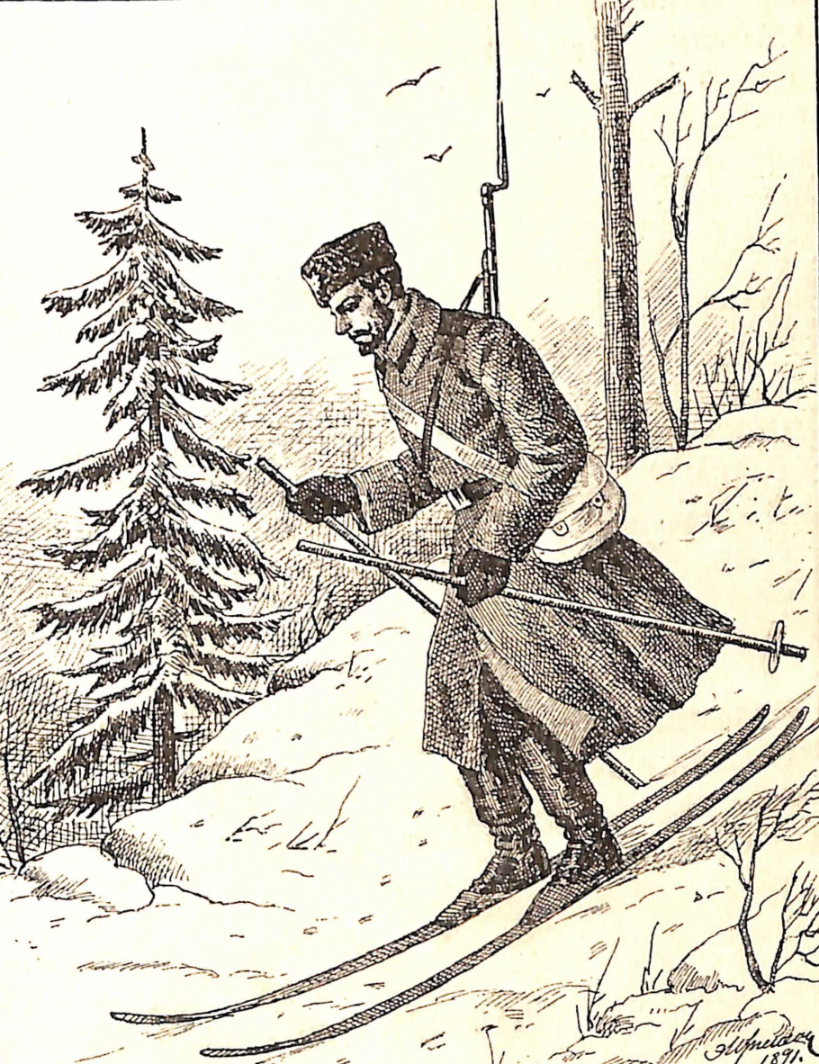
An okhotnik of the Russian Imperial Army circa 1891. From Vladimir N. Danilov and V. Polzikov, Uchebnik dlia soldata-okhotnika [Handbook for the Soldier-Okhotnik] (1896). Source: Courtesy New York Public Library
As the Norwegian revival of skiing spread across Europe’s northern tier in the late-nineteenth century, the Russian imperial army began to incorporate skiing into the training of troops posted to regions inKarelia, especially among soldiers from the Grand Duchy of Finlandwho filled the ranks of the Finnish Rifle Battalion (Frank, 2013; Frank and Allen, 2019). For service among all brigades comprising the Russian imperial army, the General Command established okhotnich'i komandy (hunter-scout teams) in 1886. Originally designated as only four men per group, by the time of the Russo-Japanese War these elite teams could consist of up to a dozen or more specially-trained okhotniki or “hunter-scouts” for each infantry and cavalry regiment. They were tasked with independent assignments that required resourcefulness and courage operating unsupported by the main army along enemy flanks and rear. These individuals were trained in reconnaissance, surveillance, communications, skiing, riding (both horse and bicycle), swimming, rapid multi-day travel, foraging and hunting, and all manner of specialized military skills (Figure 4) (Danilov and Polzikov, 1896; Meshetich, 1906). Despite the widely-despised Russification program imposed on Finland by Nicholas II and the dissolution of the Finnish Rifle Battalion in 1901, many Finns, already experts in a hunter-scout lifestyle including cross-country travel by foot, horse, or ski, volunteered to become okhotniki at the outbreak of the Russo-Japanese War (although several hundreds of ex-pat Finns living in the United States intended to join Japan in their war effort). Okhotniki served throughout the conflict in all aspects of scouting and skirmishing; they also undertook clandestine raids and sabotage targeting railroad lines, bridges, and other structures, prompting Japanese searchlight teams to operate nearly every night from defensive positions to thwart them. After the Battle of Mukden, during which intense Japanese artillery barrages increased the distance between battlelines, the Russian imperial army blended the okhotnich’i komandy reconnaissance model with cavalry to form 100-horse konno-okhotnich’i komandy attached to each infantry regiment for long-range scouting (Taburin, 1904; Talin, 1904; Girs, 1906; Meshetich, 1906; Toepfer, 1910; Committee of Imperial Defense, 1912; Sytin, 1913; Sytin, 1914). Although the introduction of horse-mounted hunter-scouts came too late to help defeat Japan, the concept proved beneficial for the Bolsheviks during the Russian Civil War.
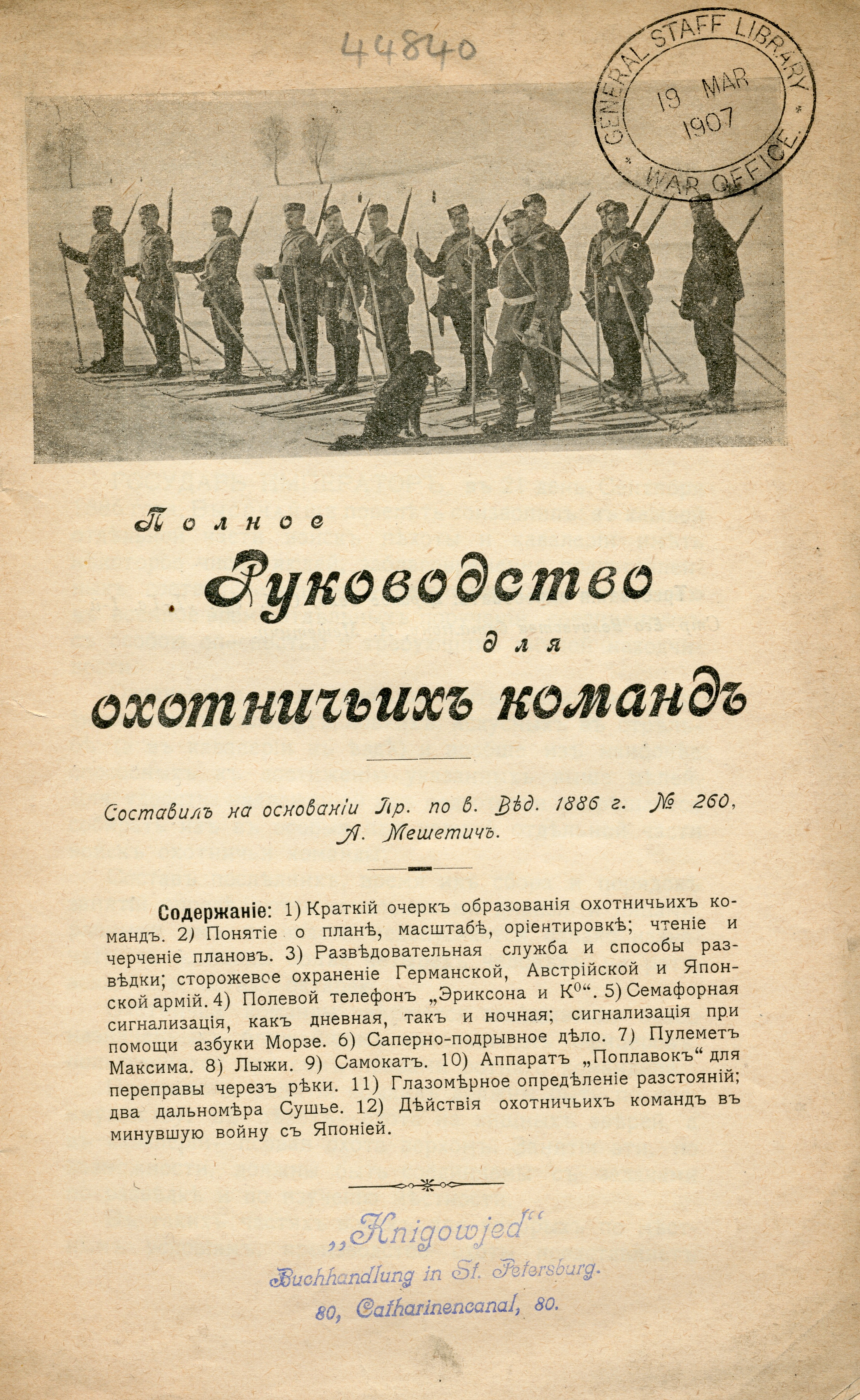 Title page of A. Meshetich, Polnoe Rukovodstvo dlia okhotnich’ikh komand [Complete Handbook for Hunter-Scout Teams](1906). The double placement of an image of skiers on both the title page and cover of this handbook, published immediately after the end of the Russo-Japanese War, indicates the importance of skiing for okhotniki training: it is the only photograph included among sixty-five hand-drawn or linotype illustrations, maps, charts, and tables in the 104-page booklet. Source: University of Calgary Archives and Special Collections, Calgary, Alberta, CAN
The okhotniki provided a template six years after the end of the Russo-Japanese War for ski units that could operate in place of cavalry in winter, a notion proposed by Finland’s Carl Bror Emil Aejmelaeus-Ãimä (Figure 7) in a ski treatise written for the Russian imperial army. He details essential techniques of skiing along with a few lessons learned from okhotniki experiences in the Russo-Japanese War. As a warning to the Russian General Staff, Aejmelaeus-Äimä bemoans the loss of the Finnish Rifle Battalion and catalogues the growth of ski training in the military forces of Sweden, Norway, the Austro-Hungarian and British Empires, France, Switzerland, Spain, Italy, Japan, and Germany just three years prior to the outbreak of World War I. Okhotniki-style sabotage forays carried out behind enemy lines also foreshadowed similar actions by Russian partisan ski brigades during Operation Barbarossa and World War II (Frank, 2013; Frank and Allen, 2019).
Nationalism and Sport
During the long nineteenth century (1789-1914), the rise of nationalism permeated nearly every aspect of politics, economics, and society with profound influence on sports. Beginning in mid-1800s, world fairs and international exhibitions occasionally included sideshows featuring the breaking of records for national prestige and athletic championships. Based on these examples, Pierre de Coubertin in 1894 proposed the modern Olympic Games as a venue for promoting internationalism through national rivalry. Early on, this idealistic notion mutated into the usurpation of the Games for political and ideological ends as nations vied with one another to showcase their strength and vitality: the armed forces in turn promoted fitness among youth in order to establish a basis for military readiness. Prior to World War I, Sweden and Germany began to invest government funds to enhance athletic performance: other nations soon followed suit. By the early decades of the twentieth century, Olympic events were already morphing into a metaphor for war. (Krüger, 1995; Rider and Llewellyn, 2015).
De Coubertin modeled his Olympic vision on the ancient Olympics but with many updated events, one in particular of his own devising: modern pentathlon. Introduced in 1912 at the Stockholm Games as a contemporary version of the ancient pentathlon, this contest epitomized a turn-of-the-century conflation of nationalism, militarism, and sport. De Coubertin intended that the five events—fencing, swimming, pistol shooting, equestrian steeplechase, and cross-country run—would showcase the pre-World War I skillset necessary for a cavalry officer caught behind enemy lines: as such, military personnel dominated the sport in its early years. Military observers bestowed tremendous prestige on the modern pentathlon medalists even as results from all Olympic events were parsed carefully by military staffs from around the world. (Frank, 2013; Frank and Allen, 2019).
A decade prior to de Coubertin’s foundation of the International Olympic Committee (IOC) in 1894, the Norwegian Association for Promotion of Ski Sports had sponsored local and national ski competitions, culminating in their flagship event held in the neighborhoods of Norway’s capital, Kristiania. In 1891, organizers moved the ski events to Holmenkollen in the hills outside Kristiania. This transfer coincided with the rise of skiing’s popularity resulting from worldwide infatuation with the polar exploration of Fridtjof Nansen. Soon, non-Norwegian competitors were allowed entry and, by the turn of the century, the Holmenkollen Ski Festival had become the most important ski event in Europe, attracting huge international crowds. In 1901, Sweden organized the Nordiska Spelen to counterbalance the Norwegian Holmenkollen Festival as a celebration of all winter sports. These events were soon dubbed “Olympic” and were, in fact, the precursor to the first Winter Olympics held in Chamonix in 1924. Just as de Coubertin’s Olympics embraced the militarized modern pentathlon, so did Nordiska Spelen include a special team event, the Military Patrol race, a combination of rifle shooting and cross-country skiing. (Jönnson, 2001; Allen, 2007; Terret, 2011; Frank, 2013; Frank, 2017).
Polar Exploration
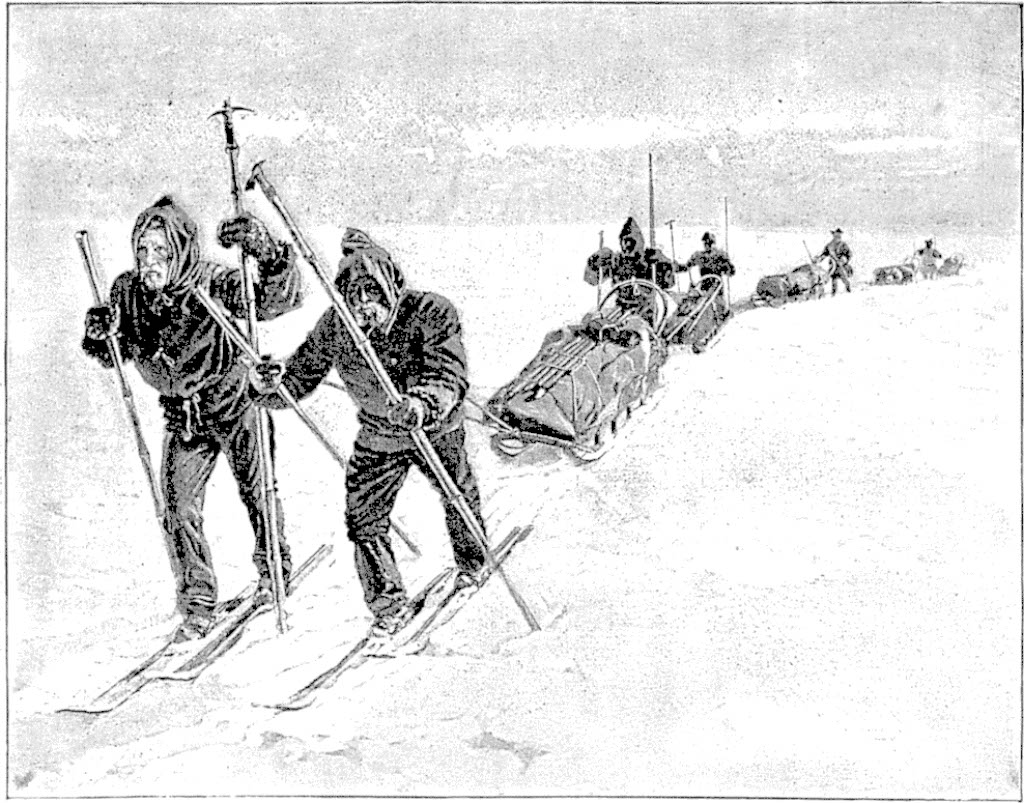 “We trudged along for weeks over an endless flat snowy desert.” Fridtjof Nansen’s ski traverse of Greenland in 1888-1889 propelled skiing into a world-wide phenomenon. An Andreas Bloch illustration from Nansen’s book Paa Ski over Grønland published in 1890. Source: https://no.wikisource.org/w/index.php?curid=61807
Polar exploration was another venue that conflated nationalism and sport with militarism during the long nineteenth century. On the world stage, national prestige accrued with the discovery of the last unknown places, infusing points on a map from Congo to the Caucasus with immense geo-political significance. At high latitudes, the turn-of-the-century military utility of skiing factored into the successful attainment of the last frontiers at either end of the earth’s poles (Frank, 2013). Great Britain was preeminent among those nations exploring the polar regions during the nineteenth century. The British Royal Navy took control of the nation’s Arctic and Antarctic exploration resulting in expensive and unwieldy expeditions devoid of cold-weather savvy. Fridtjof Nansen’s ski across Greenland and attempt on the North Pole proved the catalyst for a sea-change in the practice of polar exploration (Figure 5). Nansendemonstrated that a small, nimble group of skiers traveling unencumbered could potentially reach the ultimate polar destinations. His exploits launched world-wide enthusiasm for the sport of skiing into the bargain. Nansen’s compatriot and protégé Roald Amundsen delivered a stunning blow to the British Empire’s national pride when he out-raced Robert Falcon Scott to the South Pole in 1911. Amundsen established unquestionably the utility of the Norwegian method of applying skis and dog-sleds to a quasi-military operation at high latitudes (Allen, 2007; Frank, 2013; Frank and Allen, 2019).
World War I
World War I spanned a confounding four-year period during which warfare’s conventional wisdom based on nineteenth-century practices from the American Civil Warand the Russo-Japanese War collided with the realities of twentieth-century industrial modernization. Improvements in the lethality of machine-guns, long-range artillery, and magazine-fed rifles suggested that infantry on the attack would be vulnerable on the modern battlefield. Nonetheless, tactics at the outbreak of World War I evoked those at Vicksburg and Port Arthur with construction of complex trenchworks; massed artillery barrages preceding attacks on enemy positions; railways providing rapid deployment of troops; and cavalry maneuvering to encircle and pursue. However, as the German advance ground to a halt in the fall of 1914, the Western Front stabilized for the next twenty-seven months into a narrow line of trenches bristling with machine-guns and barbed wire from the North Sea to the Swiss border. There were no flanks around which to send cavalry units and no opportunities for envelopment; for vulnerable cavalrymen, frontal assaults were suicidal. On other fronts, however, the extremes of trench warfare did not apply. In Africa, both sides carried out wide-ranging maneuvers across vast swaths of territory: cavalry played a crucial role in the first Battle of Gaza and the Battle of Aqaba. On the Eastern Front, battlelines stretched from the Baltic Sea on the north to the Black Sea on the south. The tactical element common to both sectors was the ability of cavalry to outflank and surprise the enemy (Allen, 2007; Frank, 2013).
The Italian Front (or White War) offered a different set of circumstances. Most of the border between Italy and the Austro-Hungarian Empire straddled high alpine regions demanding an alternative method of warfare altogether. Because of the extraordinary topography, troops assigned to this region had to be well-versed in mountaineering and cold-weather travel and survival. In the pre-war years, alpinists had found skiing a useful skill for negotiating mountainous snow-covered terrain (Figure 3): the erstwhile winter sport thus became required training for specialized troops on either side of the conflict manning the region’s high-altitude peaks and passes. (Wachtler and O'Toole, 2006; Allen, 2007; Frank, 2013; Frank, 2022) (Figure 6).
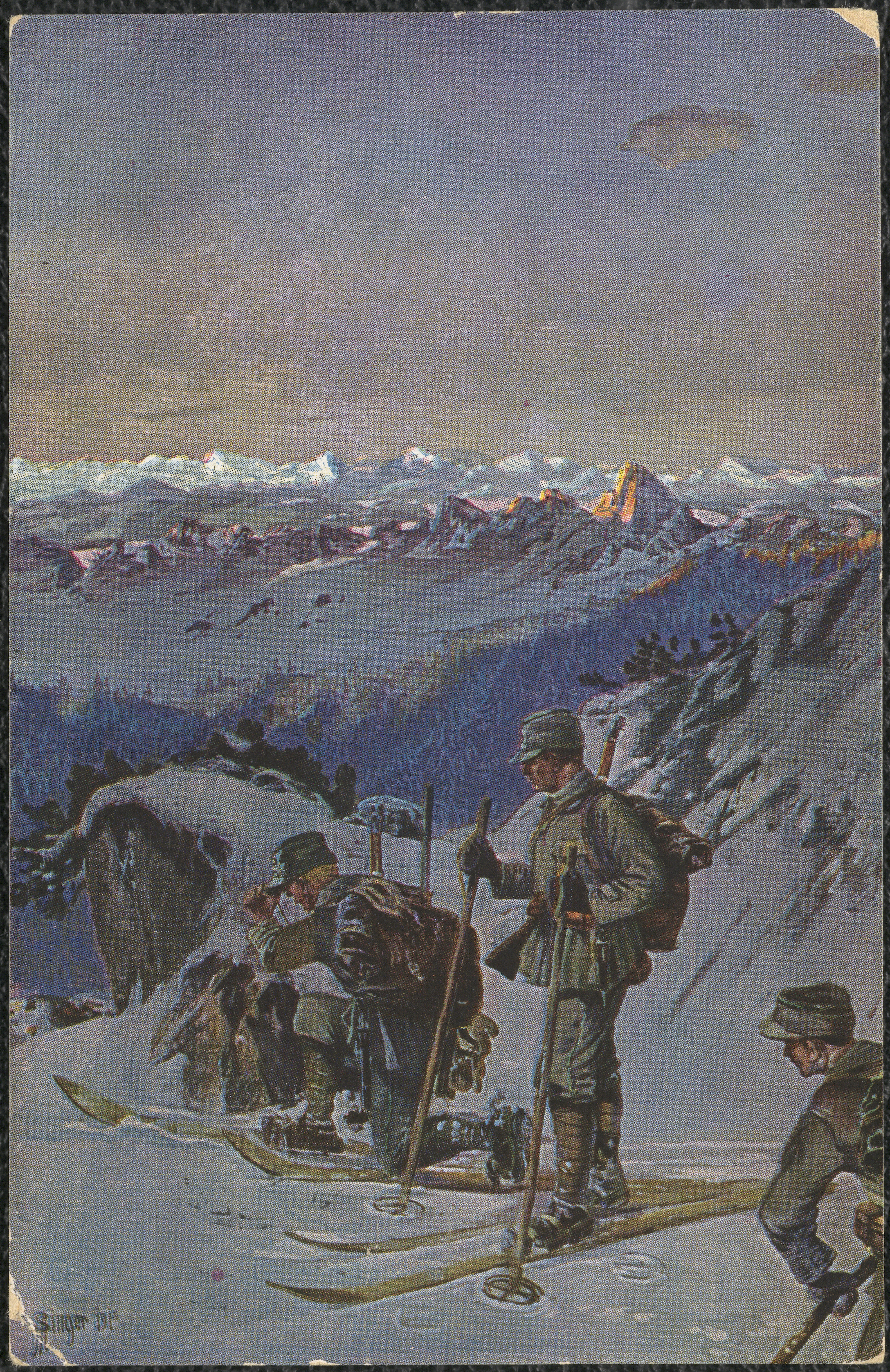 “Schneeshuhläufer-Patrouille [ski patrol],” a painting by Albert Singer featured on this German fund-raising postcard published in Dessau, postmarked 2 December 1916. Source: E. John B. Allen Collection
Russian Civil War
Although it was part of the training for troops on World War I’s Italian Front, skiing only factored marginally into actual warfare in this theater due in large part to the fixed nature of the mountainous battlelines. On the Western Front, German and French ski troops, sharing a fraternal mountaineering bond, faced off on occasion in the Vosges (Allen, 2007). Skiing truly came into play as a dynamic military activity following the expansion of the Eastern Front into post-Revolutionary Russia’s wide-open spaces.
When the Bolsheviks seized power from tsarist rule in 1917 and disengaged from the war in Europe, they refused to acknowledge any kind of shared, multi-party socialist government. The outcome was a contentious, three-year-long Civil War, most notably against the White Army. Running concurrently, a civil war in Finland and privately-organized raids (Heimosodat) into Russian Kareliacomplicated winter warfare and year-round politics along the Russian-Finnish border from 1918 to 1922. During this time, the Bolsheviks struggled to consolidate national control and establish a functioning government; one early success, however, was Leon Trotsky’s innovation in creating and organizing the Red Army. Especially effective was his application of wide, circumambulatory cavalry raids behind the White Army’s far-distant lines in Siberia and Ukraine. By 1919, mobile mounted units evolved as the mainstay of Red Army operations, symbolizing in the Civil War’s aftermath the might of the Bolshevik enterprise (Trotsky, 1921; Weiner, 2001; Frank, 2011).
Nonetheless, just as snow and ice had hampered European cavalry in the nineteenth century, so did the severity of the northern Russian winter limit horse-mounted reconnaissance and pursuit early in the twentieth. In 1918, White forces travelling on skis from Finland during the early stages of Heimosodat attacked Pechenga, presaging allied intervention the following year in the Murmansk-Arkhangel’sk region while the Bolsheviks were embroiled with their Civil War. These early wintertime successes by the Whites and allied troops prompted the Red Army to introduce ski training into its regular military regimen. The Bolshevik government tasked the Central Board of Universal Military Training with preparation of combat skiers, specifically for the coming winter campaigns of 1919-1920.
On the northern and eastern fronts, the Red Army consistently lacked enough cavalrymen; and military planners already understood that deep snow would limit the range and capabilities of mounted troops. Thus, the Russian cavalry’s fundamental functions of reconnaissance and pursuit would fall to the ski divisions. This conflation of cavalry with skiing both in military and sport (“winter cavalry” or "snow cavalry")—a concept already established in the western press in reference to Norway’s ski troops in the 1870s (see Figure 2)—carried over well into the Cold War era (Allen, 2007; Frank, 2011).
But skiing was much more than a substitute for cavalry operations: the sport was imbued with proletarian significance bolstering fundamental Marxist-Leninist theory. According to Trotsky, aristocrats and the wealthy had filled the cavalry ranks for centuries: now it was imperative that communists become cavalrymen (Trotksy, 1921). This meshed with a socio-economic dichotomy that had developed in sports around the turn of the century: European sporting organizations considered anyone who had received money or prizes in competitions, or wages for work as a sport instructor or coach, a professional and therefore ineligible for events meant only for amateur athletes. This rule eliminated most working-class athletes, allowing those from the upper-class to dominate high-profile events like the Olympics.
This class distinction spilled over into winter sports as British elites flocked to Swiss spas after World War I. These wealthy tourists preferred tobogganing (or bobsleigh) and exhilarating downhill ski runs to the more mundane aspects of cross-country skiing. Tobogganing was included for the first time at the 1922 Nordiska Spelen, raising a furor when sledders received better prizes than skiers. As the Scandinavian press pointed out, tobogganing was a pleasurable diversion for the leisure class whereas skiing was the sport of the proletariat. As more well-to-do vacationers visited the Alps in the years leading up to the 1924 Chamonix Games, a further rift developed between bourgeois Alpine and working-class Nordic branches of skiing (Allen, 2007). In Bolshevik and Soviet Russia, Nordic skiing was the preferred discipline for socialist citizens: Trotsky himself emphasized the important roles both skiing and rifle sharpshooting played in the army and among the general population. Throughout the era of the first Five-Year Plans, the government urged members of the Russian collectives to learn how to ski. Thus, the future sport of biathlon embodied the very soul of the Marxist-Leninist project from the early decades of the twentieth century (Frank, 2013).
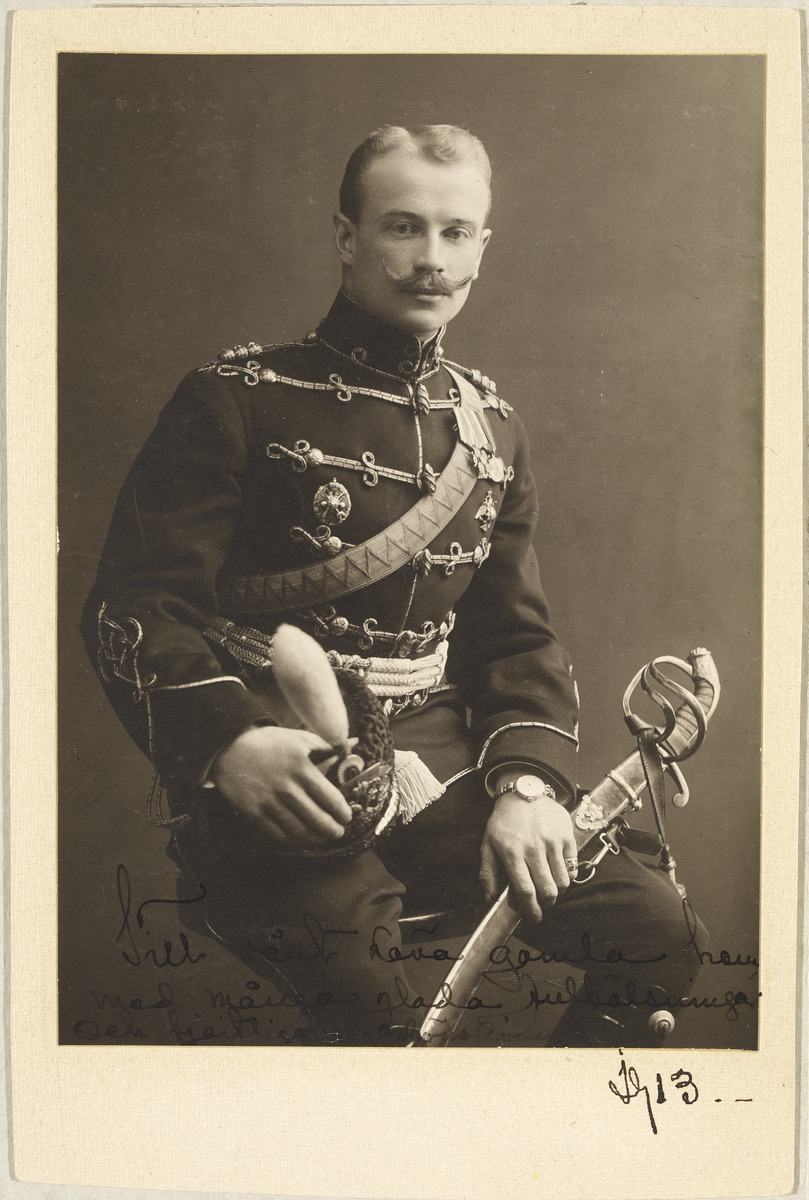
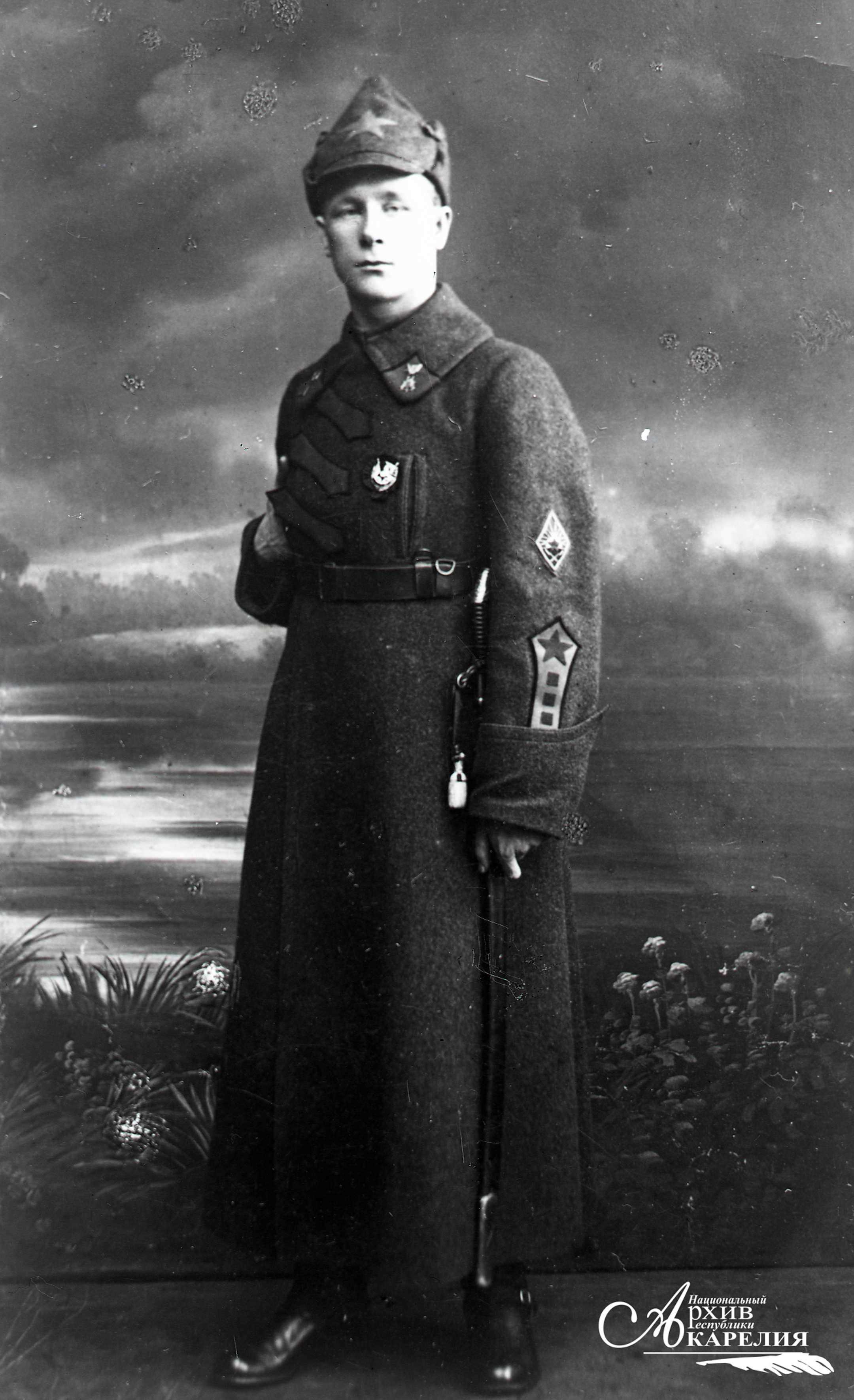 Carl Bror Emil Aejmelaeus-Äima (1882-1935) and Toivo Antikainen (1898-1941). The divergent lives of these two Finnish military skiers illustrate the fluid political situation along the border with Russia during the early twentieth century. Aejmelaeus-Äimä (left, in Russian Imperial cavalry uniform) was born in Porvoo and attended Russian military schools in St. Petersburg prior to World War I. As a cavalry officer in the Russian Imperial army, he survived the war and returned to Finland after independence to serve in the administrations of the nation’s first two presidents. His 1912 book on skiing, prepared for the Russian Imperial army, was the first to incorporate photographic montages of a skier in motion. Antikainen (right, in Red Army officer’s greatcoat and budenovka hat) was born in Helsinki and fled to Moscow at the end of the Finnish Civil War in 1918 to help establish the Communist Party of Finland in exile. He served as an officer with the Red Army in East Karelia during the Russian Civil War. Antikainen’s 1922 ski raid on Kimasozero took on legendary status in the Soviet Union. Source Museovirasto, Historian kuvakokoelma, HK19740427:3 https://finna.fi/Record/museovirasto.DC5C25A16DAAD06394D5423F7B26831A?sid=5103246439
).jpg)
As the Whites consolidated power in Finland after its civil war, a group of Finnish nationalists attempted to wrest control of East Karelia from Russia during a five-month period spanning the winter of 1921-1922. Because of the exigencies battling the White forces in winter, the Bolshevik government ordered the Petrograd Military District to establish ski battalions. Among those recruited to serve was Toivo Antikainen (Figure 8) whose 1,000-kilometer ski-reconnaissance maneuver behind White lines to capture the railway station at Kimasozero became legendary in Soviet film and book prior to World War II (Frank, 2011).
As soon as possible after Finland declared independence at the close of 1917, former Russian Imperial cavalry officer Carl Bror Emil Aejmelaeus-Äimä returned home to serve in the new Finnish government’s administration (Figure 7). In 1919, he was assigned to south Kareliato reform cavalry instruction at Lappeenranta. For his troops, Aejmelaeus-Äimä included the lessons he had formulated in his 1912 ski handbook, bolstering the efforts of Lauri “Tahko” Pihkala to establish biathlon-style competitions among the Finnish Home Guard during the 1920s. In this period of turmoil between the world wars, similar ski training was taking place in Norway, Sweden, and the Baltics (Hautamäki, 1975; Frank, 2013; Mainla, 2017; Frank and Allen, 2019; Stegen, 2019; Kanerva, 2021). Outside Scandinavia and Finland, Military Patrol, the pre-cursor to modern biathlon, had become a feature of international competition at the beginning of the twentieth century.

Military Patrol
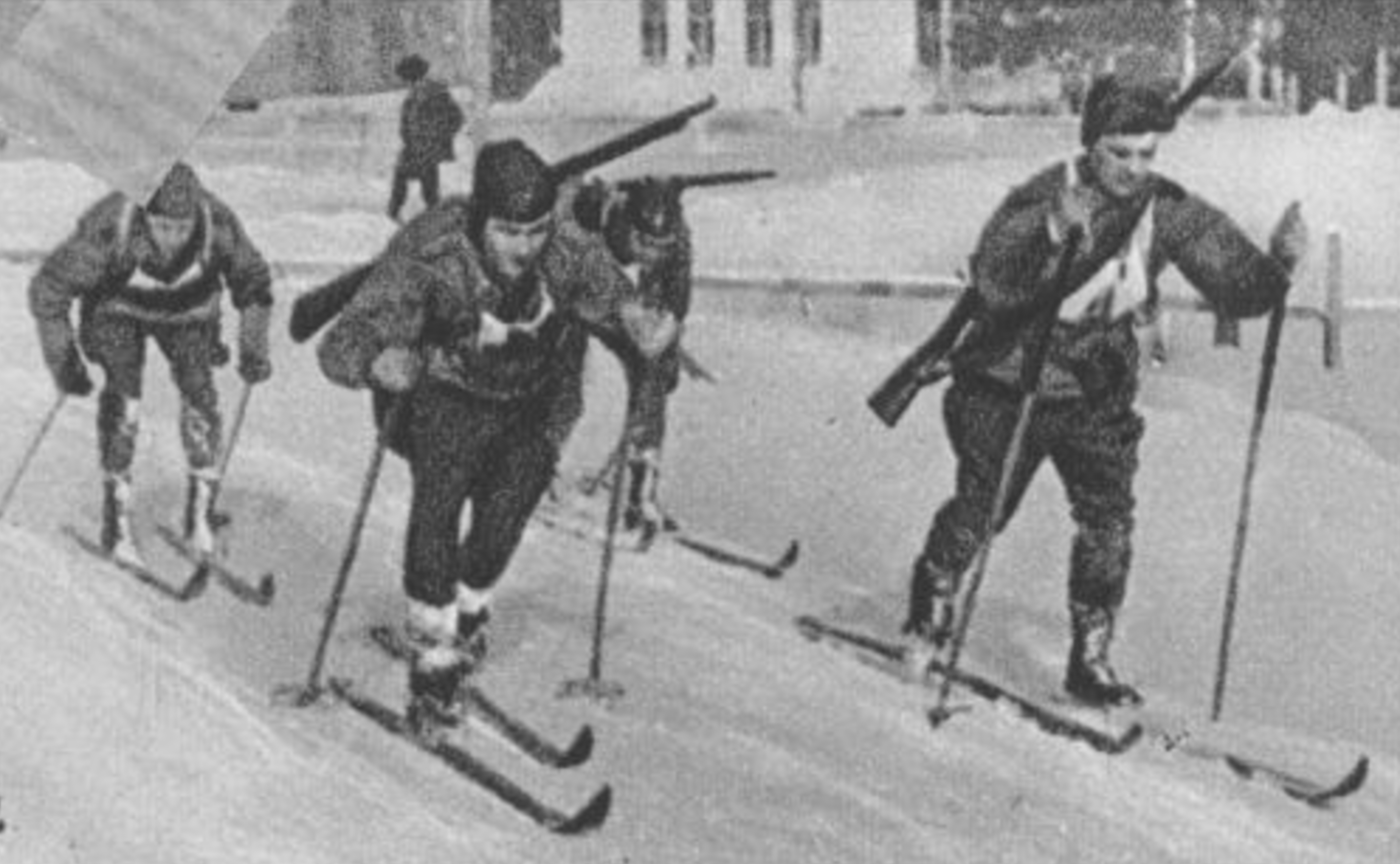
Switzerland’s Military Patrol team, gold medalists at the Chamonix Games on 29 January 1924 (left to right): Denis Vaucher, Alfred Aufdenblatten, Anton Julen, Alfons Julen. The 30-kilometer course was a continuous loop from the stadium in Chamonix (1037m) through Argentière to Charamillon (1810m) and back: the shooting range was located near Les Chosalets at around the 20-kilometer mark. This was the first Olympic military patrol race and the only one designated as a medal event. Source: Courtesy International Biathlon Union www.biathlonworld.com
Perhaps even more so than modern pentathlon, military patrol encapsulated the amalgamation of nationalism, sport, and militarismat the Olympic Games. Because it was a team event restricted to the armed forces, military patrol provided an obvious method of comparing the level of physical conditioning and military training of each nation’s army within a sporting environment. The sport’s first iteration took place in Germany in 1902 and gained inclusion in Nordiska Spelen in 1922 (Jönsson, 2001; Frank, 2013). Similar in configuration to the original four-man okhotniki teams of the Russian imperial army, military patrol teams consisted of an officer and three enlisted men who skied together on a 25- to 30-kilometer course, often over more challenging terrain than encountered on regular cross-country ski tracks. Although rules varied over the years, for the most part enlisted men, dressed in military kit, carried rifles, ammunition, and rucksacks with a total combined weight of 24 kilograms; the officer was either unarmed or carried a pistol; three competitors shot in the range with an option that the officer could substitute for one of the enlisted men; a penalty accrued for each shot missed on the firing line; and the final time registered when the last team member crossed the finish line. Military patrol was a medal event at the Chamonix Games of 1924 (Figure 9), then an Olympic demonstration sport in St. Moritz in 1928 and 1948 (Figure 10) as well as in Garmisch-Partenkirchen in 1936; the event was discontinued after 1948 because of strong international anti-military sentiments following World War II. (Jönsson, 2001; Frank, 2013; Stegen, 2019).
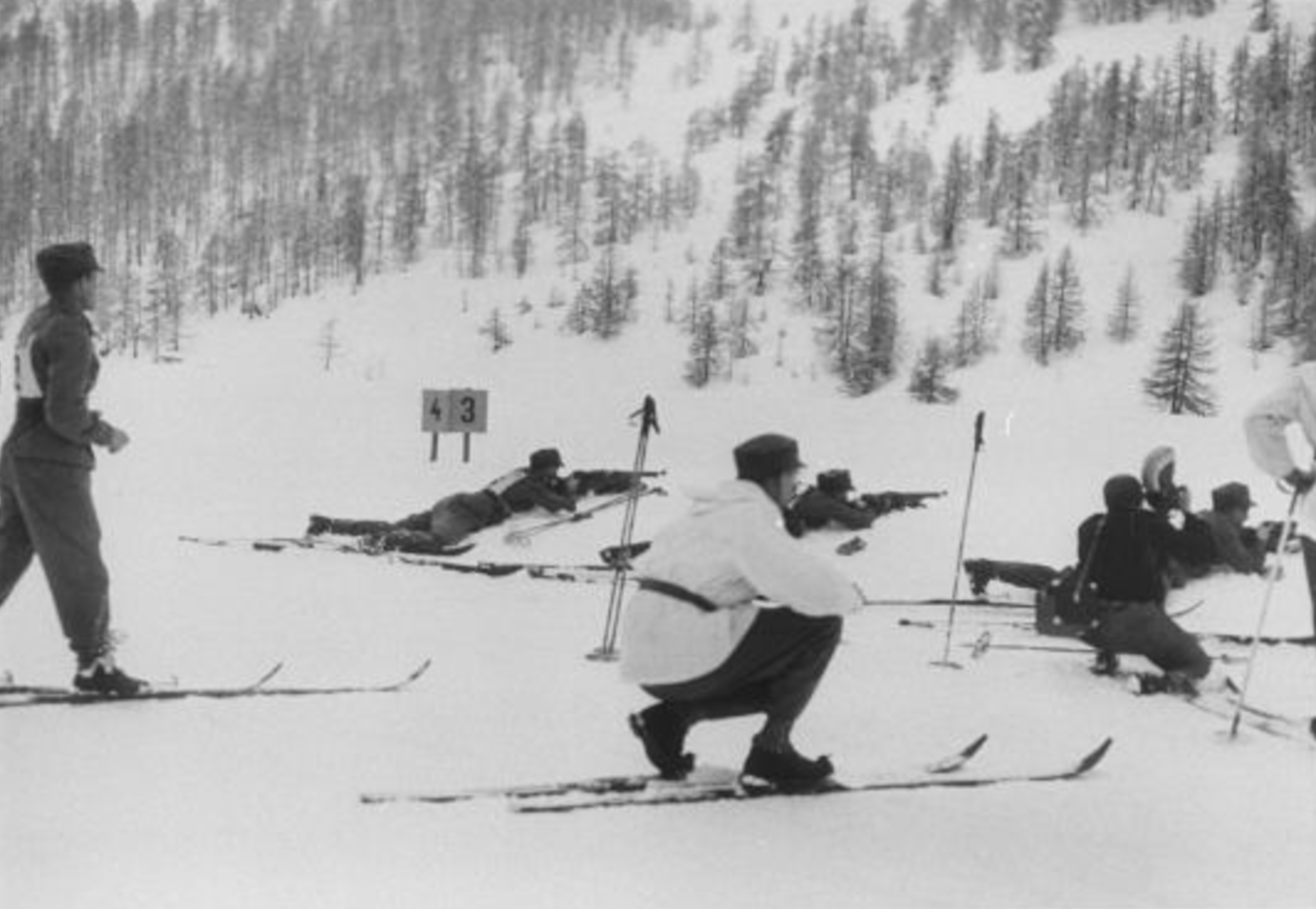
On the shooting range at the last Olympic Military Patrol race in St. Moritz, SUI, 8 February 1948. Competitors are firing at three balloons over a distance of 150 meters. Source: Courtesy International Biathlon Union www.biathlonworld.com
Winter War
The Winter War was the single-most important event leading to development of biathlon during the Cold War era. All of the hostilities in Kareliafrom 1918 to 1939 came to a head when Nazi Germany and the Soviet Union signed a non-aggression pact in August 1939 that included a secret agreement establishing mutual spheres of influence in eastern Europe. This prompted both nations to invade Poland from opposite directions in September and demarcate a new borderline separating Germany from Russia. Joseph Stalin and his government subsequently strong-armed Lithuania, Latvia, and Estonia into pacts allowing the Soviet Union to establish military bases fronting the Baltic Sea and Gulf of Finland. Turning their sights on Finland for a similar agreement, Soviet ministers experienced stubborn intransigence from their Finnish counterparts throughout protracted negotiations.
On 30 November 1939, the massed forces of the Soviet Union rolled across the Finnish border expecting to burst through Finland’s defensive Mannerheim Line and reach Helsinki within a matter of weeks. Finland’s asymmetrical guerrilla tactics over the course of three months thwarted these plans: and Finnish soldiers draped in white camouflage captured the imagination of the world while showcasing their adept use of skiing as a means of lethal warfare (Chew, 1971; Trotter, 1991; Frank, 2013; Kotkin, 2017). In a manner harking back to okhotniki teams of the Russo-Japanese War, small Finnish ski detachments used mobile guerrilla stratagems to decimate the Soviet flanks and rearat Suomussalmi, the most famous battle of the Winter War. It is worth noting that a Scandinavian volunteer infantry corps fought against the Soviet Union alongside Finland up to the war’s conclusion and beyond. Thus, Russia, Finland, Norway, and Sweden—the four main proponents of post-war biathlon—were simultaneously on the ground in Kareliathat winter.
In its aftermath, the Winter War sparked military ski training all around the world. Conventional wisdom at the end of World War I held that mountain warfare would be inevitable in future land battles; many nations continued to train mountain troops in the technical details of mountaineering just as they had prior to the war, most notably in the alpine regions of Austria, Germany, France, and Italy. The Winter War brought about a different perspective on this type of training with greater emphasis placed on ski combat. From Germany to Japan; from the United States to France, New Zealand, and Great Britain; from Denmark to Switzerland: belligerents as well as neutral nations established military ski training programs inspired by Finland (Frank, 2013; Frank, 2022).


Although the Soviet Union eventually prevailed in March 1940, Finland’s stout resistance to the Soviet mechanized onslaught proved a humiliation to the vaunted Red Army, prompting a re-assessment that spring of winter combat readiness by the Soviet general command (Glantz, 1998; Frank, 2013). Based on the debacle in Finland, many agreed that preparing skiers for the army was a priority; and in October 1940, mobilization efforts began in earnest. Newspapers promoted skiing throughout the winter of 1940-1941 urging readers “na lyzhi [to skis]!” just as Trotsky had urged potential communist cavalrymen “to horse!” during the Civil War. During the winter of 1941, Komsomol, in conjunction with the armed forces, arranged a nation-wide series of cross-country ski races for soldiers and citizens alike, all with a military bent. Within one year of subduing Finland, the Soviet government elevated skiing from a winter pastime into a primary building block of socialism integral to national defense (Frank, 2009; Frank, 2013).
Operation Barbarossa
The largest invasion of its kind, Operation Barbarossa involved blitzkrieg-style warfare in an attack against the Soviet Union along a 2,900-kilometer front in June 1941. A massive onslaught of personnel and ordnance divided into three areas of advance mirrored the Soviet Union’s own 1939 invasion of Finland although on a much broader scale. Even though the German army replaced horses with tanks, airplanes, and armored personnel carriers, cavalry tactics remained relevant: outflank the enemy to attack from the rear. The Russians retreated as rapid encirclements of the Red Army eliminated nearly half of the Soviet Union’s troops. Expecting to reach Moscow easily, the German army halted just 40 kilometers from the city’s outskirts as autumn turned to winter. The Soviet Union mounted a winter counter-offensive in December that expanded from the outskirts of Moscow into a front stretching from Leningrad to Crimea. During this campaign, the lessons of winter warfare dearly acquired in Finland bolstered the maneuvers of the Red Armyacross the vast spaces of the Russian steppe (Frank, 2013).
Red Army ski battalions were especially effective in the initial counter-offensive to Operation Barbarossa. Soviet ski detachments, just like their okhotniki predecessors, employed tried-and-true cavalry tactics in the form of swift raids across battlelines to attack the rear of harassed German troops mired in severe Russian weather throughout a vast theater of war. An early deployment that gained renown in January 1942 involved the demise of a small detachment of twenty-seven ski troopers who made a nighttime cross-country trek to battle over 400 Germans and four tanks at the battle of Khludnevo. One of the deadliest and hardest-fought campaigns stretched from December 1941 to March 1942 along the German supply route south of Smolensk. Marauding ski divisions, partisans, and Soviet paratroopers sought to cut supplies to the German Fourth Army on the outskirts of Moscow: by mid-winter, the Russians were successfully overwhelming German defensive attempts in temperatures that had plummeted to a range between -35 and -45 °C until the spring thaw in March turned the region into a corpse-strewn bog. Reports from this region as well as others across the frontlines throughout the war made wintertime news all around the world with images of Soviet skiers in action featured in newspapers and flickering in movies and newsreels. (Pospelov, 1960; Frank, 2013; Smirnov, 2016). Throughout the war, the Red Army continued to integrate horse-mounted troops with tank divisions; but during the winter, ski troops replaced the cavalry. As the war progressed, skiers rather than cavalrymen came to represent the military strength of the Soviet Union on a par with tanks, artillery, and airplanes, a notion still prevalent in twenty-first-century Russia (Frank, 2013).
Continuation War
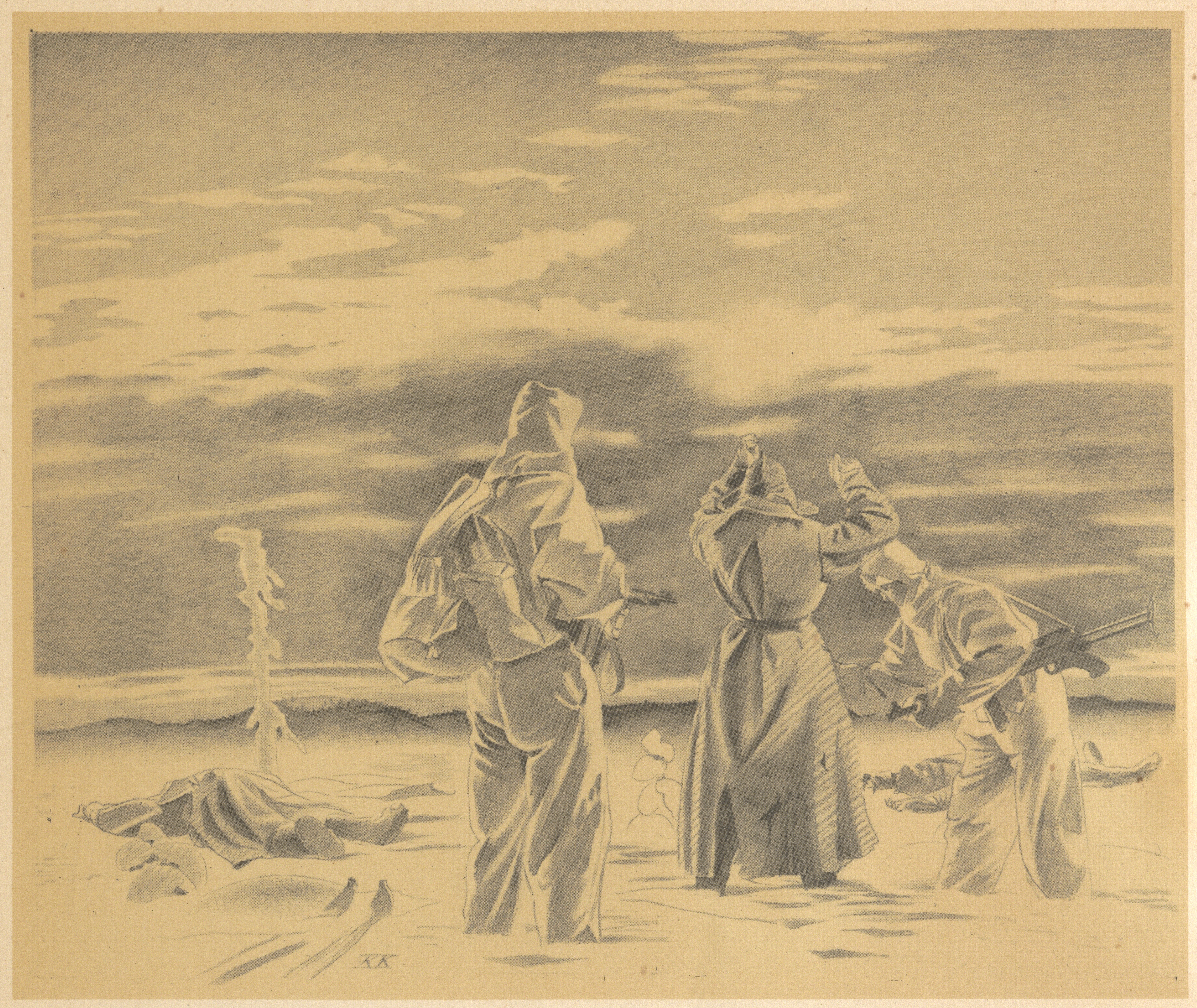
“. . . der letzte wird durchsucht [The last one is searched].” One of thirty-eight pencil illustrations by Kurt Kranz from Winteralltag im Urwald Lapplands [Daily Winter Life in Lapland’s Forest]. This 1944 propaganda collection was published in Berlin but printed in Porvoo, FIN (where the artist was serving with the army) for distribution in Germany. Kranz’s sketch shows German mountain troops in the act of capturing a Russian along the Soviet-Finnish border late in World War II. The prisoner wears a greatcoat and the budenovka headgear closely associated with the Red Army from the Russian Civil War through the Winter War but less frequently in use at the time of this fictional vignette. Source: E. John B. Allen Collection
Because of virulent anti-Soviet sentiment after the Winter War, and wedged between Nazi Germany and the Soviet Union, Finland agreed to allow German troops to operate on Finnish soil after its defeat. As Operation Barbarossa unfolded in June 1941, the Soviet Union labeled Finland a German ally which brought about repeated bombing of Helsinki and a declaration of war on the part of Finland. Finnish troops along with some Swedish and Estonian volunteers crossed back over the border into Karelia, eventually reaching the outskirts of Leningrad and Murmansk. The resumption of war lasted from 1941 to 1944 and engendered further hostilities between the two countries (Figure 11). To be sure, this final iteration of the Soviet-Finnish Wars lacked the clear-cut moral divide of the previous conflict in 1939-1940. The subsequent peace settlement between Finland and the Soviet Union led to a Cold Warstalemate known as Finlandization that generated a wary truce, a sense of unease in the rest of Scandinavia, and athletic rivalries all across the region, reflecting the ideological divide that separated east from west during the Cold War era.
Cold War
From the Bolshevik Revolution to the end of World War II, the Soviet Union refused to take part in nearly all international athletic events. The Soviet government considered these competitions elitist and bourgeois, preferring to establish a sports system based on cooperative physical culture. Post-war, the Soviet Union rivaled the United States as one of the world’s two superpowers, prompting a radical change of perspective. Now the two nations were battling for supremacy in politics and society, pitting communism against market capitalism. In this new era, international sports became a surrogate battlefield (Guttmann, 1988; Coates, 2017; Parks, 2017).
In the immediate post-war years, the Soviet Union continually promoted physical fitness programs around the nation with special emphasis on activities that had explicit military application as viewed through the filter of recent war experiences: cross-country skiing and target shooting were among the principal disciplines. Skiing especially evolved as an all-encompassing Soviet metaphor as teams from Russia began to attend international cross-country ski races, ideal platforms for celebrating the victory over Nazi Germany (in self-referential Soviet terminology, The Great Patriotic War) as well as demonstrating national strength and the superiority of communism. A ski event with shooting would elevate these notions to another level altogether (Frank, 2013).
After a war-induced twelve-year hiatus, IOC awarded the 1948 Winter Olympics to neutral Switzerland. Exhausted by World War II, the organizers banned Germany and Japan; the Soviet Union sent observers rather than participants. Military Patrol was a demonstration sport along with winter pentathlon, a five-event contest open to civilians and modeled on modern pentathlon, with Nordic and alpine skiing replacing swimming and running. The Union Internationale de Pentahlon Moderne (UIPM) established in 1948 to promote and administer both the winter and summer versions of pentathlon, was unable to keep both: because of its complexity, winter pentathlon was discontinued along with military patrol for the 1952 Winter Olympics. However, enthusiasm at IOC for some form of multi-event winter competition remained.
In the mid-to-late 1940s, Swedish defense forces had developed field shooting with a format resembling military patrol but open to all athletes competing individually: with Sweden’s input, the International Military Council devised a 20-kilometer individual time-trial event in 1948. UIPM accepted responsibility for developing this new event in 1953 and, three years later, put forth official rules of competition subsequently adopted all across Scandinavia and in the armed forces of the Soviet Union: in 1956, Norway and Finland sent teams to Sweden to compete, while the Red Armyscheduled its own intramural series. UIPMofficially assumed oversight of biathlon in 1957 and proposed to IOC that biathlon should gain a spot at a future Winter Olympics. IOC agreed; and, since bobsled had been cancelled for the next Olympics, allowed substitution of biathlon at the 1960 Winter Games. Continuation on the Olympic card would be contingent on observation, experiences, and feedback from this one-off event. (Hautamäki, 1975; Niinimaa, 1998; Heck, 2011; Frank, 2013; Stegen, 2019).
Old Program
As a lead-up to the 1960 Olympics, UIPM organized two Biathlon World Championships in Saalfelden, AUS in 1958and Courmayeur, ITA in 1959. For these events, and all subsequent individual 20-kilometer biathlon races through the 1965 Biathlon World Championships in Elverum, NOR, competitors followed a format now known as Old Program. Biathletes left the start-finish area in staggered starts of one- or two-minute intervals and skied a single continuous loop, stopping to fire large-bore, open sight rifles at four separate shooting ranges along the way. Skiers took five shots prone at each of three ranges over distances of 250, 200, and 150 meters, and then five shots from standing position at the fourth and final 100-meter range, for a total of twenty shots. Cardboard or paper targets measured 30, 25, 20, and 30 centimeters in diameter respectively. Every shot missed added a two-minute penalty to the ski time for each individual. (Hautamäki, 1975; Frank, 2013).
Compared to biathlon racing as it has evolved in the twenty-first century, Old Program provided a more equitable balance between shooting and skiing. The two-minute penalty placed a premium on marksmanship as a counter to sheer speed on the ski track. Biathletes had to contend with multiple variables at four separate ranges of varying lengths: at the first Biathlon World Championship and at subsequent early races in the 1960s at subsequent early races in the 1960s, competitors sometimes were even forbidden from practicing at the ranges: they were given a sketch of the ski-course and range locations only forty-eight hours before the start of the race. Shooting high-recoil rifles at paper targets on rudimentary and unstable firing lines, biathletes had to have confidence in their own abilities: they did not know their degree of accuracy until after the race, when targets were removed, gathered together from all four ranges, and scored by a panel of judges.
However, Old Program had significant disadvantages. It required a huge amount of space to set up the entire 20-kilometer loop and then staff the start-finish area and each shooting range. Compiling the shooting scores and adjusting the overall times of every competitor became a logistical nightmare. The most significant drawback was that spectators could not view the race in a coherent way: assessing the staggered starts in real-time was confusing; action at each of the separate ranges was far removed from the start-finish area; and waiting for results as judges tallied scores could take hours. Just as problematic was the biathlon team event, a medal-winning opportunity included at each Biathlon World Championship (excluding the Olympics) from 1958 through 1965, determined by combining individual times of a nation’s four-man team (Figure 12). Ideologically, this was a significant factor during the Cold War indicating the strength and depth of each nation’s squad, but, as an event, devoid of any possibility for spectator viewing (Frank, 2013).
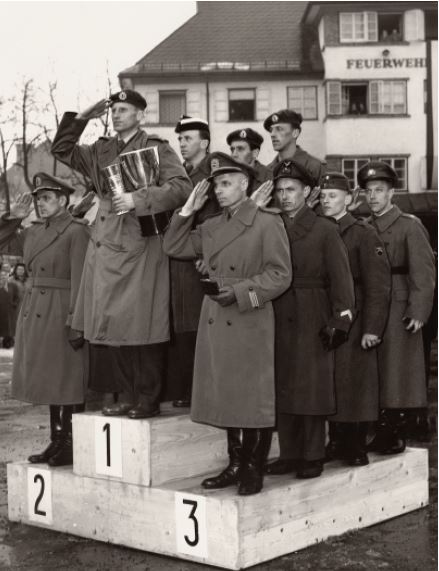
Team competition podium at the first Biathlon World Championships in Saalfelden, AUS in 1958 on 9 February: 1) Sweden; 2) Soviet Union; 3) Norway. This photograph illustrates how aspects of Military Patrol carried over into the new sport of biathlon. Competitors from the armed forces filled the ranks of biathlon until the switch from large-caliber rifles to .22 rimfire rifles in 1977, making the sport more accessible to civilians. Team competition continued at biathlon world championships through 1965, after which it was replaced by the 4 x 7.5-kilometer relay. In the twenty-first century, four variations on the relay format are part of the World Cup and Olympic biathlon schedules. Courtesy International Biathlon Union www.biathlonworld.com
IOC found these details concerning and, even before the first Olympic race took place in 1960, cut biathlon from the 1964 Games on the pretense of being too militaristic. At the next IOC Congress, held prior to the Summer Games in Rome, the Soviet Union made an unsuccessful bid to re-introduce biathlon as an Olympic event. At the next meeting in 1961, UIPMpleaded for reinstatement: IOC relented, but only if converted to some type of winter pentathlon to make it more spectator-friendly. To satisfy this demand yet retain the essence of biathlon, UIPMdevised a new format to replace Old Program after the 1964 Innsbruck Games, only the second yet final Olympic Old Program contest. The very last Old Program race took place at the Sixth Biathlon World Championship in Elverum, NOR in 1965, the sport having survived yet another vote taken to discontinue it at the IOC Congress at Innsbruck the year prior. In an attempt at self-preservation, UIPM held a test run of a new event in Elverum, the 4 x 7.5-kilometer relay which initiated changes in biathlon that had profound impact on the future viability of the sport (Frank, 2013; Stegen, 2019).
New Era
At the 1965 World Biathlon Championship in Elverum, instead of four separate shooting areas, the four different-length ranges of the Old Program 20-kilometer individual time-trial were laid out side-by-side with three prone and one standing stage: starting in 1966, the different lengths were consolidated into a single 150-meter range with two bouts of prone alternating with two standing, inside a stadium with the start-finish area nearby; and rather than a single 20-kilometer loop, smaller 3- to 5-kilometer loops connected the ski course to the stadium and shooting range: this allowed spectators to follow a biathlon race from a single vantage point. A new scoring system allowed either a one- or two-minute penalty to accrue for different distances from the center of the target. Reducing the penalty for a “pretty close” shot by a minute made the race more competitive and exciting, even though the 20-kilometer staggered starts and delayed final results from analyzing paper targets still dampened spectator enthusiasm. However, the relay format introduced at Elverum revolutionized the relationship of biathlon spectators to the sport. This new event, essentially Military Patrol in a different guise, gained immediate relevance with the often-partisan crowds on either side of the Iron Curtain at the height of the Cold War (Frank, 2013).
In the relay, each team fielded four members who skied a 7.5-kilometer course in succession with two shooting bouts at 150 meters, one prone and one standing. Each biathlete shot at five targets at both bouts; the targets were hung in a frame with cutouts the size of the regular paper targets, behind which were balloons (in subsequent years replaced by glass discs) that would burst (or shatter) when hit. For each unbroken balloon (or disc), the competitor had to ski a 200-meter penalty loop (later reduced to 150 meters) before returning to the course. Competitors could fire at the five targets at each stage with eight (originally ten) bullets (five loaded into a magazine cartridge plus five, later three, loose). Rather than staggered departures from the start-finish area, the relay featured a mass start with racers skiing and shooting head-to-head, the winner of the contest determined by the first team across the finish line. This proved to be a successful formula for attracting huge crowds, replacing the moribund team event of world championships prior to 1966 with an exciting new spectacle.
Success in the relay depended on speed: fast on the track and fast on the range. This was a far different sport than the 20-kilometer individual time-trial which placed a premium on the mental control necessary for maintaining a proper pace and having confidence in the ability to place shots onto a paper target. The relay was more visceral: each stage was a flat-out sprint from start to finish over a short 7.5-kilometer course against other racers, with immediate feedback from the bank of breakable targets at each shooting bout. This breakable-target-style short race was so popular that a 10-kilometer individual time-trial based on the relay format was introduced at the 1974 Biathlon World Championships in Minsk.
Another concerted effort to eliminate biathlon occurred during IOC deliberations at the 1972 Sapporo Winter Games by limiting the number of teams allowed to participate at the following Olympics in Innsbruck. To counteract these measures, UIPMB (the “B” for biathlon added io UIPMin 1968) eliminated large-bore rifles in favor of .22 small-caliber, rim-fire rifles for use on a 50-meter range with proportionally smaller targets, for implementation after the 1976 Winter Olympics. This switch to more accessible rifles and ammunition proved to be the sport’s saving grace because it broadened the world-wide pool of potential biathletes and opened opportunities for women by the late 1970s. The 10-kilometer sprint became an official Olympic event at the Lake Placid Games in 1980 with knockdown (or silhouette-style) targets replacing breakable glass discs in both the sprint and relay. The following year, this type of target replaced paper in the 20-kilometer race and the two-minute penalty was reduced to one minute, making the 20-kilometer individual time-trial more competitive (Frank, 2013; Stegen, 2019). By this point, biathlon—a recurring theme in books, cinema, and magazines behind the Iron Curtain for decades—began to seep into popular culture in the west: an East German biathlete/assassin becomes the main antagonist during the ski chase sequence in the 1981 James Bond film, For Your Eyes Only.
Biathlon’s administrators began to reconfigure their sport with an eye toward the future. In 1984, women competed in the first Biathlon World Championships with women’s individual, sprint, and relay events introduced at the 1992 Olympics. UIPMB stole the march on the International Ski Federation in 1986 by officially allowing biathletes to use a new technique that mimicked speedskating rather than traditional striding in tracks for all events. By the turn of the century, the International Biathlon Union, the new governing body for biathlon as of 1993, introduced pursuit and mass start races at World Championships in 1997 and the Olympics of 1998 and 2002, setting biathlon on the path to becoming one of Europe’s most popular winter spectator sports.
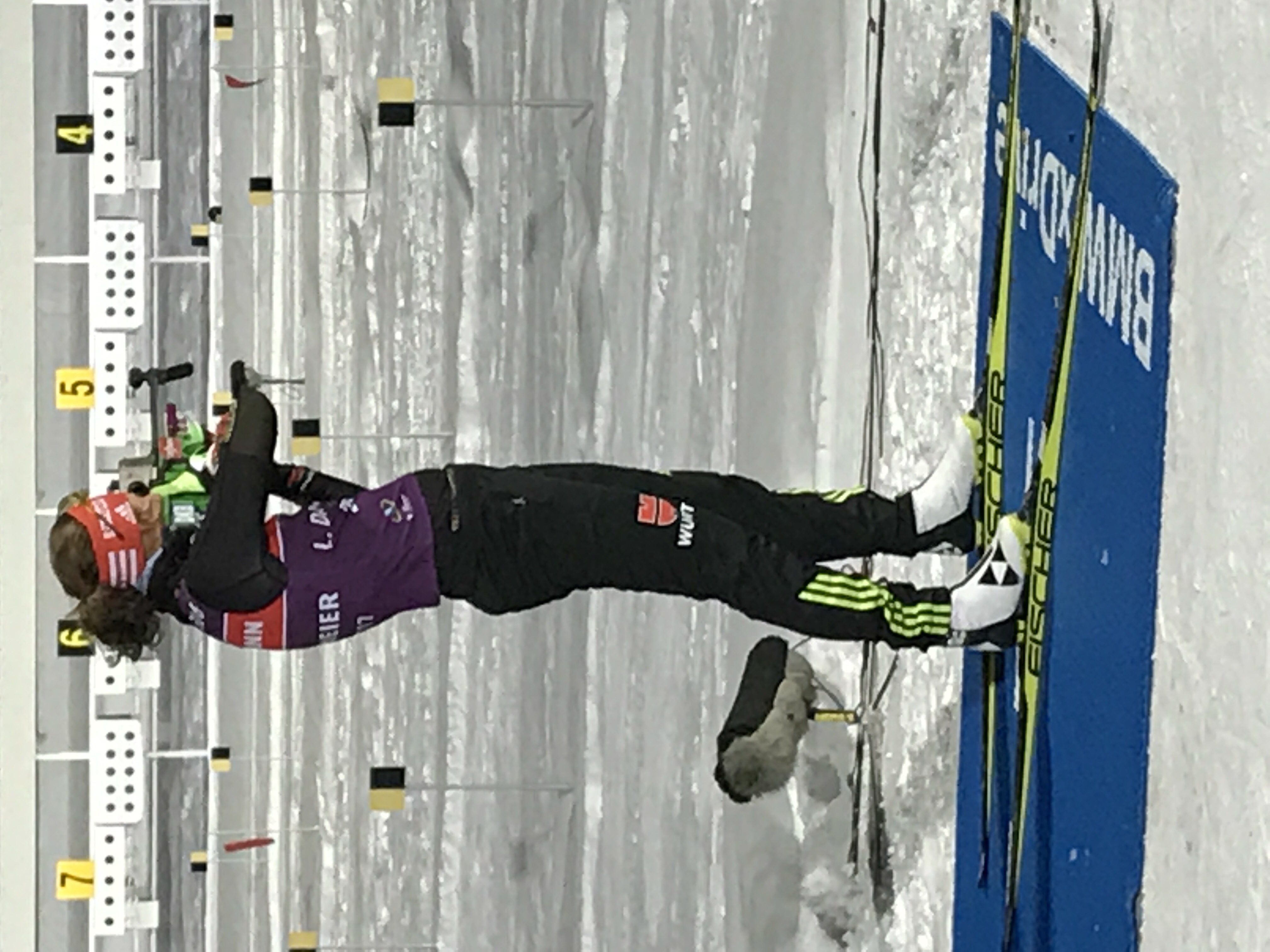
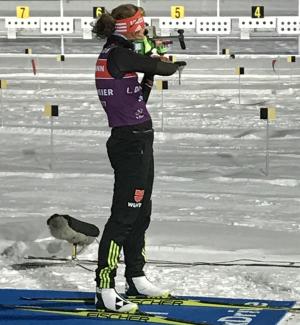
Laura Dahlmeier of Germany zeros her rifle from the standing position prior to a 2017 World Cup race in Kontiolahti, FIN. Dahlmeier (1993-2025) was a bronze and double gold medalist in biathlon at the 2018 Winter Olympics. After retiring from competition in 2019, she took up climbing and high-altitude mountaineering. In 2025, Dahlmeier lost her life in the Pakistan Himalaya at the age of 31. From the 1950s through the early 1980s, official world championships in biathlon were restricted to men only; but during that time, women were participating in biathlon competitions in Eastern Europe and the Soviet Union with a smattering of involvement in Scandinavia and North America. In 1970, the German Democratic Republic, Bulgaria, Poland, Czechoslovakia, and the Soviet Union held the first international women’s biathlon competitions known as Za druzhbu i bratstvo [For Friendship and Brotherhood]. The first Biathlon World Championships for women took place in in Chamonix, FRA in 1984. IOC finally included three women’s biathlon events at the 1992 Olympics in Albertville, FRA. Source: William D. Frank photographs
Television and Spectator Sport
Television has played a significant role in boosting biathlon’s profile due to increased interest worldwide in all aspects of the Olympics. The first broadcast of the Winter Games from Cortina in 1956 featured easily-filmed events like figure skating, ice hockey, and ski jumping. As Olympic viewership grew, money from sponsors flowed to events like alpine skiing and bobsled that were flashy, fast, and simple to follow. Less-telegenic events such as cross-country and biathlon had to reconfigure their sports to attract similar audiences. The addition of pursuit and mass start biathlon was a particularly brilliant move on the part of IBU.
In mass start, skiers leave the starting line together to fire two bouts prone, then two standing, with a penalty lap for each miss at the range, a psychologically-demanding scenario. Pursuit incorporates the Gundersen start method from the two-day Nordic Combined: results from a 10-kilometer sprint time-trial on one day determine the pursuit start order on the next. The winning skier from the previous 10-kilometer race starts first followed by competitors according to their order and time-gap behind, with a penalty lap for each miss at the range over four shooting stages. In both mass start and pursuit, the first skier across the finish line is the winner.
These events along with new relay formats are ideal subjects for live television. Viewing mass start and pursuit with the aid of technical advancements in cameras, electronic scoring, split-screen formatting, and knowledgeable color commentary makes it easy to follow the racers with exciting action on the shooting range thrown into the mix: a disaster on the firing line can dash the hopes of the race leader in a heartbeat. Biathlon’s on-line streaming services have mushroomed viewership figures in the twenty-first century, outpacing nearly all other winter sports: for the 2021-2022 Biathlon World Cup season, European television broadcast 608 hours; by 2023-2024, the number of hours had increased to 2,332 (Frank, 2013; Morton, 2018; Stegen, 2019; IBU, 2025; Herz and Kershaw, 2025; Niinimaa, forthcoming).
Team Sport, Nationalism, and NATO
From its inception, nationalism has been woven into the very fabric of the Olympics as well as world championship competitions (Coates, 2017). Although nations certainly celebrate individual medals, the team events have held particular importance as a method of gauging national fitness and preparedness as well as the depth of a nation’s program throughout the Cold War and into the post-Cold-War era. The biathlon relay has been a prime example of this notion. From 1966 through the dissolution of the Soviet Union in 1991, the Soviet Union won every gold medal in the biathlon relay over six consecutive Olympics, and eighteen out of a possible twenty-eight at the world championships. This event evinced an extraordinary relationship to Soviet national self-perception, as the mythology of Operation Barbarossa and the Great Patriotic War displaced that of the Russian Civil War and its iconic connection to cavalry. The joint memory of World War II and 27 million Soviet casualties outlasted the Soviet Union (Weiner, 2001) and remains a potent force in a revanchist Russian Federation.
Similarly, a reciprocal notion applies to Finland and the Scandinavian countries as a reflection of their shared experience fending off the Soviet Union during the Winter War and Continuation War, then maintaining a defensive posture in the decades following World War II. From the very first biathlon competitions in the 1950s, the idea that Scandinavian countries bordering the Soviet Union employed biathlon as a surrogate display of national defense has been a hallmark of international racing (Frank, 2013). This concept, still viable in the twenty-first century, underscored the decision by both Sweden and Finland to join NATO in 2023 after Russia’s invasion of Ukraine in 2022. Memories of the Winter War among modern-day okhotniki infuse defensive training throughout NATO’s new northern expanse.
It is worth noting that just weeks prior to Vladimir Putin’s seizure of Crimea in 2014, Russia won the men’s biathlon relay at the Sochi Olympics after a hiatus of over two decades, a major anti-Western propaganda coup for Putin and the Russian regime. However, the extent to which Russia had engaged in corruption and clandestine cheating for years leading up to and during Sochi came to light in 2016: the scandal engulfed biathlon in 2021 following a two-year investigation into illicit ties between Russia and IBU’s longtime Norwegian president, Anders Besseberg. In 2025, IBUstripped Russia of its first-place relay finish at Sochi after the Biathlon Integrity Unit, the Court of Arbitration for Sport, and the Swiss Federal Tribunal all judged relay team member Evgenii Ustiugov guilty of anti-doping rule violations after a years-long appeals process. At the 2026 Cortina Olympics, IOC redistributed biathlon medals awarded at the 2010 Vancouver and 2014 Sochi Winter Games based on these investigations.
Eighty years prior to this final judgement in the Ustiugov case, George Orwell wrote: “Serious sport . . . is war without the shooting.” Orwell’s phrase is still apt, even in a sport like biathlon where, quite to the contrary, the contest has always included both.
Bibliography
Allen, E. John B. (2007). The culture and sport of skiing: from antiquity to World War II. University of Massachusetts Press.
Allen, E. John B. (1993). From Skisport to Skiing: One Hundred Years of an American Sport, 1840-1940. University of Massachusetts Press.
Allen, E. John B. and Frank, William D. (2020). “The Russo-Japanese War 1905: Crisis Year for Military Skiing.” Urheilun kriisejä: Suomen urheiluhistoriallisen seuran vuosikirja 2019-2020, 39-56. Jyväskylän Yliopistopaino.
Chew, Allen F. (1971). The White Death: The Epic of the Soviet-Finnish Winter War. Michigan State University Press.
Coates, Dennis C. (2017). “Weaponization of Sports: The Battle for World Influence through Sporting Success.” The Independent Review 22(2), 215-221.
Committee of Imperial Defense (1912). Official History (Naval and Military) of The Russo-Japanese War (2). HM Stationary Office.
Committee of Imperial Defense (1920). Official History (Naval and Military) of The Russo-Japanese War (3). HM Stationary Office.
Danilov, Vladimir N. and Polzikov, V. (1896). Uchebnik dlia soldata-okhotnika. Tipografiia Trenke i Fiusno.
Frank, William D. (2009). “Cold Bullets, Hot Borders: The Shooting War that Russia Won.” Skiing Heritage: Journal of the International Skiing History Association 21 (2), 36-41.
Frank, William D. (2013). Everyone to Skis! Skiing in Russia and the Rise of Soviet Biathlon.Northern Illinois University Press.
Frank, William D. (2011). “’Proletarii, na konia!’ Bolshevism, Cavalry and the Sport of Skiing.” Winter Sport and Outdoor Life. Norsk Skieventyr, 275-283.
Frank, William D. (2017). “Mud in the Tracks and Soviet Wax: Nikolai Vasil’ev at Russia’s First International Ski Race, 1913.” Journal of Sport History 44(3), 421-437.
Frank, William D. and Allen, E. John B. (2019). Skis in the Art of War K.B.E.E. Eimeleus. Cornell University Press.
Frank, William D. (2022). “Skiing and Mountaineering.” Let’s Take the Sporting Route: Mountaineering in Central Washington 1949-1970. Yakima Valley Museum, 85-90.
German General Staff (1910). Russo-Japanese War: The Raid to Yin-Kou and the Battle of San-De-Pu. Rees.
German General Staff (1913). Russo-Japanese War: Between San-De-Pu and Mukden. Rees.
Girs, P. D. (1906). Konno-Okhotnich’i Komandy v Russko-Iapanskuiu voiny. V. K. Shneur.
Glantz, David M. (1998). Stumbling Colossus: The Red Army on the Eve of World War. University of Kansas Press.
Goksøyr, Matti (2002). “Skis as National Symbols, Ski Tracks as Historical Traits: The Case of Norway.” 2002 International Ski History Congress: Selected Papers From the Seminars Held in Park City, Utah, January 20-24, 2002 International Ski History Association, 197-203.
Gripenberg, O. (1910). Iznanka “operatsii okhvata levago flanga raspolozheniia armii Oku” v Ianvare 1905 g. Tipografiia Bezobrazova.
Guttmann, Allen (1988). “The Cold War and the Olympics.” International Journal 43(4), 554-568.
Hamilton, Ian (1908). “The Japanese Cavalry in the Field.” Reports from British Officers Attached to the Japanese and Russian Forces in the Field, Volume 2. HM Stationary Office, 526-529.
Hautamäki, E., Miettinen, T., Mustakari, E., Nelin, V., Närvä, E., & Paasio, U. (1975). Ampumahiihto. Seinäjoen Kirjapaino.
Heck, Sandra (2011). “‘A Superfluous Appearance’? The Olympic Winter Pentathlon 1948.” Winter Sport and Outdoor Life. Norsk Skieventyr, 184-192.
Herz, Nathaniel and Kershaw, Devon (2025). “The Devon Kershaw Show: Carrots and yellow cards and biathlete trash-talking.”
https://fasterskier.com/2025/03/the-devon-kershaw-show-carrots-and-yellow-cards-and-biathlete-trash-talking/
Holm, Tor (1965). En hærordningsforandring, offentlig premiering av skiløping, og opprinnelsen til den moderne skisport for 200 år siden. Hærmuseet Akershus.
IBU (2025). IBU Biathlon Guide 2024/2025. International Biathlon Union.
Jönnson, Åke (2001). Nordiska Spelen: Historien om sju vinterspel i Stockholm av olympiskt format 1901 till 1926. Bokförlaget Arena.
Kanerva, Jari (2021). “Kadonneen hiihto-oppaan jäljillä.” Liikuntatieteellinen Seura https://www.lts.fi/liikunta-tiede/artikkelit/kadonneen-hiihto-oppaan-jaljilla.html
Koda, Yoji (2005). “The Russo-Japanese War: Primary Causes of Japanese Success.” Naval War College Review 58(2), 10-44.
Komets, Konstantin (1904). Lyzhnyi i lyzhno-parusnyi sport. [self-published].
Kotkin, Stephen (2017). Stalin: Waiting for Hitler, 1929-1941. Penguin.
Krüger, Arnd (1995). “‘Buying Victories is Positively Degrading’: European Origins of Government Pursuit of National Prestige Through Sport.” The International Journal of the History of Sport 12(2), 183-200.
Mainla, Enn (2017). “The Estonians as Apprentices at the World Championships in Lahti 1938.” The Many Faces of Snow Sports: Ski Congress 2017. Jyväskylä University Press, 241-253.
Martynov, E. I. (1906). Iz pechal’nogo opyta Russko-Iaponskoi voiny. Voennaia tipografiia.
Menning, Bruce W. (1992). Bayonets Before Bullets: The Imperial Russian Army, 1861-1914. Indiana University Press.
Meshetich, A. (1906). Polnoe Rukovodstvo dlia okhotnich’ikh komand. Ekonomich. tip. V. O.
Morton, John (2018). “Reflections of an Old-Timer at the PyeongChang Winter Olympics.”
https://fasterskier.com/2018/03/reflections-old-timer-pyeongchang-winter-olympics/
Niinimaa, Veli (forthcoming). Biathlon Ups and Downs.
Niinimaa, Veli (1998). Double Contest Biathlon: History and Development. International Biathlon Union.
Parks, Jenifer (2017). The Olympic Games, the Soviet Sports Bureaucracy, and the Cold War: Red Sport, Red Tape. Lexington Books.
Pospelov, P. N. (Ed.) (1960). Istoriia Velikoi Otechestvennoi voiny Sovetskogo Soiuza 1941-1945 (2) Voennoe izdatel’stvo.
Rider, Toby C. and Llewellyn, Matthew P. (2015). “The Five Rings and the “Imagined Community”: Nationalism and the Modern Olympic Games.” The SAIS Review of National Affairs 35(2). Flying the Flag: Considering Nationalism in its Modern Incarnations, 21-32.
Salik, Naeem (2020). “Evolution of Military Technology from Early 19th to Late 20th Century: Its Impact on Warfare.” Strategic Vision Institute.
https://thesvi.org/wp-content/uploads/2022/11/SVI-Monograph-Series-No.1.pdf
Smirnov, Georgii A. (2016). Lyzhnye batal’ony v Velikoi Otechestvennoi voine.” Lyzhnyi Sport 67. https://www.skisport.ru/articles/read/87903/.
Stegan, Art (2019). Unique and Unknown: The Story of Biathlon in the United States. Great Life Press.
Stuart, Reginald C. (1971). “Cavalry Raids in the West: Case Studies of Civil War Cavalry.” Tennessee Historical Quarterly 30(3), 259-276.
Sytin, I. D. (1913). “Konno-okhotnich’i komandy.” In Voennaia Entsiklopediia 13 Tipografiia Sytina, 116.
Sytin, I. D. (1914). “Okhotnich’i komandy.” In Voennaia Entsiklopediia 17 Tipografiia Sytina, 237.
Taburin, V. (1904). “Okhotnich’ia komanda, proizvedia pozhar, vybivaet Iapontsev iz derevni.” Niva 52.
Talin, N. A. (1904). “Vepechatleniia voini na Finliandskoi okrane.” Mosckovskiia vedomosti 50 (20 February/4 March).
Terret, Thierry (2011). “Contest, Test, and Protest: Revisiting the First Winter Olympic Games of Chamonix 1924.” Winter Sport and Outdoor Life. Norsk Skieventyr, 146-157.
Toepfer, Captain (1910). “Technics in the Russo-Japanese War.” Professional Memoirs, Corps of Engineers, United States Army, and Engineer Department at Large 2(6). Engineer School, 174-201.
Trotsky, Leon (1923). Kak vooruzhalas’ revoliutsiia (na voennoi rabote) 2(1). Vysshii voennyi redaktsionnyi sovet.
Trotter, William R. (1991). A Frozen Hell: The Russo-Finnish War of 1939-1940. Algonquin Books of Chapel Hill.
Vaissière, Lt.-Col. (1910). La Guerre Russo-Japonaise: Historique-Enseignements Charles-Lavauzelee.
Von Tettau, Eberhard (1911a). Der Russisch-japanische Krieg: amtliche Darstellung des russischen Generalstabes 3(2). Mitler.
Von Tettau, Eberhard (1911b). Der Russisch-japanische Krieg: amtliche Darstellung des russischen Generalstabes 4(1). Mitler.
Weiner, Amir (2001). Making Sense of War: The Second World War and the Fate of the Bolshevik Revolution. Princeton University Press.
Wachtler, Michael and O’Toole, Tom (2006). The First World War in the Alps. Athesia.
https://www.dolomythos.com/wp-content/uploads/wissenswertesEN_world-war-alps.pdf